Knowledge What are the applications of mechanical press? High-Speed Stamping for Mass Production
Author avatar

Tech Team · Kintek Solution

Updated 6 days ago

What are the applications of mechanical press? High-Speed Stamping for Mass Production


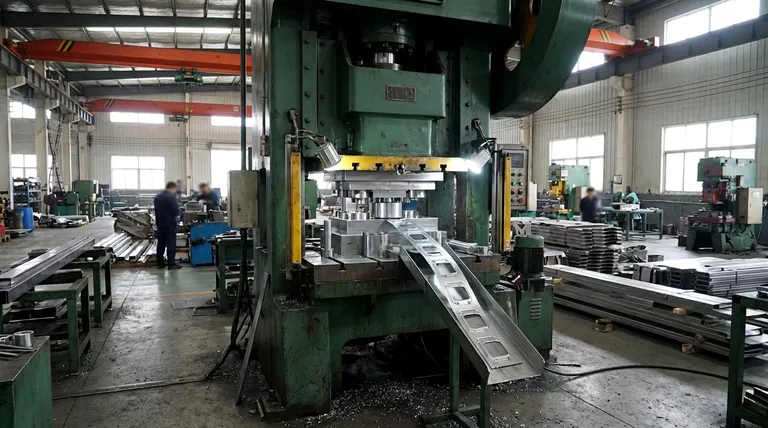
At their core, mechanical presses are used for high-speed, high-volume manufacturing operations like metal stamping, blanking, and coining. They are the workhorses of industries that require rapid and repeatable production of identical parts, such as automotive body panels, appliance casings, and electronic components.

The defining characteristic of a mechanical press is its ability to deliver a quick, powerful stroke with immense consistency. This makes it the ideal choice for mass production where speed and repetition are more critical than raw, sustained force.
What are the applications of mechanical press? High-Speed Stamping for Mass Production

The Core Principle: Energy in Motion

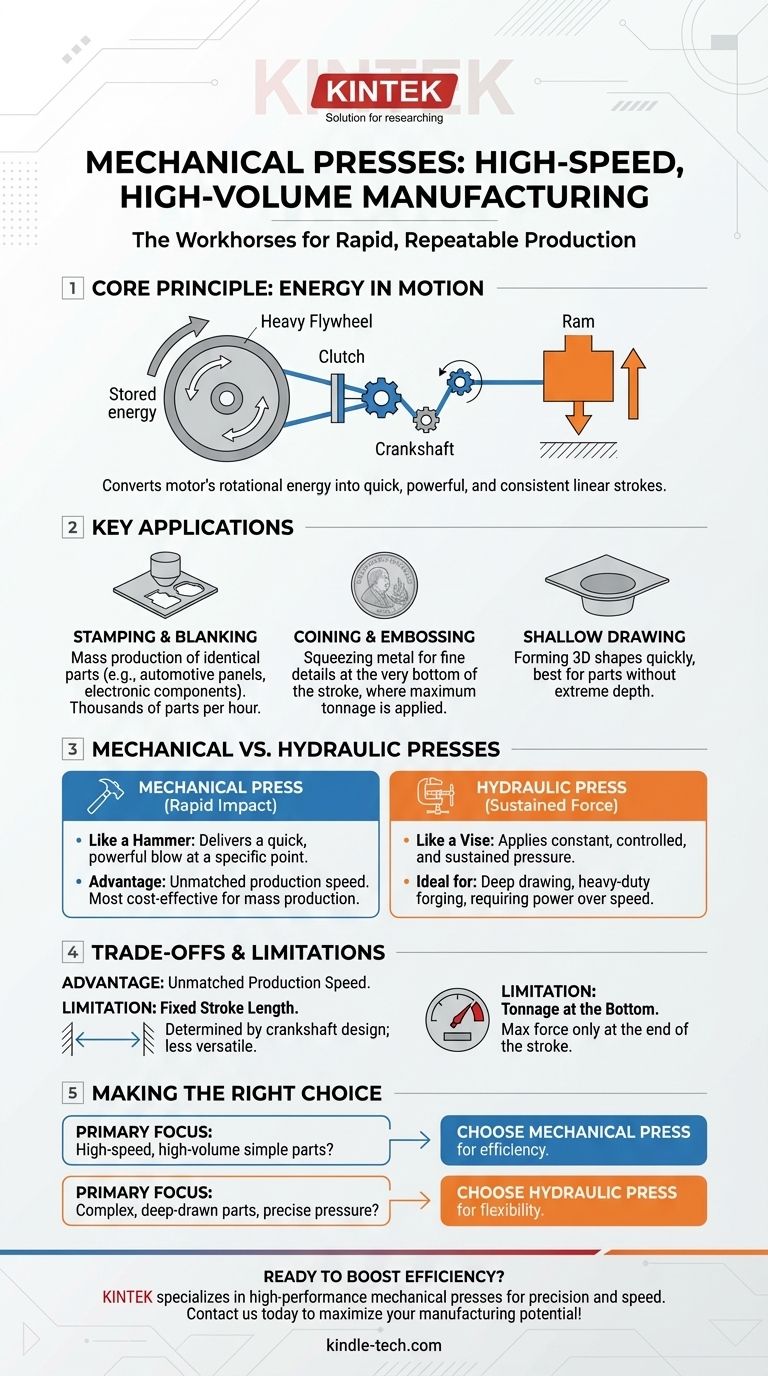
A mechanical press functions by converting the rotational energy of a motor into linear motion. This is typically achieved with a large, heavy flywheel that stores energy, which is then transferred through a clutch and crankshaft to drive a ram up and down.

High-Volume Stamping and Blanking

This is the most common application. Stamping uses a die to shape or cut a sheet of metal, while blanking is the process of punching out a specific shape (a "blank") from a larger sheet for further processing. The fast cycle time of a mechanical press allows for thousands of parts to be produced per hour.

Coining and Embossing

These processes require a tremendous amount of force applied at the very bottom of the press stroke. Coining involves squeezing metal within a die to create fine details, like the features on a currency coin. The mechanical press's design naturally delivers its maximum tonnage at this specific point, making it perfect for the task.

Shallow Drawing and Forming

Mechanical presses are also used for drawing, which is the process of stretching sheet metal into a three-dimensional shape. They are best suited for shallow-drawn parts, where the depth is not extreme, and the speed of the operation is the primary concern.

Clarification: Mechanical vs. Hydraulic Presses

It is critical to distinguish between mechanical and hydraulic presses, as their applications differ significantly. The provided references primarily describe the uses of hydraulic presses, which operate on a different principle.

Where Hydraulic Presses Excel

A hydraulic press uses fluid pressure to exert a constant, controlled force throughout its entire stroke. This makes it better suited for applications requiring immense, sustained power rather than speed. This includes heavy-duty forging, deep drawing of complex parts, car crushing, and other tasks mentioned in the references.

The Key Distinction

Think of it this way: a mechanical press is like a hammer, delivering a rapid, powerful impact at a specific point. A hydraulic press is like a vise, applying a slow, deliberate, and sustained squeezing force.

Understanding the Trade-offs

Choosing the correct press type depends entirely on the requirements of the manufacturing process. Each has distinct advantages and limitations.

The Advantage: Unmatched Production Speed

For repetitive tasks with a consistent part design, nothing matches the output rate of a mechanical press. Its design is optimized for rapid cycling, making it the most cost-effective solution for mass production.

The Limitation: Fixed Stroke Length

The primary drawback of a mechanical press is its fixed stroke length, which is determined by the physical design of the crankshaft. This makes it less versatile than a hydraulic press, where stroke length and pressure can be easily adjusted.

The Limitation: Tonnage at the Bottom

A mechanical press only achieves its maximum rated tonnage at the very bottom of its stroke. The force available is significantly less at any other point in the cycle, which limits its use for jobs requiring sustained pressure.

Making the Right Choice for Your Goal

Selecting the appropriate technology comes down to a simple analysis of your primary manufacturing objective.

  • If your primary focus is high-speed, high-volume production of relatively simple stamped parts: A mechanical press is unequivocally the correct choice for its efficiency and low cost-per-part.
  • If your primary focus is forming complex, deep-drawn parts or you need precise control over pressure throughout the stroke: A hydraulic press offers the necessary power and flexibility that a mechanical press cannot.

Ultimately, the choice is dictated by the fundamental trade-off between manufacturing speed and operational versatility.

Summary Table:

Application Key Function Ideal Use Case
Stamping & Blanking Cutting/shaping sheet metal High-volume production of identical parts (e.g., automotive panels)
Coining Squeezing metal for fine details Creating detailed features like currency coins
Shallow Drawing Forming 3D shapes from sheet metal Manufacturing shallow-drawn components quickly
Embossing Raising surface designs Adding textures or logos to metal parts

Ready to boost your production line's efficiency? KINTEK specializes in high-performance lab equipment and consumables, including robust mechanical presses designed for precision and speed. Whether you're in automotive, appliance, or electronics manufacturing, our solutions ensure consistent, high-volume output. Contact us today to find the perfect press for your laboratory or production needs and start maximizing your manufacturing potential!

Visual Guide
What are the applications of mechanical press? High-Speed Stamping for Mass Production Visual Guide

Related Products

People Also Ask

Related Products

Anti-Cracking Press Mold for Lab Use

Anti-Cracking Press Mold for Lab Use

The anti-cracking press mold is a specialized equipment designed for molding various shapes and sizes of film using high pressure and electric heating.

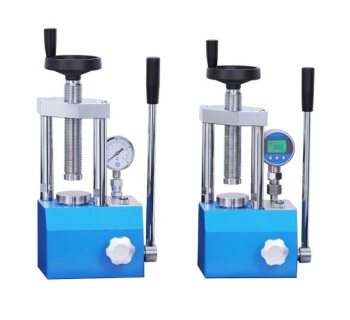
Laboratory Manual Hydraulic Pellet Press for Lab Use

Laboratory Manual Hydraulic Pellet Press for Lab Use

Efficient sample preparation with small footprint Manual Lab Hydraulic Press. Ideal for material researching labs, pharmacy, catalytic reaction, and ceramics.

Automatic Laboratory Hydraulic Pellet Press Machine for Lab Use

Automatic Laboratory Hydraulic Pellet Press Machine for Lab Use

Experience efficient sample preparation with our Automatic Lab Press Machine. Ideal for material research, pharmacy, ceramics, and more. Features a compact size and hydraulic press functionality with heating plates. Available in various sizes.

Vacuum Hot Press Furnace Machine for Lamination and Heating

Vacuum Hot Press Furnace Machine for Lamination and Heating

Experience clean and precise lamination with Vacuum Lamination Press. Perfect for wafer bonding, thin-film transformations, and LCP lamination. Order now!

Laboratory Test Sieves and Sieving Machines

Laboratory Test Sieves and Sieving Machines

Precision lab test sieves & sieving machines for accurate particle analysis. Stainless steel, ISO-compliant, 20μm-125mm range. Request specs now!

High-Purity Titanium Foil and Sheet for Industrial Applications

High-Purity Titanium Foil and Sheet for Industrial Applications

Titanium is chemically stable, with a density of 4.51g/cm3, which is higher than aluminum and lower than steel, copper, and nickel, but its specific strength ranks first among metals.

Laboratory Horizontal Planetary Ball Mill Milling Machine

Laboratory Horizontal Planetary Ball Mill Milling Machine

Improve sample uniformity with our Horizontal Planetary Ball Mills. KT-P400H reduces sample deposition and KT-P400E has multi-directional capabilities. Safe, convenient and efficient with overload protection.

Variable Speed Peristaltic Pump

Variable Speed Peristaltic Pump

KT-VSP Series Smart Variable Speed Peristaltic Pumps offer precise flow control for labs, medical, and industrial applications. Reliable, contamination-free liquid transfer.

HFCVD Machine System Equipment for Drawing Die Nano-Diamond Coating

HFCVD Machine System Equipment for Drawing Die Nano-Diamond Coating

The nano-diamond composite coating drawing die uses cemented carbide (WC-Co) as the substrate, and uses the chemical vapor phase method ( CVD method for short ) to coat the conventional diamond and nano-diamond composite coating on the surface of the inner hole of the mold.

915MHz MPCVD Diamond Machine Microwave Plasma Chemical Vapor Deposition System Reactor

915MHz MPCVD Diamond Machine Microwave Plasma Chemical Vapor Deposition System Reactor

915MHz MPCVD Diamond Machine and its multi-crystal effective growth, the maximum area can reach 8 inches, the maximum effective growth area of single crystal can reach 5 inches. This equipment is mainly used for the production of large-size polycrystalline diamond films, the growth of long single crystal diamonds, the low-temperature growth of high-quality graphene, and other materials that require energy provided by microwave plasma for growth.

High Energy Planetary Ball Mill Milling Machine for Laboratory

High Energy Planetary Ball Mill Milling Machine for Laboratory

The biggest feature is that the high energy planetary ball mill can not only perform fast and effective grinding, but also has good crushing ability

High-Energy Omnidirectional Planetary Ball Mill Milling Machine for Laboratory

High-Energy Omnidirectional Planetary Ball Mill Milling Machine for Laboratory

The KT-P4000E is a new product derived from the vertical high-energy planetary ball mill with a 360° swivel function. Experience faster, uniform, and smaller sample output results with 4 ≤1000ml ball mill jars.

High-Energy Omnidirectional Planetary Ball Mill Machine for Laboratory

High-Energy Omnidirectional Planetary Ball Mill Machine for Laboratory

The KT-P2000E is a new product derived from the vertical high-energy planetary ball mill with a 360°rotation function. The product not only has the characteristics of the vertical high-energy ball mill, but also has a unique 360°rotation function for the planetary body.

High Energy Planetary Ball Mill Milling Machine for Laboratory

High Energy Planetary Ball Mill Milling Machine for Laboratory

Experience fast and effective sample processing with the F-P2000 high-energy planetary ball mill. This versatile equipment offers precise control and excellent grinding capabilities. Perfect for laboratories, it features multiple grinding bowls for simultaneous testing and high output. Achieve optimal results with its ergonomic design, compact structure, and advanced features. Ideal for a wide range of materials, it ensures consistent particle size reduction and low maintenance.

High Energy Vibratory Laboratory Ball Mill Grinding Mill Single Tank Type

High Energy Vibratory Laboratory Ball Mill Grinding Mill Single Tank Type

High-energy vibration ball mill is a small desktop laboratory grinding instrument.It can be ball-milled or mixed with different particle sizes and materials by dry and wet methods.

Laboratory Sterilizer Lab Autoclave Pulse Vacuum Lifting Sterilizer

Laboratory Sterilizer Lab Autoclave Pulse Vacuum Lifting Sterilizer

The pulse vacuum lifting sterilizer is a state-of-the-art equipment for efficient and precise sterilization. It uses pulsating vacuum technology, customizable cycles, and a user-friendly design for easy operation and safety.

Benchtop Laboratory Vacuum Freeze Dryer

Benchtop Laboratory Vacuum Freeze Dryer

Benchtop laboratory freeze dryer for efficient lyophilization of biological, pharmaceutical, and food samples. Features intuitive touchscreen, high-performance refrigeration, and durable design. Preserve sample integrity—consult now!

Benchtop Laboratory Freeze Dryer for Lab Use

Benchtop Laboratory Freeze Dryer for Lab Use

Premium benchtop laboratory freeze dryer for lyophilization, preserving samples with ≤ -60°C cooling. Ideal for pharmaceuticals & research.

Laboratory Sterilizer Lab Autoclave Vertical Pressure Steam Sterilizer for Liquid Crystal Display Automatic Type

Laboratory Sterilizer Lab Autoclave Vertical Pressure Steam Sterilizer for Liquid Crystal Display Automatic Type

Liquid crystal display automatic vertical sterilizer is a safe, reliable and automatic control sterilization equipment, which is composed of heating system, microcomputer control system and overheating and overvoltage protection system.

CVD Diamond Cutting Tool Blanks for Precision Machining

CVD Diamond Cutting Tool Blanks for Precision Machining

CVD Diamond Cutting Tools: Superior Wear Resistance, Low Friction, High Thermal Conductivity for Non-Ferrous Materials, Ceramics, Composites Machining


Leave Your Message