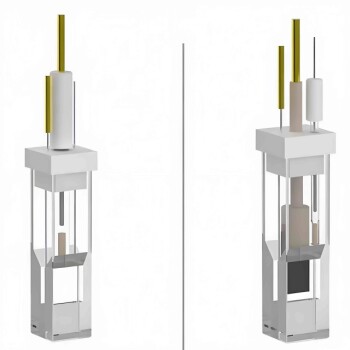
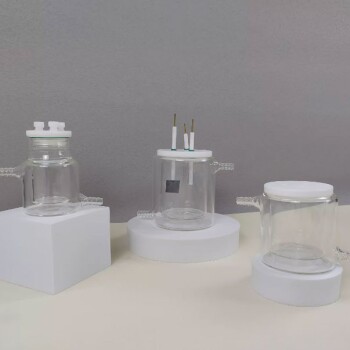
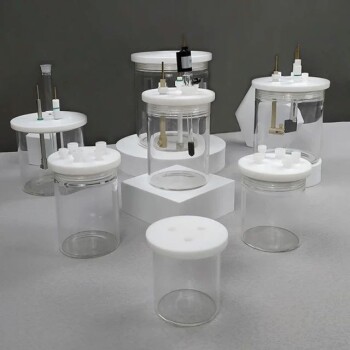
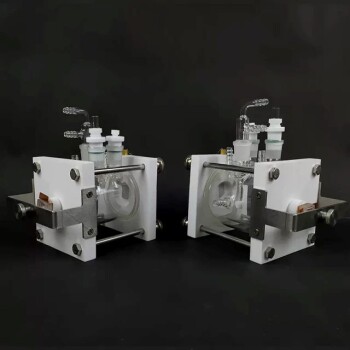
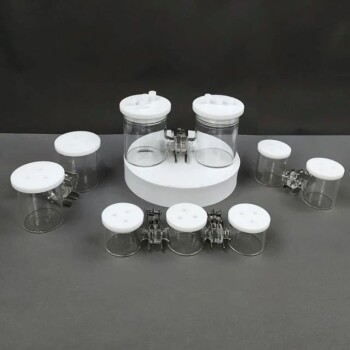
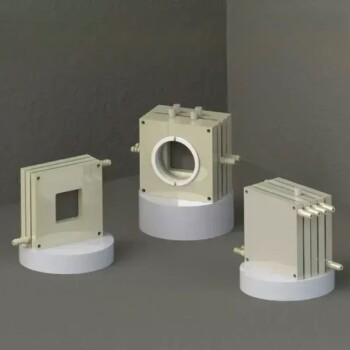
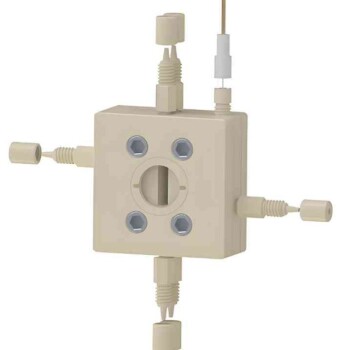
The thin-layer spectroelectrochemical cell body is constructed from integrated ground quartz, specifically designed to allow four-sided light transmission without the use of adhesives. This high-purity body is paired with a lid made from polytetrafluoroethylene (PTFE) to ensure broad chemical resistance.
Core Takeaway: By utilizing a monolithic quartz design that eliminates adhesives, this cell guarantees exceptional chemical purity and optical clarity, making it robust enough for both aqueous and non-aqueous electrochemical systems.
Material Composition and Purity
Integrated Ground Quartz
The primary structure of the cell body is manufactured from integrated ground quartz.
This specific material choice is critical because it allows for high optical transparency, which is essential for spectroscopic analysis.
Because the quartz is integrated, the design avoids the use of adhesives during assembly, preventing the leaching of impurities into your sample.
Chemical Resistance via PTFE
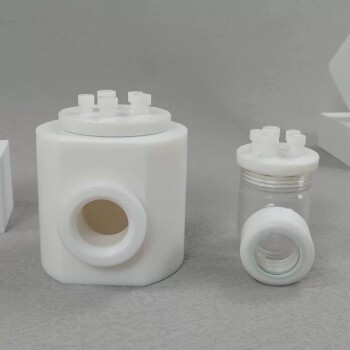
The cell lid is fabricated from polytetrafluoroethylene (PTFE).
This material is selected for its chemical inertness, ensuring the lid does not react with aggressive electrolytes or solvents.
This combination of quartz and PTFE allows the cell to function effectively in both aqueous and non-aqueous environments.
Structural Design and Dimensions
Four-Sided Light Transmission
The quartz body is engineered to provide four-sided light transmission.
This feature maximizes optical access, allowing for flexible experimental setups involving various spectroscopic techniques.
Specific Dimensional Configurations
The external body of the cell features a standard square footprint measuring 12 by 12mm.
Internally, the cell utilizes a specific slit design available in two path lengths: 10 by 8 by 0.5mm or 10 by 8 by 1.0mm.
These precise internal dimensions define the thin-layer volume necessary for rapid electrolysis and accurate spectroscopic measurements.
Electrode Integration
The design accommodates a specific three-electrode configuration to maintain the thin-layer environment.
It supports a platinum mesh working electrode, a platinum wire counter electrode, and a silver/silver chloride reference electrode.
Operational Considerations and Trade-offs
Voltage and Polarity Limits
While the materials are chemically resistant, the system is sensitive to electrical parameters.
Users must strictly control applied voltage to avoid decomposing the electrolyte or physically damaging the electrodes.
Furthermore, correct polarity must be maintained; reversing the anode and cathode connections can lead to immediate experimental failure.
Maintenance and Handling
The integrated quartz body is fragile and requires careful inspection for damage prior to every use.
Cleaning must be thorough, involving suitable solvents and distilled water to remove impurities without scratching the optical surfaces.
Making the Right Choice for Your Goal
To maximize the utility of this spectroelectrochemical cell, align your experimental protocols with its design capabilities:
- If your primary focus is high-purity analysis: Rely on the adhesive-free quartz construction to prevent sample contamination, particularly in non-aqueous solvents.
- If your primary focus is optical flexibility: Utilize the four-sided light transmission to arrange your light source and detector in the most optimal geometry for your specific spectrometer.
- If your primary focus is electrochemical precision: Select the internal slit dimension (0.5mm vs 1.0mm) that best balances your need for signal intensity against the speed of electrolysis.
Leveraging the chemical inertness of quartz and PTFE ensures your data reflects the sample's true properties, not the degradation of your equipment.
Summary Table:
| Feature | Material / Specification | Key Benefit |
|---|---|---|
| Cell Body Material | Integrated Ground Quartz | Adhesive-free for high purity & optical clarity |
| Lid Material | Polytetrafluoroethylene (PTFE) | Excellent chemical resistance (Aqueous/Non-aqueous) |
| Optical Design | 4-Sided Light Transmission | Maximum flexibility for spectroscopic setups |
| Internal Path Lengths | 0.5mm or 1.0mm Slit | Optimized for rapid electrolysis & thin-layer volume |
| External Dimensions | 12 x 12mm Square Footprint | Standard compatibility with lab equipment |
| Electrode Compatibility | Pt Mesh (WE), Pt Wire (CE), Ag/AgCl (RE) | Precise three-electrode electrochemical control |
Elevate your spectroscopic accuracy with KINTEK’s high-purity laboratory solutions. As specialists in advanced electrochemical tools and consumables, KINTEK offers premium electrolytic cells, electrodes, and PTFE products designed for demanding research environments. Whether you need precise thin-layer cells, high-temperature furnaces, or specialized ceramic crucibles, our team is ready to provide the durable, high-performance equipment your lab requires. Contact KINTEK today to find the perfect fit for your analytical goals!
Related Products
- Thin-Layer Spectral Electrolysis Electrochemical Cell
- Side Window Optical Electrolytic Electrochemical Cell
- H-Type Double-Layer Optical Electrolytic Electrochemical Cell with Water Bath
- FS Electrochemical Hydrogen Fuel Cells for Diverse Applications
- PTFE Electrolytic Cell Electrochemical Cell Corrosion-Resistant Sealed and Non-Sealed
People Also Ask
- What are the recommended post-experiment procedures for cleaning and storing the thin-layer spectroelectrochemical cell?
- What preparation steps are required before initiating an experiment with the thin-layer spectroelectrochemical cell?
- What operational environments and sealing options are available for the thin-layer spectroelectrochemical cell?
- For what types of systems, temperature ranges, and sealing configurations is the thin-layer spectroelectrochemical cell designed? Ideal for Aqueous and Non-Aqueous Analysis
- What are the necessary preparation steps before using a thin-layer spectroelectrochemical cell? A Guide to Reliable Results