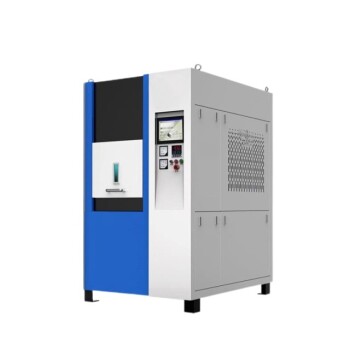
The primary function of a vacuum hot press sintering furnace in this context is to act as a simultaneous catalyst for mechanical densification and chemical bonding. Specifically for Al0.6CoCrFeNi/5052Al composites, it utilizes a vacuum environment to prevent oxidation while applying high pressure (30 MPa) and high temperature (550°C–700°C) to force powder particles to rearrange, deform, and atomically bond into a solid, dense material.
Core Takeaway The vacuum hot press does not merely heat the material; it creates a specific thermodynamic environment that overcomes the natural resistance of aluminum powders to bond. By stripping away oxide risks and forcing atomic contact, it transforms loose powder into a structurally integral composite with a specialized transition layer.
Mechanisms of Densification
Particle Rearrangement and Deformation
The furnace applies a specific uniaxial pressure, typically 30 MPa, to the powder mixture. This mechanical force is the primary driver for the initial stage of densification.
Under this pressure, the loose powder particles are forced to physically rearrange into a tighter packing structure. As pressure is maintained, the particles undergo plastic deformation, changing shape to fill the voids between them.
Elimination of Internal Porosity
A critical goal of the furnace is the removal of structural defects. The combination of particle rearrangement and plastic flow effectively closes internal pores.
This leads to a significant improvement in the density of the final Al0.6CoCrFeNi/5052Al composite. High density is essential for achieving the material's intended mechanical strength and fatigue resistance.
Thermal Activation and Bonding
Facilitating Atomic Diffusion
The furnace maintains a high-temperature environment, ranging from 550°C to 700°C (approx. 823K). This provides the thermal energy necessary to activate the atoms within the metal powders.
At these temperatures, atoms gain enough energy to migrate across particle boundaries. This process, known as atomic diffusion, is the mechanism that transitions the material from a collection of pressed particles to a unified solid.
Creating the Interfacial Transition Layer
According to the primary technical data, the most sophisticated function of the furnace is inducing the formation of an interfacial transition layer.
This layer forms between the 5052Al matrix and the Al0.6CoCrFeNi reinforcement particles. It represents a metallurgical bond, which is significantly stronger than a simple mechanical interlock, ensuring the composite acts as a single cohesive unit under stress.
Environmental Control and Purity
Prevention of Metal Oxidation
Aluminum and its alloys are highly reactive and prone to rapid oxidation, which inhibits bonding. The furnace creates a vacuum environment to strip oxygen from the processing chamber.
This protection is vital for maintaining the metallic purity of the powder surfaces. Without this vacuum, oxide layers would form on the particles, acting as a barrier to diffusion and weakening the final composite.
Desorption of Impurities
Beyond preventing new oxidation, the vacuum system (often active at lower temperatures during the ramp-up) removes adsorbed gases.
Metal powders have large surface areas that trap water vapor and oxygen. The vacuum environment facilitates the desorption and discharge of these volatiles, preventing them from becoming trapped inside the material as closed pores during the high-temperature sintering phase.
Understanding the Trade-offs
Process Constraints and Cycle Time
While vacuum hot pressing produces superior material properties, it is a batch process constrained by the mechanics of the press.
The requirement to heat and cool a large thermal mass (including the graphite molds) under vacuum results in longer cycle times compared to continuous sintering methods. This makes it ideal for high-performance requirements but less efficient for mass-volume production.
Dependency on Graphite Molds
The process relies on high-purity graphite molds to transmit the 30 MPa of pressure while withstanding 700°C temperatures.
While graphite ensures dimensional accuracy, it acts as a consumable or semi-consumable component. The quality of the final composite is strictly limited by the mechanical integrity and surface finish of these molds.
Making the Right Choice for Your Goal
When configuring your sintering parameters for Al0.6CoCrFeNi/5052Al composites, consider the following specific adjustments:
- If your primary focus is Maximum Density: Prioritize the pressure application (30 MPa) and ensure the hold time is sufficient for complete plastic deformation to eliminate all micropores.
- If your primary focus is Interfacial Strength: Focus on the upper range of the temperature window (near 700°C) to maximize atomic diffusion and ensure a thick, robust interfacial transition layer forms.
- If your primary focus is Material Purity: Ensure the vacuum system is fully operational and allowed to dwell at lower temperatures (<400°C) to fully degas the powder before high-heat sintering begins.
Ultimately, the vacuum hot press serves as the critical bridge that converts thermodynamic potential into structural reality, turning reactive powders into a unified, high-performance composite.
Summary Table:
| Function | Key Mechanism | Benefit for Al-Composites |
|---|---|---|
| Densification | 30 MPa Uniaxial Pressure | Eliminates internal porosity and increases material density. |
| Thermal Activation | 550°C – 700°C Heat | Facilitates atomic diffusion for unified solid transition. |
| Bonding | Interfacial Layer Formation | Creates a strong metallurgical bond between matrix and reinforcement. |
| Environmental Control | Vacuum Atmosphere | Prevents oxidation and removes trapped gas impurities. |
Elevate Your Composite Research with KINTEK Precision
Achieving the perfect balance of density and interfacial strength requires high-performance thermal processing equipment. KINTEK specializes in advanced laboratory solutions, offering a comprehensive range of vacuum hot presses, isostatic hydraulic presses, and high-temperature furnaces designed to meet the rigorous demands of material science.
Whether you are developing Al0.6CoCrFeNi/5052Al composites or specialized alloys, our equipment provides the precise pressure and temperature control necessary for superior metallurgical bonding and purity. From vacuum and atmosphere furnaces to high-purity ceramic crucibles, we provide the tools to turn your research into high-performance reality.
Ready to optimize your sintering process? Contact our technical experts today to find the ideal equipment for your laboratory!
Related Products
- 600T Vacuum Induction Hot Press Furnace for Heat Treat and Sintering
- Vacuum Heat Treat and Sintering Furnace with 9MPa Air Pressure
- Vacuum Heat Treat and Pressure Sintering Furnace for High Temperature Applications
- 2200 ℃ Tungsten Vacuum Heat Treat and Sintering Furnace
- Vacuum Hot Press Furnace Heated Vacuum Press Machine Tube Furnace
People Also Ask
- What role does an induction vacuum hot pressing furnace play in sintering? Achieve 98% Density in Carbide Blocks
- What advantages does a vacuum hot press furnace provide for LSLBO ceramic electrolytes? Achieve 94% Relative Density
- What role does a Vacuum Hot Press (VHP) furnace play in the densification of austenitic stainless steel 316 composites?
- What are the advantages of a vacuum hot press furnace for W-50%Cu? Achieve 99.6% Density at Lower Temperatures
- What role does mechanical pressure play during the vacuum diffusion bonding of tungsten and copper? Keys to Solid Bonding