
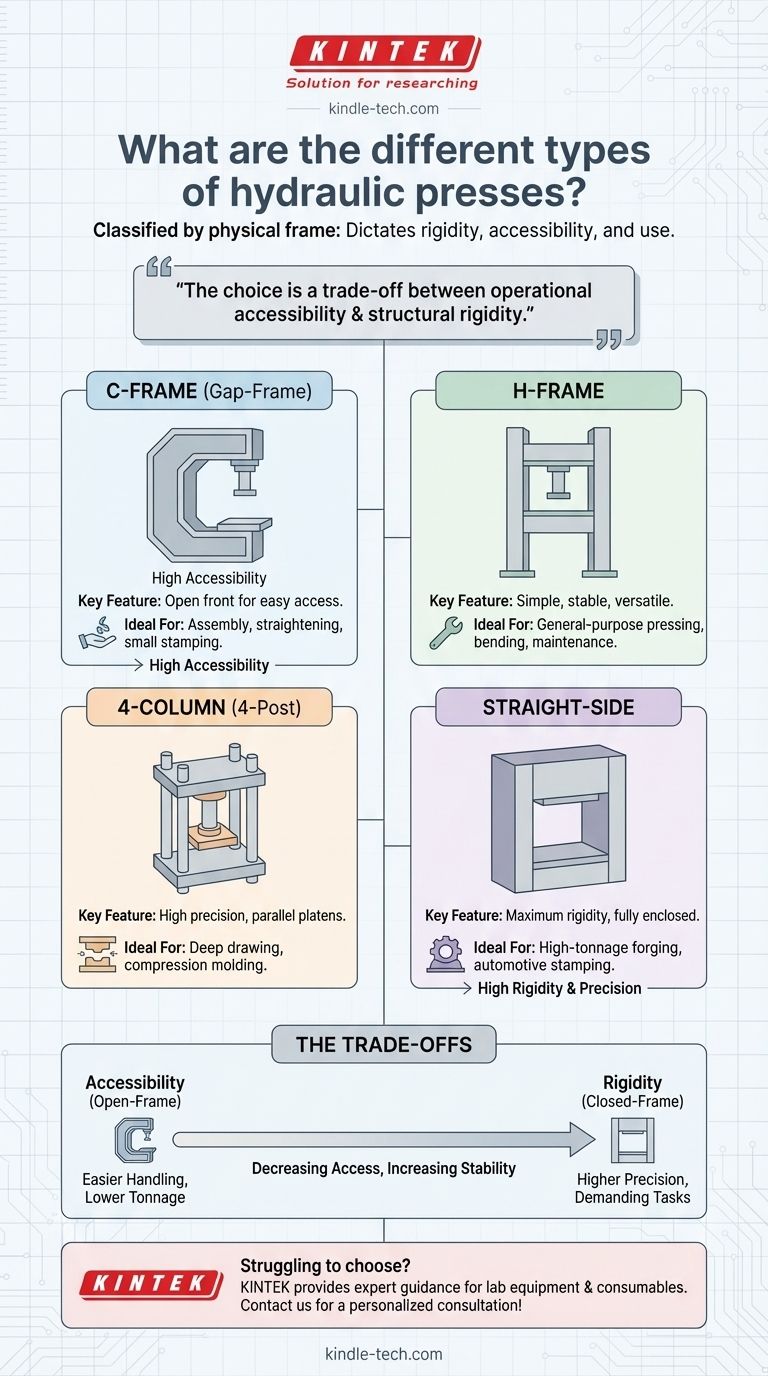
At its core, a hydraulic press is classified by its physical frame. While they are used for countless applications from forging to molding, the fundamental types are distinguished by their structure, which dictates their rigidity, accessibility, and ideal use case. The four primary types are the C-frame, H-frame, 4-column, and straight-side press.
The choice of a hydraulic press is a direct trade-off between operational accessibility and structural rigidity. Open-frame designs are easier to work with, while closed-frame designs deliver higher precision and power for demanding industrial tasks.

Deconstructing the Frame: The Primary Classification
The frame is the backbone of the press. It is responsible for resisting the immense force generated by the hydraulic system. Its design determines how that force is managed and, consequently, what kind of work the press can accurately perform.
The C-Frame (or Gap-Frame) Press
A C-frame press has a distinctive shape like the letter "C," leaving the front and sides open. This design provides excellent access to the die area for loading, unloading, and observation.
These presses are ideal for applications requiring manual part handling, such as assembly, straightening, and smaller stamping or blanking jobs.
The H-Frame Press
The H-frame press is a simple, effective design commonly found in repair shops and smaller production environments. It consists of two vertical supports with a movable cylinder and bolster.
It offers more stability and a higher tonnage capacity than many C-frame models, making it a versatile tool for general-purpose pressing, bending, and maintenance tasks.
The 4-Column (or 4-Post) Press
This design uses four heavy-duty cylindrical columns to support the upper platen. This construction ensures the moving platen remains perfectly parallel to the bed, even under high pressure.
The inherent stability of a 4-column press makes it the standard for applications demanding high precision, such as deep drawing, compression molding of composites and plastics, and other forming operations over a large surface area.
The Straight-Side Press
As the name implies, this press features a solid, fully enclosed frame with two straight sides. This design offers the maximum possible rigidity and minimizes any deflection or distortion under load.
Straight-side presses are built for the most demanding, high-tonnage production environments. They are the go-to choice for heavy-duty industrial work like automotive stamping, progressive die operations, and high-volume forging.
Understanding the Trade-offs: Accessibility vs. Rigidity
Choosing a press type is not about which is "best," but which is best for a specific job. Each design has inherent compromises you must understand.
The Cost of Access: C-Frame Deflection
The open front of a C-frame press is its greatest strength and its primary weakness. Under significant load, the "throat" of the C can deflect or "yawn," causing the ram and bed to become slightly non-parallel.
This can impact the precision of punching or forming operations, especially with off-center loads. They are best suited for lower-tonnage work or tasks where absolute parallelism is not critical.
The Demand for Precision: Closed-Frame Designs
4-column and straight-side presses provide superior rigidity and precision by enclosing the work area. The trade-off is reduced accessibility.
Loading and unloading, especially for large or complex parts, may require more sophisticated automation. These presses are also typically larger, heavier, and represent a more significant capital investment.
Selecting the Right Press for Your Application
Your operational goal is the single most important factor in choosing a press. Base your decision on the fundamental requirements of the task.
- If your primary focus is manual part handling and assembly: A C-frame press offers the necessary accessibility.
- If your primary focus is general-purpose workshop tasks: An H-frame provides a versatile balance of performance and cost.
- If your primary focus is precision molding or deep drawing: A 4-column press delivers the stability and even pressure required.
- If your primary focus is high-tonnage, automated industrial production: A straight-side press provides the ultimate rigidity and durability.
Ultimately, matching the press's fundamental design to your specific operational need is the key to a successful outcome.
Summary Table:
| Press Type | Key Feature | Ideal For |
|---|---|---|
| C-Frame (Gap-Frame) | Open front for easy access | Assembly, straightening, small stamping |
| H-Frame | Simple, stable, versatile | General-purpose pressing, bending, maintenance |
| 4-Column (4-Post) | High precision, parallel platens | Deep drawing, compression molding |
| Straight-Side | Maximum rigidity, fully enclosed frame | High-tonnage forging, automotive stamping |
Struggling to choose the right hydraulic press for your specific application? KINTEK specializes in lab equipment and consumables, providing expert guidance to help you select the perfect press for your needs—whether it's for precision molding, high-volume production, or general workshop tasks. Let our expertise ensure you get the performance, rigidity, and accessibility your work demands. Contact us today for a personalized consultation!
Visual Guide
Related Products
- Heated Hydraulic Press Machine with Heated Plates for Vacuum Box Laboratory Hot Press
- Automatic High Temperature Heated Hydraulic Press Machine with Heated Plates for Lab
- Manual High Temperature Heated Hydraulic Press Machine with Heated Plates for Lab
- Heated Hydraulic Press Machine with Integrated Manual Heated Plates for Lab Use
- 24T 30T 60T Heated Hydraulic Press Machine with Heated Plates for Laboratory Hot Press
People Also Ask
- Why is a heated laboratory hydraulic press necessary for composite laminates? Achieve Void-Free Structural Integrity
- What role does a heated hydraulic press play in Cold Sintering (CSP)? Enhancing LATP-Halide Densification
- What technical conditions does a heated hydraulic press provide for PEO batteries? Optimize Solid-State Interfaces
- Why is the heating function of a laboratory hydraulic press essential for MEA assembly in DEFC? Optimize Cell Bonding
- What is the core function of a laboratory heated hydraulic press in CSP? Revolutionize Low-Temp Ceramic Sintering



















