Knowledge vacuum induction melting furnace What are the disadvantages of direct core type induction furnace? High Standby Costs and Inflexibility
Author avatar

Tech Team · Kintek Solution

Updated 3 months ago

What are the disadvantages of direct core type induction furnace? High Standby Costs and Inflexibility


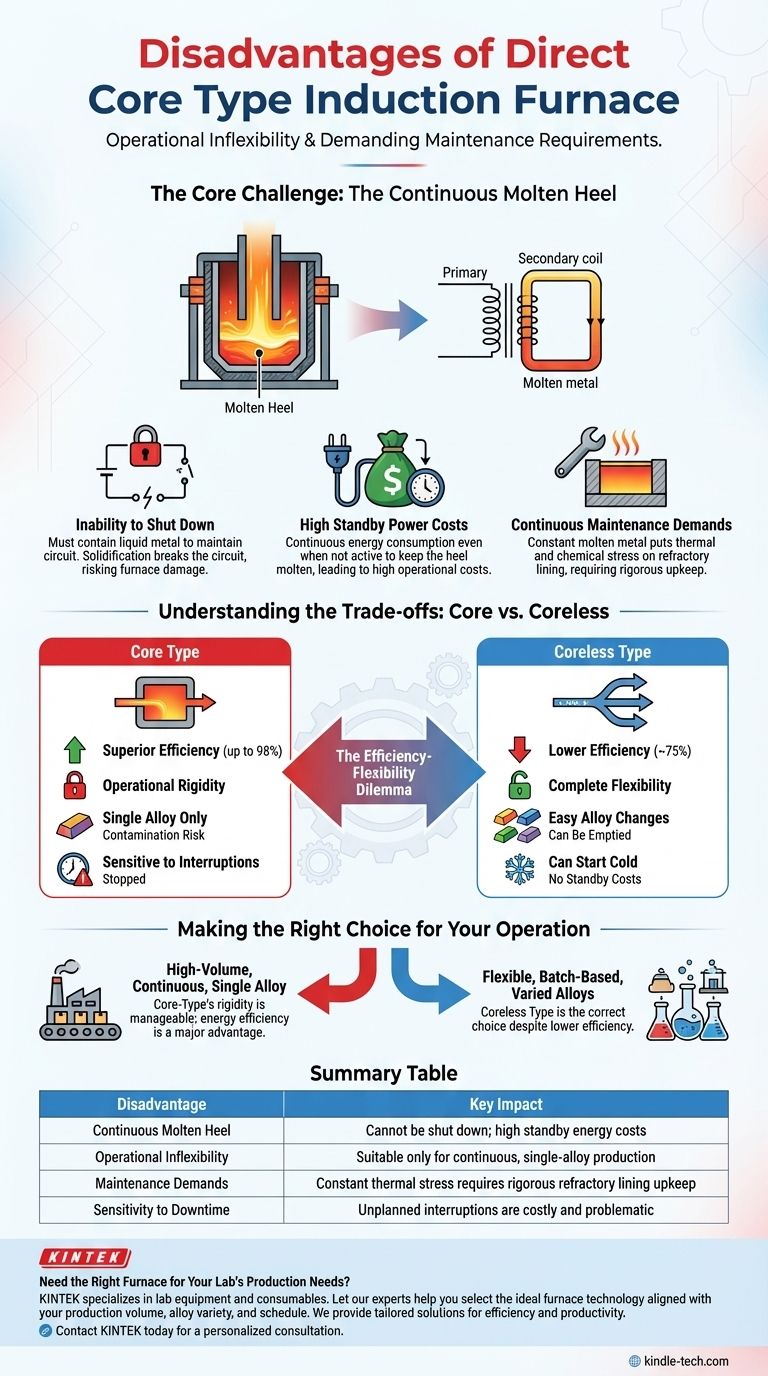
The primary disadvantages of a direct core type induction furnace are its operational inflexibility and demanding maintenance requirements. Because it must maintain a continuous loop of molten metal, it cannot be easily shut down or used for varied alloys, making it unsuitable for anything other than continuous, high-volume production.

The core-type furnace trades operational flexibility for exceptional power efficiency. Its key disadvantages all stem from a single, defining characteristic: the necessity of maintaining a permanent, molten metal "heel," which dictates its use case and creates significant standby costs.
What are the disadvantages of direct core type induction furnace? High Standby Costs and Inflexibility

The Core Challenge: The Continuous Molten Heel

The design of a core-type furnace, which functions like a transformer with a molten metal secondary coil, is the source of both its efficiency and its drawbacks. This design requires that a portion of the metal remains molten at all times.

Inability to Shut Down

The furnace channel must always contain liquid metal to maintain a complete electrical circuit. If the furnace is allowed to cool and this "heel" solidifies, the circuit is broken, and restarting becomes extremely difficult and can potentially damage the furnace lining.

High Standby Power Costs

This inability to shut down means the furnace consumes significant energy even when it is not actively melting new material. Power must be continuously supplied to keep the molten heel at temperature during nights, weekends, or production lulls, leading to high operational costs.

Continuous Maintenance Demands

The constant presence of molten metal puts continuous thermal and chemical stress on the furnace's refractory lining. This necessitates ongoing monitoring and a rigorous maintenance schedule to prevent failures in the metal loop.

Understanding the Trade-offs: Core vs. Coreless

The disadvantages of the core-type furnace are best understood when compared to its alternative, the coreless induction furnace. The choice between them is a fundamental decision based on production philosophy.

The Efficiency-Flexibility Dilemma

The core-type furnace boasts superior power efficiency, often reaching up to 98%. However, this comes at the cost of rigidity. In contrast, a coreless furnace has lower efficiency (around 75%) but offers complete flexibility—it can be started cold, shut down completely, and emptied between uses.

Unsuitability for Alloy Changes

The permanent molten heel makes changing alloys impractical. Any new metal added will be contaminated by the existing heel. This locks the furnace into producing a single alloy for long campaigns, whereas a coreless furnace can be emptied completely, allowing for simple and frequent alloy changes.

Sensitivity to Production Interruptions

The core-type furnace is designed for high-throughput, 24/7 operations. Unplanned downtime or interruptions in the production schedule are particularly costly and problematic due to the need to keep the furnace hot regardless of output.

Making the Right Choice for Your Operation

Understanding these disadvantages is critical to aligning the technology with your specific operational needs.

  • If your primary focus is high-volume, continuous production of a single alloy: The operational rigidity of a core-type furnace is a manageable constraint, and its exceptional energy efficiency presents a major competitive advantage.
  • If your primary focus is flexible, batch-based production with varied alloys: The disadvantages of a core-type furnace make it entirely unsuitable; a coreless furnace is the correct choice despite its lower power efficiency.

Ultimately, selecting the right furnace is about matching the tool's inherent characteristics to the financial and operational realities of your production environment.

Summary Table:

Disadvantage Key Impact
Continuous Molten Heel Cannot be shut down; high standby energy costs
Operational Inflexibility Suitable only for continuous, single-alloy production
Maintenance Demands Constant thermal stress requires rigorous refractory lining upkeep
Sensitivity to Downtime Unplanned interruptions are costly and problematic

Need the Right Furnace for Your Lab's Production Needs?

Choosing between a core-type and a coreless induction furnace is a critical decision that impacts your operational flexibility and energy costs. KINTEK specializes in lab equipment and consumables, serving laboratory needs with precision and expertise.

Let our experts help you select the ideal furnace technology that aligns with your production volume, alloy variety, and operational schedule. We provide tailored solutions to enhance your lab's efficiency and productivity.

Contact KINTEK today for a personalized consultation and discover how our equipment can power your success.

Visual Guide
What are the disadvantages of direct core type induction furnace? High Standby Costs and Inflexibility Visual Guide

Related Products

People Also Ask

Related Products

600T Vacuum Induction Hot Press Furnace for Heat Treat and Sintering

600T Vacuum Induction Hot Press Furnace for Heat Treat and Sintering

Discover the 600T Vacuum Induction Hot Press Furnace, designed for high-temperature sintering experiments in vacuum or protected atmospheres. Its precise temperature and pressure control, adjustable working pressure, and advanced safety features make it ideal for nonmetal materials, carbon composites, ceramics, and metal powders.

Non Consumable Vacuum Arc Induction Melting Furnace

Non Consumable Vacuum Arc Induction Melting Furnace

Explore the benefits of Non-Consumable Vacuum Arc Furnace with high melting point electrodes. Small, easy to operate & eco-friendly. Ideal for laboratory research on refractory metals & carbides.

Vacuum Arc Induction Melting Furnace

Vacuum Arc Induction Melting Furnace

Discover the power of Vacuum Arc Furnace for melting active & refractory metals. High-speed, remarkable degassing effect, and free of contamination. Learn more now!

Lab-Scale Vacuum Induction Melting Furnace

Lab-Scale Vacuum Induction Melting Furnace

Get precise alloy composition with our Vacuum Induction Melting Furnace. Ideal for aerospace, nuclear energy, and electronic industries. Order now for effective smelting and casting of metals and alloys.

Controlled Nitrogen Inert Hydrogen Atmosphere Furnace

Controlled Nitrogen Inert Hydrogen Atmosphere Furnace

KT-AH Hydrogen atmosphere furnace - induction gas furnace for sintering/annealing with built-in safety features, dual housing design, and energy-saving efficiency. Ideal for lab and industrial use.

Multi Heating Zones CVD Tube Furnace Machine Chemical Vapor Deposition Chamber System Equipment

Multi Heating Zones CVD Tube Furnace Machine Chemical Vapor Deposition Chamber System Equipment

KT-CTF14 Multi Heating Zones CVD Furnace - Precise Temperature Control and Gas Flow for Advanced Applications. Max temp up to 1200℃, 4 channels MFC mass flow meter, and 7" TFT touch screen controller.

Graphite Vacuum Furnace High Thermal Conductivity Film Graphitization Furnace

Graphite Vacuum Furnace High Thermal Conductivity Film Graphitization Furnace

The high thermal conductivity film graphitization furnace has uniform temperature, low energy consumption and can operate continuously.

Vertical High Temperature Graphite Vacuum Graphitization Furnace

Vertical High Temperature Graphite Vacuum Graphitization Furnace

Vertical high temperature graphitization furnace for carbonization and graphitization of carbon materials up to 3100℃.Suitable for shaped graphitization of carbon fiber filaments and other materials sintered in a carbon environment.Applications in metallurgy, electronics, and aerospace for producing high-quality graphite products like electrodes and crucibles.

High Temperature Muffle Oven Furnace for Laboratory Debinding and Pre Sintering

High Temperature Muffle Oven Furnace for Laboratory Debinding and Pre Sintering

KT-MD High temperature debinding and pre-sintering furnace for ceramic materials with various molding processes. Ideal for electronic components such as MLCC and NFC.

1700℃ Controlled Atmosphere Furnace Nitrogen Inert Atmosphere Furnace

1700℃ Controlled Atmosphere Furnace Nitrogen Inert Atmosphere Furnace

KT-17A Controlled atmosphere furnace: 1700℃ heating, vacuum sealing technology, PID temperature control, and versatile TFT smart touch screen controller for laboratory and industrial use.

1200℃ Controlled Atmosphere Furnace Nitrogen Inert Atmosphere Furnace

1200℃ Controlled Atmosphere Furnace Nitrogen Inert Atmosphere Furnace

Discover our KT-12A Pro Controlled atmosphere furnace - high precision, heavy duty vacuum chamber, versatile smart touch screen controller, and excellent temperature uniformity up to 1200C. Ideal for both laboratory and industrial application.

1200℃ Split Tube Furnace with Quartz Tube Laboratory Tubular Furnace

1200℃ Split Tube Furnace with Quartz Tube Laboratory Tubular Furnace

KT-TF12 split tube furnace: high-purity insulation, embedded heating wire coils, and max. 1200C. Widely used for new materials and chemical vapour deposition.

Mesh belt controlled atmosphere furnace

Mesh belt controlled atmosphere furnace

Discover our KT-MB mesh belt sintering furnace - perfect for high-temperature sintering of electronic components & glass insulators. Available for open air or controlled atmosphere environments.

Spark Plasma Sintering Furnace SPS Furnace

Spark Plasma Sintering Furnace SPS Furnace

Discover the benefits of Spark Plasma Sintering Furnaces for rapid, low-temperature material preparation. Uniform heating, low cost & eco-friendly.

Laboratory Rapid Thermal Processing (RTP) Quartz Tube Furnace

Laboratory Rapid Thermal Processing (RTP) Quartz Tube Furnace

Get lightning-fast heating with our RTP Rapid Heating Tube Furnace. Designed for precise, high-speed heating and cooling with convenient sliding rail and TFT touch screen controller. Order now for ideal thermal processing!

Horizontal High Temperature Graphite Vacuum Graphitization Furnace

Horizontal High Temperature Graphite Vacuum Graphitization Furnace

Horizontal Graphitization Furnace: This type of furnace is designed with the heating elements placed horizontally, allowing for uniform heating of the sample. It's well-suited for graphitizing large or bulky samples that require precise temperature control and uniformity.

Vertical Laboratory Tube Furnace

Vertical Laboratory Tube Furnace

Elevate your experiments with our Vertical Tube Furnace. Versatile design allows for operation under various environments and heat treatment applications. Order now for precise results!

Large Vertical Graphite Vacuum Graphitization Furnace

Large Vertical Graphite Vacuum Graphitization Furnace

A large vertical high-temperature graphitization furnace is a type of industrial furnace used for the graphitization of carbon materials, such as carbon fiber and carbon black. It is a high-temperature furnace that can reach temperatures of up to 3100°C.

Graphite Vacuum Furnace Bottom Discharge Graphitization Furnace for Carbon Materials

Graphite Vacuum Furnace Bottom Discharge Graphitization Furnace for Carbon Materials

Bottom-out graphitization furnace for carbon materials, ultra-high temperature furnace up to 3100°C, suitable for graphitization and sintering of carbon rods and carbon blocks. Vertical design, bottom discharging, convenient feeding and discharging, high temperature uniformity, low energy consumption, good stability, hydraulic lifting system, convenient loading and unloading.

1400℃ Controlled Atmosphere Furnace with Nitrogen and Inert Atmosphere

1400℃ Controlled Atmosphere Furnace with Nitrogen and Inert Atmosphere

Achieve precise heat treatment with KT-14A controlled atmosphere furnace. Vacuum sealed with a smart controller, it's ideal for lab and industrial use up to 1400℃.


Leave Your Message



















