Knowledge What are the disadvantages of metal iron? Key Limitations and Why We Use Alloys Instead
Author avatar

Tech Team · Kintek Solution

Updated 5 days ago

What are the disadvantages of metal iron? Key Limitations and Why We Use Alloys Instead


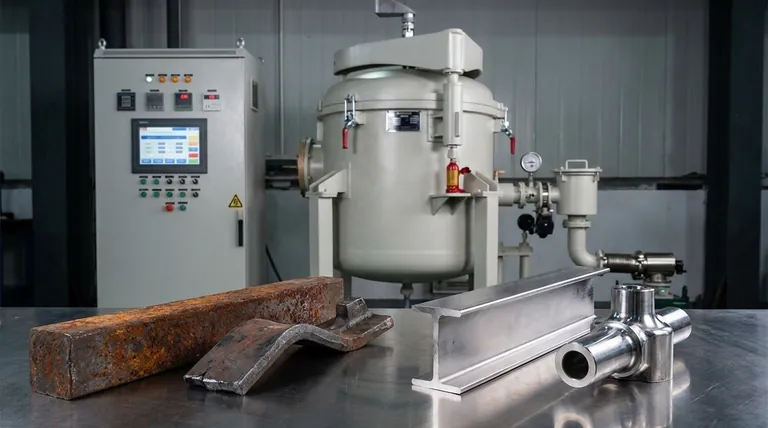
In its pure form, metallic iron is rarely used in modern applications due to two primary disadvantages: it is highly susceptible to corrosion (rusting) and possesses relatively poor mechanical properties compared to its alloys. It is both softer and less strong than the materials we derive from it, most notably steel.

The fundamental disadvantage of iron is its reactive nature, which leads to rapid corrosion, and its inherent softness. This is precisely why we almost never use pure iron, but instead rely on its alloys—like steel and cast iron—which are engineered to overcome these exact weaknesses.
What are the disadvantages of metal iron? Key Limitations and Why We Use Alloys Instead

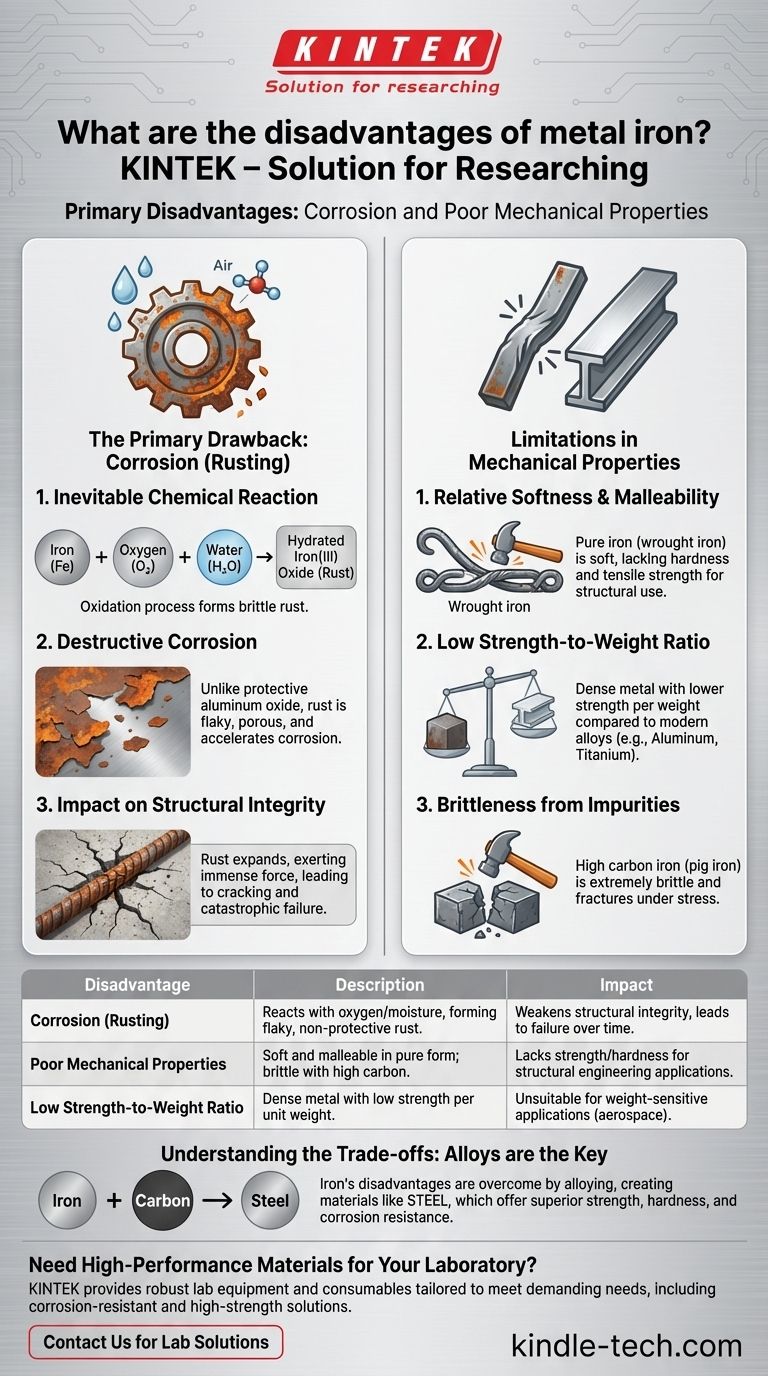
The Primary Drawback: Corrosion (Rusting)

The most well-known weakness of iron is its tendency to rust. This is not just a cosmetic issue; it's a chemical process that actively destroys the metal.

The Inevitable Chemical Reaction

Iron reacts readily with oxygen in the presence of water or air moisture. This electrochemical process, known as oxidation, forms hydrated iron(III) oxide, which we call rust.

A Destructive Form of Corrosion

Unlike the protective oxide layer that forms on aluminum, rust is flaky, brittle, and porous. It flakes away, exposing fresh iron underneath to continue the corrosion process, effectively eating away at the material from the outside in.

The Impact on Structural Integrity

The rust that forms is also less dense than the original iron. This expansion can exert immense force, causing surrounding materials like concrete to crack and leading to catastrophic structural failure over time.

Limitations in Mechanical Properties

While we think of iron as strong, its pure form is mechanically unimpressive for most engineering needs. Its properties are highly sensitive to impurities, especially carbon.

Relative Softness and Malleability

Pure iron, sometimes found as wrought iron, is quite soft and malleable. While this makes it easy to work with for decorative purposes, it lacks the hardness and tensile strength required for structural beams, tools, or engine components.

Lower Strength-to-Weight Ratio

Iron is a dense metal. Compared to modern materials like aluminum alloys or titanium, its strength for a given weight is significantly lower. This makes it unsuitable for applications where weight is a critical factor, such as in aerospace or performance vehicles.

Brittleness from Impurities

Conversely, iron with a high carbon content (like pig iron straight from a blast furnace) is extremely brittle. It will fracture under stress or impact rather than bending. The entire science of steelmaking is a precise balancing act of controlling this carbon content.

Understanding the Trade-offs

Iron's disadvantages are significant, but they must be weighed against its single greatest advantage, which explains why it remains the most widely used metal on Earth.

Unbeatable Cost and Abundance

Iron is the fourth most common element in the Earth's crust. This incredible abundance makes it, and the steel derived from it, extraordinarily inexpensive compared to virtually any other metal. For most applications, its cost-effectiveness outweighs its flaws.

The Power of Alloying

The limitations of pure iron are the very reason we developed steel. By adding a small, controlled amount of carbon and other elements (like chromium for stainless steel), we dramatically enhance its strength, hardness, and corrosion resistance. Steel is not a different metal; it's iron, perfected.

Essential Magnetic Properties

Iron is one of the few naturally ferromagnetic materials. This unique property is essential for creating electric motors, generators, transformers, and data storage devices, applications where no other common element can substitute for it.

Making the Right Choice for Your Goal

The "disadvantages" of iron are better understood as baseline properties that we modify through alloying to fit a specific purpose.

  • If your primary focus is structural strength and durability: Use steel, as it is specifically an iron alloy engineered to overcome iron's inherent softness and improve its resilience.
  • If your primary focus is fighting corrosion in a harsh environment: Use stainless steel or galvanized (zinc-coated) steel, which directly addresses iron's tendency to rust.
  • If your primary focus is low-cost casting for complex shapes: Cast iron is the ideal choice, but you must design around its inherent brittleness.
  • If your primary focus is decorative metalwork: Wrought iron is a viable option, but it will require a protective coating to prevent rust.

Understanding the limitations of pure iron is the key to appreciating why its alloys built, and continue to support, the modern world.

Summary Table:

Disadvantage Description Impact
Corrosion (Rusting) Reacts with oxygen and moisture, forming flaky, non-protective rust. Weakens structural integrity, leading to material failure over time.
Poor Mechanical Properties Soft and malleable in pure form; becomes brittle with high carbon content. Lacks the strength and hardness needed for most structural or engineering applications.
Low Strength-to-Weight Ratio Dense metal with lower strength per unit weight compared to modern alloys. Unsuitable for weight-sensitive applications like aerospace or high-performance vehicles.

Need High-Performance Materials for Your Laboratory?

Understanding material limitations is the first step to finding the right solution. At KINTEK, we specialize in providing robust lab equipment and consumables tailored to meet the demanding needs of modern laboratories. Whether you require corrosion-resistant components or high-strength materials for your applications, our expertise ensures you get reliable, efficient, and durable products.

Let us help you overcome material challenges and enhance your lab's performance. Contact us today to discuss your specific requirements and discover how KINTEK can support your research and operations!

Visual Guide
What are the disadvantages of metal iron? Key Limitations and Why We Use Alloys Instead Visual Guide

Related Products

People Also Ask

Related Products

Ultra-High Temperature Graphite Vacuum Graphitization Furnace

Ultra-High Temperature Graphite Vacuum Graphitization Furnace

The ultra-high temperature graphitization furnace utilizes medium frequency induction heating in a vacuum or inert gas environment. The induction coil generates an alternating magnetic field, inducing eddy currents in the graphite crucible, which heats up and radiates heat to the workpiece, bringing it to the desired temperature. This furnace is primarily used for graphitization and sintering of carbon materials, carbon fiber materials, and other composite materials.

Graphite Vacuum Continuous Graphitization Furnace

Graphite Vacuum Continuous Graphitization Furnace

High-temperature graphitization furnace is a professional equipment for graphitization treatment of carbon materials. It is a key equipment for the production of high-quality graphite products. It has high temperature, high efficiency and uniform heating. It is suitable for various high-temperature treatments and graphitization treatments. It is widely used in metallurgy, electronics, aerospace, etc. industry.

Bomb Type Probe for Steelmaking Production Process

Bomb Type Probe for Steelmaking Production Process

Bomb-type probe for precise steelmaking control: measures carbon content (±0.02%) and temperature (20℃ accuracy) in 4-8s. Boost efficiency now!

Custom PTFE Teflon Parts Manufacturer Grinding Bowl

Custom PTFE Teflon Parts Manufacturer Grinding Bowl

PTFE is renowned for its exceptional chemical resistance, thermal stability, and low friction properties, making it a versatile material in various industries. The PTFE grinding bowl, specifically, finds applications where these properties are crucial.

Laboratory Vibratory Sieve Shaker Machine Slap Vibrating Sieve

Laboratory Vibratory Sieve Shaker Machine Slap Vibrating Sieve

KT-T200TAP is a slapping and oscillating sieving instrument for laboratory desktop use, with 300 rpm horizontal circular motion and 300 vertical slapping motions to simulate manual sieving to help sample particles pass through better.

Desktop Fast Laboratory Autoclave Sterilizer 35L 50L 90L for Lab Use

Desktop Fast Laboratory Autoclave Sterilizer 35L 50L 90L for Lab Use

The desktop fast steam sterilizer is a compact and reliable device used for rapid sterilization of medical, pharmaceutical, and research items. It efficiently sterilizes surgical instruments, glassware, medicines, and resistant materials, making it suitable for various applications.

Metallographic Specimen Mounting Machine for Laboratory Materials and Analysis

Metallographic Specimen Mounting Machine for Laboratory Materials and Analysis

Precision metallographic mounting machines for labs—automated, versatile, and efficient. Ideal for sample prep in research and quality control. Contact KINTEK today!

Round Bidirectional Press Mold for Lab

Round Bidirectional Press Mold for Lab

The round bidirectional press mold is a specialized tool used in high-pressure molding processes, particularly for creating intricate shapes from metal powders.

Silicon Carbide (SIC) Ceramic Sheet Flat Corrugated Heat Sink for Engineering Advanced Fine Ceramics

Silicon Carbide (SIC) Ceramic Sheet Flat Corrugated Heat Sink for Engineering Advanced Fine Ceramics

Silicon carbide (sic) ceramic heat sink not only does not generate electromagnetic waves, but also can isolate electromagnetic waves and absorb part of electromagnetic waves.

Powerful Plastic Crusher Machine

Powerful Plastic Crusher Machine

KINTEK's powerful plastic crusher machines process 60-1350 KG/H of diverse plastics, ideal for labs and recycling. Durable, efficient, and customizable.

Vacuum Sealed Continuous Working Rotary Tube Furnace Rotating Tube Furnace

Vacuum Sealed Continuous Working Rotary Tube Furnace Rotating Tube Furnace

Experience efficient material processing with our vacuum-sealed rotary tube furnace. Perfect for experiments or industrial production, equipped with optional features for controlled feeding and optimized results. Order now.

Assemble Square Lab Press Mold for Laboratory Applications

Assemble Square Lab Press Mold for Laboratory Applications

Achieve perfect sample preparation with Assemble Square Lab Press Mold. Quick disassembly eliminates sample deformation. Perfect for battery, cement, ceramics, and more. Customizable sizes available.

Precision Wire Saw Laboratory Cutting Machine with 800mm x 800mm Workbench for Diamond Single Wire Circular Small Cutting

Precision Wire Saw Laboratory Cutting Machine with 800mm x 800mm Workbench for Diamond Single Wire Circular Small Cutting

Diamond wire cutting machines are mainly used for precision cutting of ceramics, crystals, glass, metals, rocks, thermoelectric materials, infrared optical materials, composite materials, biomedical materials and other material analysis samples. Especially suitable for precision cutting of ultra-thin plates with thickness up to 0.2mm.

Cylindrical Lab Electric Heating Press Mold for Laboratory Applications

Cylindrical Lab Electric Heating Press Mold for Laboratory Applications

Efficiently prepare samples with Cylindrical Lab Electric Heating Press Mold. Fast heating, high temp & easy operation. Custom sizes available. Perfect for battery, ceramic & biochemical research.

Evaporation Crucible for Organic Matter

Evaporation Crucible for Organic Matter

An evaporation crucible for organic matter, referred to as an evaporation crucible, is a container for evaporating organic solvents in a laboratory environment.

Multi-Punch Rotary Tablet Press Mold Ring for Rotating Oval and Square Molds

Multi-Punch Rotary Tablet Press Mold Ring for Rotating Oval and Square Molds

The multi-punch rotary tablet press mold stands as a pivotal component in pharmaceutical and manufacturing industries, revolutionizing the process of tablet production. This intricate mold system comprises multiple punches and dies arranged in a circular fashion, facilitating rapid and efficient tablet formation.

Special Shape Press Mold for Lab

Special Shape Press Mold for Lab

Discover high-pressure special shape press molds for diverse applications, from ceramics to automotive parts. Ideal for precise, efficient molding of various shapes and sizes.

Small Jaw Crusher for Laboratory and Small Mines Efficient Flexible Affordable Laboratory Ore Crusher Coal Crusher

Small Jaw Crusher for Laboratory and Small Mines Efficient Flexible Affordable Laboratory Ore Crusher Coal Crusher

Discover the small jaw crusher for efficient, flexible, and affordable crushing in labs and small mines. Ideal for coal, ores, and rocks. Learn more now!

E Beam Crucibles Electron Gun Beam Crucible for Evaporation

E Beam Crucibles Electron Gun Beam Crucible for Evaporation

In the context of electron gun beam evaporation, a crucible is a container or source holder used to contain and evaporate the material to be deposited onto a substrate.

Ball Press Mold for Lab

Ball Press Mold for Lab

Explore versatile Hydraulic Hot Press molds for precise compression molding. Ideal for creating various shapes and sizes with uniform stability.


Leave Your Message