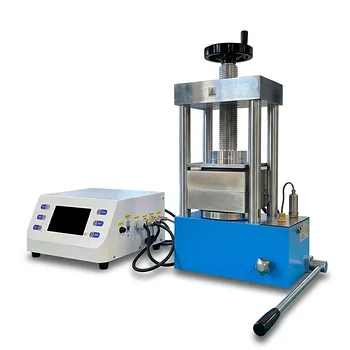
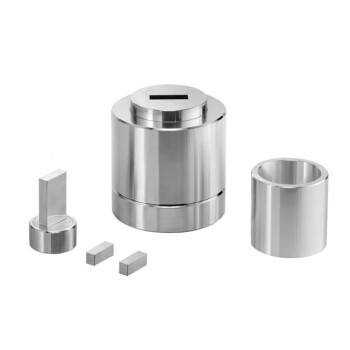
Ideally, a laboratory hydraulic press functions as a precision compaction tool used to bond active electrode materials onto current collectors.
For high-nickel cathode research, this device applies uniform, adjustable pressure to a mixture of active materials, conductive agents, and binders placed on an aluminum foil substrate. This process is critical for establishing the physical integrity of the electrode "green sheet" before it undergoes electrochemical cycling or microscopic analysis.
Core Takeaway The hydraulic press is not merely for shaping; it serves as a standardization device that establishes specific compaction densities. By creating a consistent structural baseline, it allows researchers to distinguish between manufacturing inconsistencies and actual degradation mechanisms—such as particle fragmentation—during post-cycling analysis.
The Mechanics of Electrode Preparation
Achieving Ideal Compaction Density
The primary function of the press is to force the electrode components—active high-nickel particles, conductive additives, and binders—into a dense, cohesive layer.
By applying controlled force, the press reduces the void volume between particles. This optimization of compaction density is essential for ensuring the electrode meets volumetric energy density requirements.
Minimizing Contact Resistance
Loose connection between particles impedes electron flow. The hydraulic press physically forces particles into closer proximity.
This creates a robust electrical network, significantly reducing contact resistance between the active material particles and the aluminum foil current collector. This structural foundation is necessary for the electrode to function efficiently during charging and discharging.
Enabling Structural Research and SEM Analysis
Creating a Standardized Sample Base
In structural research, consistency is paramount. The hydraulic press ensures that every sample starts with the same physical parameters.
This standardization provides a reliable baseline. Without it, researchers cannot accurately determine if structural anomalies observed later are due to material failure or simply inconsistent sample preparation.
Facilitating Micro-Crack Observation
High-nickel cathodes are prone to mechanical degradation. The press prepares the sample for cross-sectional scanning electron microscopy (SEM).
By creating a uniform green sheet, researchers can clearly observe the evolution of micro-cracks and particle fragmentation that occur after cycling. The initial pressing quality directly impacts the clarity of these microscopic observations.
Understanding the Trade-offs
Manual vs. Automatic Variability
While hydraulic presses are essential, manual versions introduce user-dependent variables. Slight variations in pressure application or duration can lead to inconsistent green sheet densities.
Automatic hydraulic presses mitigate this by ensuring high accuracy and repeatability, eliminating human error. For sensitive high-nickel research, consistent pressure application is often more critical than the magnitude of the pressure itself.
The Risk of Over-Compaction
Pressure must be precise, not just high. Excessive pressure can crush the delicate high-nickel secondary particles before cycling even begins.
This "false damage" complicates structural research, as it becomes difficult to separate mechanical damage caused by the press from damage caused by electrochemical cycling.
Making the Right Choice for Your Goal
To maximize the value of your hydraulic press in cathode research, align your operation with your specific analytical objectives:
- If your primary focus is Electrochemical Performance: Prioritize precise density control to minimize contact resistance and maximize volumetric energy density.
- If your primary focus is Failure Analysis (SEM): Prioritize repeatability and standardization to ensure that any observed micro-cracks are the result of cycling, not preparation inconsistencies.
The hydraulic press is the gatekeeper of your sample quality; its proper use ensures that the physical structure of your green sheet creates valid, reproducible scientific data.
Summary Table:
| Function | Key Benefit | Impact on Structural Research |
|---|---|---|
| Compaction Density | Optimizes volumetric energy density | Establishes a consistent physical baseline for samples |
| Contact Resistance | Enhances electrical network connectivity | Reduces impedance between active material and collector |
| Standardization | Eliminates preparation variability | Distinguishes cycle-induced damage from prep errors |
| Sample Preparation | Enables clear cross-sectional SEM | Facilitates accurate observation of micro-cracks/fragmentation |
Elevate Your Battery Research with KINTEK Precision
Consistency is the foundation of breakthrough structural analysis. KINTEK specializes in advanced laboratory equipment, offering high-precision manual and automatic hydraulic presses (pellet, hot, isostatic) designed to ensure perfectly standardized electrode green sheets. Whether you are investigating particle fragmentation in high-nickel cathodes or optimizing electrochemical performance, our equipment provides the repeatability your research demands.
Our extensive portfolio also includes high-temperature furnaces, high-pressure reactors, electrolytic cells, and essential battery research consumables to support every stage of your workflow.
Ready to eliminate sample variability? Contact KINTEK today to find the ideal compaction solution for your laboratory.
References
- Mehdi Ahangari, Hongmei Luo. Advancements and Challenges in High-Capacity Ni-Rich Cathode Materials for Lithium-Ion Batteries. DOI: 10.3390/ma17040801
This article is also based on technical information from Kintek Solution Knowledge Base .
Related Products
- Heated Hydraulic Press Machine with Integrated Manual Heated Plates for Lab Use
- Automatic Laboratory Hydraulic Press for XRF & KBR Pellet Press
- Automatic High Temperature Heated Hydraulic Press Machine with Heated Plates for Lab
- Laboratory Manual Hydraulic Pellet Press for Lab Use
- Automatic Laboratory Hydraulic Pellet Press Machine for Lab Use
People Also Ask
- Why is a heated laboratory hydraulic press necessary for composite laminates? Achieve Void-Free Structural Integrity
- What role does a heated hydraulic press play in Cold Sintering (CSP)? Enhancing LATP-Halide Densification
- What technical conditions does a heated hydraulic press provide for PEO batteries? Optimize Solid-State Interfaces
- Why is the heating function of a laboratory hydraulic press essential for MEA assembly in DEFC? Optimize Cell Bonding
- What are heated hydraulic presses used for? Molding Composites, Vulcanizing Rubber, and More