Knowledge What are the functions of a vacuum high-temperature furnace? Master Diffusion Bonding for Titanium Alloys
Author avatar

Tech Team · Kintek Solution

Updated 2 days ago

What are the functions of a vacuum high-temperature furnace? Master Diffusion Bonding for Titanium Alloys


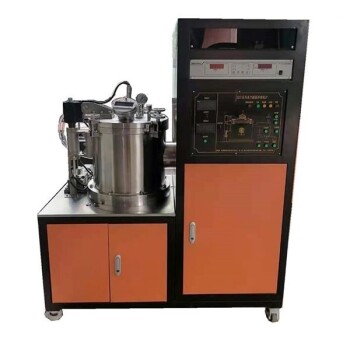
A vacuum high-temperature furnace serves as the fundamental processing environment for manufacturing near-alpha titanium alloy multi-layered laminates. Its primary function is to facilitate diffusion bonding by maintaining a high-vacuum atmosphere to prevent oxidation while simultaneously applying precise heat and pressure. This forces the stacked titanium sheets to merge at an atomic level, transforming them into a single, cohesive structural unit.

The furnace is not merely a heating element; it is a controlled reaction chamber that enables solid-state joining. By driving atomic diffusion across interfaces, it eliminates physical gaps between layers, resulting in a laminate that offers a superior balance of strength and toughness compared to monolithic materials.

The Mechanics of Solid-State Bonding

Facilitating Atomic Diffusion

The furnace creates the thermodynamic conditions necessary for atoms to migrate across the boundaries of the titanium sheets.

By applying high temperatures below the melting point, the furnace increases atomic mobility. Simultaneously, applied mechanical pressure ensures intimate contact between layers, allowing atoms to cross the interface and form a solid-state bond.

Eliminating Interfacial Defects

A critical function of the furnace is the complete removal of voids between the stacked layers.

Through the combined application of pressure and heat, the process collapses surface asperities and eliminates interfacial pores. This results in a joint where the fusion line becomes microstructurally indistinguishable from the base material.

Microstructural Homogenization

The furnace environment ensures that the bonding process does not degrade the material's grain structure.

Properly controlled cycles promote a uniform microstructure, often characterized by equiaxed Alpha grains. This uniformity is essential for creating isotropic mechanical properties, meaning the material performs consistently in all directions.

Critical Environmental Controls

Prevention of Oxidation and Embrittlement

Titanium alloys are highly reactive to oxygen at elevated temperatures, which can lead to a brittle, compromised surface layer.

The vacuum capability of the furnace is the primary defense against this. By removing oxygen and other atmospheric gases, the furnace preserves the chemical purity of the titanium, ensuring the bond is formed between clean metal surfaces rather than oxide layers.

Precise Pressure Application

To bond complex laminates, the furnace must apply force evenly across the entire stack.

Advanced furnaces often utilize mechanisms such as flexible membranes under argon gas pressure to transmit force. This ensures that even if the stack has slight geometric variations, the pressure remains uniform, preventing weak spots in the laminate.

Understanding the Trade-offs

Sensitivity to Vacuum Integrity

The reliability of the process is entirely dependent on maintaining a pristine vacuum.

Any leak or failure in the vacuum system immediately introduces oxygen, which can cause rapid oxidation of the titanium. This irreversibly compromises the interface quality and the mechanical ductility of the final part.

Complexity of Process Control

Achieving the "indistinguishable" bond described requires exacting control over thermal and pressure cycles.

If the temperature is too low, diffusion will be incomplete, leaving pores. If the temperature is too high or held too long, it may alter the titanium's microstructure unfavorably. The furnace must execute these cycles with extreme precision.

Making the Right Choice for Your Goal

When evaluating furnace capabilities for titanium diffusion bonding, consider your specific performance requirements:

  • If your primary focus is Structural Integrity: Prioritize furnaces with advanced pressure delivery systems (like flexible membranes) to guarantee pore elimination and maximize strength-toughness matching.
  • If your primary focus is Material Purity: Ensure the furnace has a high-integrity vacuum system capable of maintaining ultra-low pressures to prevent oxidation and embrittlement.

The ultimate value of this equipment lies in its ability to produce a multi-layered material that acts as a single, high-performance solid.

Summary Table:

Key Function Mechanism Impact on Material
Atomic Diffusion Sustained heat below melting point Facilitates solid-state joining at an atomic level
Oxidation Prevention High-vacuum atmosphere Maintains chemical purity and prevents embrittlement
Void Elimination Uniform pressure application Collapses interfacial pores for a cohesive structure
Homogenization Precise thermal cycling Ensures isotropic mechanical properties and grain uniformity

Elevate Your Material Research with KINTEK Precision

Unlock the full potential of diffusion bonding and solid-state joining with KINTEK’s high-performance laboratory solutions. Whether you are working on near-alpha titanium alloy laminates or advanced aerospace components, our range of vacuum high-temperature furnaces, CVD/PECVD systems, and hydraulic hot presses provides the thermal precision and atmospheric control essential for superior structural integrity.

Why choose KINTEK?

  • Comprehensive Equipment: From sintering and melting to specialized battery research tools and crushing systems.
  • Expertise in High-Performance Materials: We provide the crucibles, ceramics, and high-pressure reactors needed for rigorous experimental environments.
  • Targeted Lab Solutions: Designed specifically for researchers and industrial engineers who demand no-fail vacuum integrity.

Ready to achieve microstructurally perfect bonds? Contact KINTEK today to discuss your project requirements!

References

  1. В. И. Иващенко, Petro Mazur. Radiation-resistant high-entropy boride (TiZrNbHfTa)B2 coatings: Experiment and theory. DOI: 10.21175/rad.abstr.book.2023.19.16

This article is also based on technical information from Kintek Solution Knowledge Base .

Related Products

People Also Ask

Related Products

1400℃ Controlled Atmosphere Furnace with Nitrogen and Inert Atmosphere

1400℃ Controlled Atmosphere Furnace with Nitrogen and Inert Atmosphere

Achieve precise heat treatment with KT-14A controlled atmosphere furnace. Vacuum sealed with a smart controller, it's ideal for lab and industrial use up to 1400℃.

High Pressure Laboratory Vacuum Tube Furnace Quartz Tubular Furnace

High Pressure Laboratory Vacuum Tube Furnace Quartz Tubular Furnace

KT-PTF High Pressure Tube Furnace: Compact split tube furnace with strong positive pressure resistance. Working temp up to 1100°C and pressure up to 15Mpa. Also works under controller atmosphere or high vacuum.

Molybdenum Vacuum Heat Treat Furnace

Molybdenum Vacuum Heat Treat Furnace

Discover the benefits of a high-configuration molybdenum vacuum furnace with heat shield insulation. Ideal for high-purity, vacuum environments like sapphire crystal growth and heat treatment.

Vacuum Hot Press Furnace Machine Heated Vacuum Press

Vacuum Hot Press Furnace Machine Heated Vacuum Press

Discover the advantages of Vacuum Hot Press Furnace! Manufacture dense refractory metals & compounds, ceramics, and composites under high temp and pressure.

2200 ℃ Tungsten Vacuum Heat Treat and Sintering Furnace

2200 ℃ Tungsten Vacuum Heat Treat and Sintering Furnace

Experience the ultimate refractory metal furnace with our Tungsten vacuum furnace. Capable of reaching 2200℃, perfect for sintering advanced ceramics and refractory metals. Order now for high-quality results.

2200 ℃ Graphite Vacuum Heat Treat Furnace

2200 ℃ Graphite Vacuum Heat Treat Furnace

Discover the power of the KT-VG Graphite Vacuum Furnace - with a maximum working temperature of 2200℃, it's perfect for vacuum sintering of various materials. Learn more now.

1800℃ Muffle Oven Furnace for Laboratory

1800℃ Muffle Oven Furnace for Laboratory

KT-18 muffle furnace with Japan Al2O3 polycrystalline fibe and Silicon Molybdenum heating element, up to 1900℃, PID temperature control and 7" smart touch screen. Compact design, low heat loss, and high energy efficiency. Safety interlock system and versatile functions.

Vacuum Heat Treat Furnace with Ceramic Fiber Liner

Vacuum Heat Treat Furnace with Ceramic Fiber Liner

Vacuum furnace with polycrystalline ceramic fiber insulation liner for excellent heat insulation and uniform temperature field. Choose from 1200℃ or 1700℃ max. working temperature with high vacuum performance and precise temperature control.

Horizontal High Temperature Graphite Vacuum Graphitization Furnace

Horizontal High Temperature Graphite Vacuum Graphitization Furnace

Horizontal Graphitization Furnace: This type of furnace is designed with the heating elements placed horizontally, allowing for uniform heating of the sample. It's well-suited for graphitizing large or bulky samples that require precise temperature control and uniformity.

Ultra-High Temperature Graphite Vacuum Graphitization Furnace

Ultra-High Temperature Graphite Vacuum Graphitization Furnace

The ultra-high temperature graphitization furnace utilizes medium frequency induction heating in a vacuum or inert gas environment. The induction coil generates an alternating magnetic field, inducing eddy currents in the graphite crucible, which heats up and radiates heat to the workpiece, bringing it to the desired temperature. This furnace is primarily used for graphitization and sintering of carbon materials, carbon fiber materials, and other composite materials.

Vacuum Heat Treat Sintering Brazing Furnace

Vacuum Heat Treat Sintering Brazing Furnace

A vacuum brazing furnace is a type of industrial furnace used for brazing, a metalworking process that joins two pieces of metal using a filler metal that melts at a lower temperature than the base metals. Vacuum brazing furnaces are typically used for high-quality applications where a strong, clean joint is required.

1700℃ Muffle Oven Furnace for Laboratory

1700℃ Muffle Oven Furnace for Laboratory

Get superior heat control with our 1700℃ Muffle Furnace. Equipped with intelligent temperature microprocessor, TFT touch screen controller & advanced insulation materials for precise heating up to 1700C. Order now!

Vertical High Temperature Graphite Vacuum Graphitization Furnace

Vertical High Temperature Graphite Vacuum Graphitization Furnace

Vertical high temperature graphitization furnace for carbonization and graphitization of carbon materials up to 3100℃.Suitable for shaped graphitization of carbon fiber filaments and other materials sintered in a carbon environment.Applications in metallurgy, electronics, and aerospace for producing high-quality graphite products like electrodes and crucibles.

Graphite Vacuum Furnace Bottom Discharge Graphitization Furnace for Carbon Materials

Graphite Vacuum Furnace Bottom Discharge Graphitization Furnace for Carbon Materials

Bottom-out graphitization furnace for carbon materials, ultra-high temperature furnace up to 3100°C, suitable for graphitization and sintering of carbon rods and carbon blocks. Vertical design, bottom discharging, convenient feeding and discharging, high temperature uniformity, low energy consumption, good stability, hydraulic lifting system, convenient loading and unloading.

1400℃ Muffle Oven Furnace for Laboratory

1400℃ Muffle Oven Furnace for Laboratory

Get precise high-temperature control up to 1500℃ with KT-14M Muffle furnace. Equipped with a smart touch screen controller and advanced insulation materials.

Vacuum Heat Treat and Sintering Furnace with 9MPa Air Pressure

Vacuum Heat Treat and Sintering Furnace with 9MPa Air Pressure

The air pressure sintering furnace is a high-tech equipment commonly used for the sintering of advanced ceramic materials. It combines vacuum sintering and pressure sintering techniques to achieve high-density and high-strength ceramics.

1200℃ Split Tube Furnace with Quartz Tube Laboratory Tubular Furnace

1200℃ Split Tube Furnace with Quartz Tube Laboratory Tubular Furnace

KT-TF12 split tube furnace: high-purity insulation, embedded heating wire coils, and max. 1200C. Widely used for new materials and chemical vapour deposition.

Graphite Vacuum Continuous Graphitization Furnace

Graphite Vacuum Continuous Graphitization Furnace

High-temperature graphitization furnace is a professional equipment for graphitization treatment of carbon materials. It is a key equipment for the production of high-quality graphite products. It has high temperature, high efficiency and uniform heating. It is suitable for various high-temperature treatments and graphitization treatments. It is widely used in metallurgy, electronics, aerospace, etc. industry.

Laboratory Vacuum Tilt Rotary Tube Furnace Rotating Tube Furnace

Laboratory Vacuum Tilt Rotary Tube Furnace Rotating Tube Furnace

Discover the versatility of Laboratory Rotary Furnace: Ideal for calcination, drying, sintering, and high-temperature reactions. Adjustable rotating and tilting functions for optimal heating. Suitable for vacuum and controlled atmosphere environments. Learn more now!

Small Vacuum Heat Treat and Tungsten Wire Sintering Furnace

Small Vacuum Heat Treat and Tungsten Wire Sintering Furnace

The small vacuum tungsten wire sintering furnace is a compact experimental vacuum furnace specially designed for universities and scientific research institutes. The furnace features a CNC welded shell and vacuum piping to ensure leak-free operation. Quick-connect electrical connections facilitate relocation and debugging, and the standard electrical control cabinet is safe and convenient to operate.


Leave Your Message