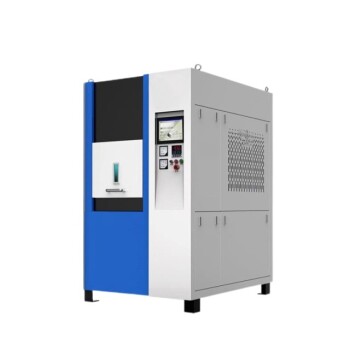
Conductive punches are the central interface in a Spark Plasma Sintering (SPS) assembly, serving as the direct conduit for both the thermal energy and mechanical force required to sinter materials. They function simultaneously as the electrodes that deliver high-amperage current and as the mechanical rams that compress the powder compact.
Core Takeaway The efficiency of Spark Plasma Sintering relies on the conductive punches to perform a synchronized dual role: they act as heating elements (or current carriers) to rapidly raise temperature and as hydraulic rams to apply the uniaxial pressure necessary for high-density consolidation.
1. The Energy Transfer Function
The first critical function of the conductive punches is to manage the delivery of the high-amperage Direct Current (DC) generated by the power supply. The mechanism of heat generation depends entirely on the electrical properties of the powder being sintered.
Handling Non-Conductive Powders
When sintering insulating materials (non-conductive powders), the current cannot pass through the sample itself. In this scenario, the conductive punches act as external heating sources. They transfer the high thermal energy generated by the pulsed current within the die assembly directly to the powder body via thermal conduction.
Handling Conductive Powders
For conductive materials, the role of the punches changes significantly. Instead of just transferring external heat, they directly conduct the current through the powder compact. This generates Joule heating within the sample itself, allowing for extremely rapid and uniform heating.
Enabling Rapid Heating Rates
Because the punches deliver energy directly to the site of sintering, SPS can achieve heating rates significantly higher than conventional methods. It is common to see rates up to 1000°C/min. This capability is fundamental to shortening process cycles and preventing grain growth.
2. The Mechanical Loading Function
While the punches are managing thermal energy, they act simultaneously as the primary components of the mechanical loading system.
Applying Uniaxial Pressure
The punches physically transmit force from the axial pressure device to the powder. According to standard assembly specifications, the punches typically apply a uniaxial pressure ranging from 50 to 250 KN.
Facilitating Densification
This mechanical pressure is not passive; it drives the densification kinetics. By compressing the powder while it is heated, the punches reduce porosity and force particles together, resulting in higher solid densities than are typically achievable with pressureless sintering.
Understanding the Trade-offs
While conductive punches enable the unique advantages of SPS, understanding their operation reveals specific constraints and considerations.
The Material Conductivity Variable
The efficiency of the punches is dictated by your sample material. You must recognize that conductive samples will heat differently (internally) compared to insulating samples (externally). This affects the temperature gradients within your sample and must be accounted for in your process design.
Structural Integrity vs. Thermal Expansion
Because the punches are subjected to immense physical pressure (up to 250 KN) and rapid thermal expansion simultaneously, they are the most stressed components in the system. Misalignment or excessive ramp rates can lead to punch failure, compromising the vacuum seal or the mold itself.
Making the Right Choice for Your Goal
To maximize the utility of the conductive punches in your SPS assembly, align your process parameters with your specific material goals:
- If your primary focus is high density: Prioritize the mechanical loading capability of the punches, utilizing the higher end of the pressure range (up to 250 KN) to forcefully eliminate voids.
- If your primary focus is preserving nano-structure: Leverage the punches' ability to support rapid heating rates; use fast ramp-up times to consolidate the material before grain growth can occur.
- If your primary focus is conductive materials: Ensure excellent contact between the punches and the powder to facilitate efficient Joule heating directly through the compact.
By viewing the conductive punches as active, dynamic tools rather than static components, you can precisely control the temperature and pressure profiles required for advanced material synthesis.
Summary Table:
| Function Category | Mechanism of Action | Key Performance Metrics |
|---|---|---|
| Energy Transfer | Conducts high-amperage DC for Joule heating | Heating rates up to 1000°C/min |
| Mechanical Loading | Transmits uniaxial force from hydraulic rams | Pressure range of 50 to 250 KN |
| Heat Source | Acts as heating element for non-conductive powders | Rapid thermal conduction to die |
| Densification | Compresses powder to eliminate porosity | Achievement of near-theoretical solid density |
Maximize Your Material Synthesis with KINTEK Precision
Unlock the full potential of your Spark Plasma Sintering (SPS) processes with high-performance laboratory equipment from KINTEK. Whether you are working on advanced ceramics, metallic alloys, or nano-structured materials, our comprehensive range of high-temperature furnaces, hydraulic presses, and specialized consumables ensures superior heating uniformity and mechanical stability.
Our value to your laboratory:
- High-Temperature Expertise: From tube and muffle furnaces to advanced CVD and PECVD systems.
- Precision Pressing: Professional hydraulic pellet and isostatic presses for optimal powder consolidation.
- Complete Material Solutions: A full portfolio of crucibles, ceramics, and PTFE consumables tailored for extreme environments.
Ready to enhance your lab's efficiency and achieve superior densification? Contact KINTEK today for a customized consultation!
Related Products
People Also Ask
- What is SPS sintering method? A Guide to High-Speed, High-Performance Material Fabrication
- Why are Spark Plasma Sintering (SPS) furnaces or hot presses utilized in the preparation of Li3PS4 solid electrolytes?
- What is the difference between spark plasma sintering and flash sintering? A Guide to Advanced Sintering Methods
- What technical advantages does a Spark Plasma Sintering (SPS) furnace offer for LZP ceramics? Enhance Ionic Conductivity
- What is the theory of spark plasma sintering? A Guide to Rapid, Low-Temperature Densification