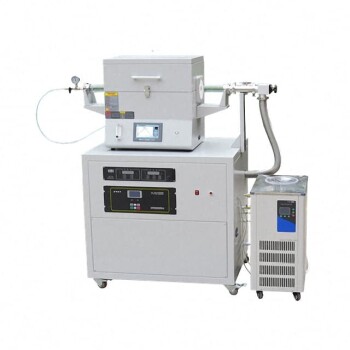
High-Temperature Chemical Vapor Deposition (HTCVD) is a sophisticated process defined by the complex interplay of gas transport, thermodynamics, and film growth. Fundamentally, it involves transporting a mixed reaction gas to a heated substrate, where thermal decomposition triggers a chemical reaction that synthesizes a solid crystal film.
The core of HTCVD is a continuous, dynamic cycle: precursor gases are delivered to a surface, intense heat drives a reaction to deposit solid material, and the system resets via flow dynamics to allow layer-by-layer crystalline growth.
The Three Core Stages of HTCVD
The HTCVD process is generally categorized into three distinct, sequential steps that transform a gaseous precursor into a solid material.
Step 1: Gas Transport and Arrival
The process begins with the introduction of a mixed reaction gas into the system.
This gas is transported through the reaction chamber until it reaches the surface of the substrate material.
Precise control of the gas delivery system is critical here to ensure uniform distribution across the target area.
Step 2: Thermal Decomposition and Surface Reaction
Once the gas contacts the substrate, the "High-Temperature" aspect of HTCVD becomes the driving force.
The intense heat causes the gas to decompose and undergo a specific chemical reaction directly on the substrate surface.
This reaction generates the target material, forming a solid crystal film that adheres to the substrate.
Step 3: Byproduct Removal and Continuous Growth
For the film to thicken into a usable layer, the process must be continuous.
Reaction byproducts and depleted gases are moved away from the surface (often referred to as desorption and exhaust).
Simultaneously, fresh reaction gas is continuously introduced, allowing the crystal film layer to grow continuously without interruption.
The Supporting Ecosystem
To facilitate these three steps, a typical CVD system relies on several integrated subsystems.
The Reaction Environment
The process occurs within a specialized reaction chamber capable of maintaining specific vacuum and temperature conditions.
A heating system provides the thermal energy required to trigger gas decomposition, while an exhaust system ensures the removal of volatile byproducts.
Common Material Applications
This process is essential for creating high-performance materials used in advanced technology.
Common outputs include polysilicon for solar panels and synthetic diamonds for industrial cutting or electronics.
It is also the standard for depositing metals like tungsten, which serves as conductive contacts in semiconductor devices.
Understanding the Trade-offs
While HTCVD produces high-quality crystalline films, it is not without challenges.
Thermal Stress Implications
Because the process relies on high temperatures to decompose the gas, the substrate must be heat-resistant.
This limits the types of materials you can coat; temperature-sensitive substrates may degrade or melt before the film is deposited.
Thermodynamic Complexity
The interaction between gas transport and thermodynamics is sensitive.
Slight variances in temperature or gas flow can lead to uneven film growth or defects in the crystal lattice.
Making the Right Choice for Your Goal
- If your primary focus is Semiconductor Contacts: Prioritize HTCVD for metals like Tungsten to ensure robust conductive pathways.
- If your primary focus is Photovoltaics: Leverage this process for Polysilicon production to maximize solar panel efficiency.
- If your primary focus is Hard Coatings: Utilize HTCVD for synthetic diamond growth to achieve extreme durability.
Success in HTCVD depends on balancing precise gas transport with rigorous thermal management to achieve uniform crystalline growth.
Summary Table:
| Stage | Key Action | Primary Outcome |
|---|---|---|
| 1. Gas Transport | Delivery of mixed precursor gases | Uniform arrival of reactants at the substrate surface |
| 2. Surface Reaction | Thermal decomposition via intense heat | Synthesis of a solid crystal film on the substrate |
| 3. Continuous Growth | Byproduct removal & fresh gas delivery | Layer-by-layer crystalline growth and film thickening |
Elevate Your Material Research with KINTEK
Ready to achieve precision in your HTCVD and thin-film deposition workflows? KINTEK specializes in high-performance laboratory equipment designed for the most demanding thermal processes.
Whether you are scaling semiconductor production or developing advanced hard coatings, our comprehensive range of high-temperature furnaces (CVD, PECVD, MPCVD, and vacuum systems), high-pressure reactors, and precision cooling solutions provides the stability and control your research requires.
Maximize your lab's efficiency and output quality today. Contact our specialists to find the perfect system for your application!
Related Products
- HFCVD Machine System Equipment for Drawing Die Nano-Diamond Coating
- Chemical Vapor Deposition CVD Equipment System Chamber Slide PECVD Tube Furnace with Liquid Gasifier PECVD Machine
- Split Chamber CVD Tube Furnace with Vacuum Station Chemical Vapor Deposition System Equipment Machine
- Multi Heating Zones CVD Tube Furnace Machine Chemical Vapor Deposition Chamber System Equipment
- Customer Made Versatile CVD Tube Furnace Chemical Vapor Deposition Chamber System Equipment
People Also Ask
- What is the full form of HFCVD? A Guide to Hot Filament Chemical Vapor Deposition
- What are the disadvantages and challenges of the HFCVD method? Overcome Growth Limits and Filament Issues
- What is the function of tungsten filaments in HFCVD? Powering Diamond Film Synthesis with Thermal Excitation
- Why is Chemical Vapor Deposition (CVD) equipment uniquely suited for constructing hierarchical superhydrophobic structures?
- What is the chemical vapor deposition growth process? Build Superior Thin Films from the Atom Up