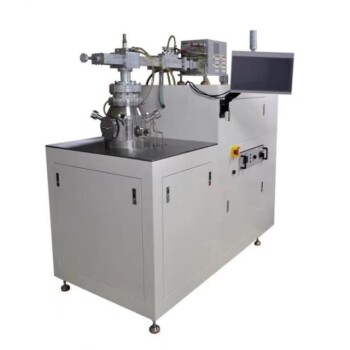
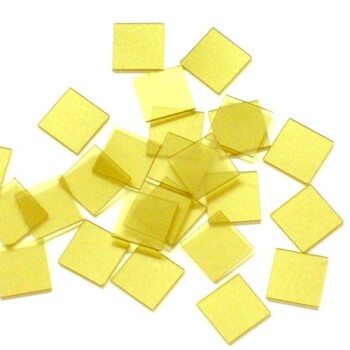
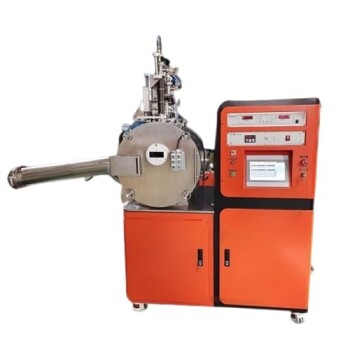
An HFCVD system is a specialized assembly primarily engineered for diamond production, integrating high-temperature thermal elements with precise vacuum controls. Its architecture centers on a stainless steel double-walled reactor containing a horizontal filament holder, a tensioning system, and a dedicated DC power supply, supported by external gas, vacuum, and cooling infrastructure.
The effectiveness of an HFCVD system relies not just on the heating element, but on the precise synchronization of the filament's physical tension with the reactor's pressure and gas chemistry to maintain a stable deposition environment.
The Reaction Chamber and Thermal Management
The core of the HFCVD process occurs within a robust physical enclosure designed to withstand extreme conditions.
The Double-Walled Reactor
The central vessel is a stainless steel double-walled reactor. This dual-wall construction is critical for isolating the reaction environment while allowing for thermal regulation of the chamber walls.
The Cooling Circuit
To manage the immense heat generated during the process, the system includes a cooling circuit. This typically features a separate heat exchanger to ensure the reactor walls and auxiliary components remain at safe operating temperatures.
The Filament Assembly
The distinguishing feature of HFCVD is the "Hot Filament" itself, which requires specialized mechanical and electrical support.
Filament Holder and Tensioning
The system utilizes a horizontal filament holder equipped with a tensioning system. As the filament heats up, it expands; the tensioning system is vital to prevent sagging, which would alter the distance to the substrate and affect uniformity.
DC Power Supply
A regulated DC power supply drives the heating of the filament. This provides the energy necessary to decompose the precursor gases and activate the chemical reaction.
Gas and Vacuum Control Systems
Precise control over the chemical atmosphere is essential for high-quality diamond synthesis.
The Gas Panel
A dedicated gas panel manages the injection of process gases. Standard configurations are designed to handle Hydrogen (H2), Methane (CH4), and Nitrogen (N2), balancing the ratios required for specific diamond characteristics.
Pumping and Pressure Control
The vacuum environment is maintained by a pumping system, often utilizing oil pumps. Critical to this component is the ability to provide fine-tuning pressure control, allowing the user to stabilize the deposition pressure accurately.
Machine Control (PLC)
The entire operation is orchestrated by a machine control PLC (Programmable Logic Controller). This centralizes the logic for the vacuum, heating, and gas flow, ensuring reproducible results.
Understanding the Trade-offs
While HFCVD systems are robust, the reliance on a physical filament introduces specific limitations that users must manage.
Filament Degradation
The filament is a consumable component that physically interacts with the reaction gas. Over time, the filament will degrade or become brittle, requiring regular replacement which impacts system uptime.
Contamination Risks
Because the filament is extremely hot and in close proximity to the substrate, there is a risk of filament material evaporating and incorporating into the diamond film. This makes the tensioning system and precise temperature control critical to minimizing contamination.
Making the Right Choice for Your Goal
When evaluating or operating an HFCVD system configuration, focus on the components that align with your specific production targets.
- If your primary focus is Film Uniformity: Prioritize the quality of the tensioning system, as a sagging filament causes uneven heating and inconsistent film thickness.
- If your primary focus is Crystal Purity: Ensure the gas panel and pumping system offer high-precision fine-tuning to strictly control the chemical composition and chamber pressure.
Success in HFCVD comes from balancing the thermal intensity of the filament with the stability of the vacuum and cooling support systems.
Summary Table:
| Component | Primary Function | Key Feature |
|---|---|---|
| Double-Walled Reactor | Physical enclosure & thermal isolation | Stainless steel construction |
| Filament Assembly | Thermal decomposition of gases | Tensioning system to prevent sagging |
| DC Power Supply | Driving filament heating | High-precision electrical regulation |
| Gas Panel | Chemical atmosphere management | Handles H2, CH4, and N2 ratios |
| Pumping System | Vacuum and pressure stability | Fine-tuning pressure control |
| PLC Controller | System orchestration | Automated logic for reproducible results |
Elevate Your Material Research with KINTEK Precision
Ready to achieve superior diamond film uniformity and crystal purity? KINTEK specializes in advanced laboratory equipment, offering state-of-the-art CVD systems (including HFCVD, PECVD, and MPCVD), high-temperature furnaces, and precision vacuum solutions tailored for demanding research environments.
Our expertise extends to a comprehensive range of high-temperature high-pressure reactors, crushing systems, and essential lab consumables like ceramics and crucibles. Let our technical team help you configure the perfect system for your specific deposition needs.
Contact KINTEK Today to Consult with an Expert
Related Products
- HFCVD Machine System Equipment for Drawing Die Nano-Diamond Coating
- Customer Made Versatile CVD Tube Furnace Chemical Vapor Deposition Chamber System Equipment
- Multi Heating Zones CVD Tube Furnace Machine Chemical Vapor Deposition Chamber System Equipment
- Chemical Vapor Deposition CVD Equipment System Chamber Slide PECVD Tube Furnace with Liquid Gasifier PECVD Machine
- Split Chamber CVD Tube Furnace with Vacuum Station Chemical Vapor Deposition System Equipment Machine
People Also Ask
- What is the full form of HFCVD? A Guide to Hot Filament Chemical Vapor Deposition
- What are the disadvantages and challenges of the HFCVD method? Overcome Growth Limits and Filament Issues
- What is the function of tungsten filaments in HFCVD? Powering Diamond Film Synthesis with Thermal Excitation
- Why is Chemical Vapor Deposition (CVD) equipment uniquely suited for constructing hierarchical superhydrophobic structures?
- What is the chemical vapor deposition growth process? Build Superior Thin Films from the Atom Up