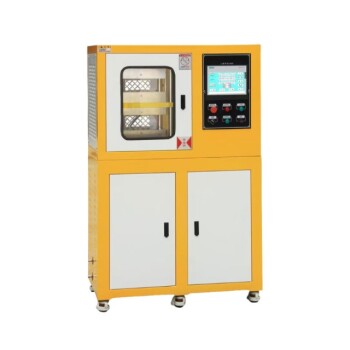
The primary barriers to effective heating in hot press platens are the accumulation of condensate and the entrapment of air within the steam channels. These two factors fundamentally disrupt the physics of heat transfer, transforming the heating medium into an insulating barrier. The result is uneven temperature distribution and a significant drop in thermal efficiency, particularly affecting the consistency required for high-quality pressing.
The core challenge in hot press operation is not generating heat, but transferring it efficiently. When steam condenses into water or mixes with air, it creates an insulating layer between the heat source and the platen wall, making precise temperature control nearly impossible.
The Challenge of Condensate Accumulation
The Insulating Water Barrier
When steam releases its latent heat to the platen, it naturally changes state from gas to liquid. If this resulting water (condensate) is not evacuated immediately, it forms a layer along the internal channel walls. As noted in the technical data, this water layer acts as a thermal insulator, drastically impeding the transfer of heat from the steam to the metal platen.
Uneven Heating on Undersides
The impact of condensation is rarely uniform. Gravity causes the water to pool at the bottom of the horizontal channels. Consequently, the undersides of the platens often suffer the most significant temperature drops, leading to distinct thermal gradients between the top and bottom surfaces of the processed material.
The Challenge of Air Entrapment
Disruption of Homogeneity
Steam systems are most efficient when the medium is pure saturated steam. The introduction or presence of air within the steam supply disturbs the uniformity of the temperature distribution. Because air does not condense and release heat at the same rate as steam, pockets of air create "cold spots" across the platen surface.
Reduction in Transfer Efficiency
Air is a potent insulator—far more effective at blocking heat than water or steel. Even small percentages of air mixed with steam can significantly reduce the heat transfer coefficient. This forces the system to work harder to maintain the target temperature, increasing energy consumption while decreasing process reliability.
Understanding the Trade-offs
Evacuation vs. Steam Loss
To combat these challenges, operators often employ aggressive condensate evacuation systems. However, a common trade-off involves the risk of "blowing through" steam. If the evacuation system (such as steam traps) is set too openly to ensure zero condensate buildup, the system may vent live steam, resulting in significant energy waste.
System Complexity vs. Control
Eliminating air and water requires sophisticated syphon systems and air vents. While these additions improve temperature control, they introduce mechanical complexity and maintenance points. A failure in a single trap or air vent can immediately revert the platen to an uneven heating state, requiring vigilant monitoring.
Making the Right Choice for Your Goal
To mitigate these thermal challenges, you must align your maintenance strategy with your production priorities.
- If your primary focus is Product Quality: Prioritize the installation of high-performance air vents and vacuum breakers to ensure uniform temperature distribution, even if it slightly increases system complexity.
- If your primary focus is Thermal Efficiency: Focus on the precise sizing and maintenance of steam traps to evacuate condensate rapidly without venting live steam.
Mastering hot press performance requires treating the internal environment of the platen as a dynamic system that must be kept free of liquid and gas impurities.
Summary Table:
| Challenge | Cause | Impact on Performance | Solution Strategy |
|---|---|---|---|
| Condensate Layer | Steam latent heat release | Acts as thermal insulator; creates cold spots on undersides | High-performance steam traps |
| Air Entrapment | Non-condensable gas in system | Disrupts homogeneity; significantly lowers heat transfer | Air vents and vacuum breakers |
| Energy Loss | Poor trap calibration | "Blowing through" live steam; increased operational costs | Precise sizing of evacuation systems |
| Thermal Gradients | Uneven water pooling | Inconsistent product quality; material warping | Improved syphon and drainage design |
Maximize Your Pressing Precision with KINTEK Solutions
Thermal inconsistency can compromise your material integrity and waste valuable energy. At KINTEK, we specialize in advanced laboratory equipment designed to overcome complex heating challenges. Whether you are using our hydraulic pellet presses, hot presses, or isostatic systems, our expertise ensures you achieve the uniform temperature control necessary for high-quality research and production.
From high-temperature furnaces and reactors to precision-engineered hydraulic systems, KINTEK provides the tools and consumables you need to optimize your lab's performance. Don't let air or condensate hinder your results.
Contact KINTEK today to discuss your thermal control needs!
Related Products
- Heated Hydraulic Press Machine with Heated Plates for Vacuum Box Laboratory Hot Press
- Automatic Heated Hydraulic Press Machine with Heated Plates for Laboratory Hot Press 25T 30T 50T
- Automatic High Temperature Heated Hydraulic Press Machine with Heated Plates for Lab
- Manual High Temperature Heated Hydraulic Press Machine with Heated Plates for Lab
- 24T 30T 60T Heated Hydraulic Press Machine with Heated Plates for Laboratory Hot Press
People Also Ask
- Why is a heated laboratory hydraulic press necessary for composite laminates? Achieve Void-Free Structural Integrity
- How is a heated hydraulic press used for Li-LLZO batteries? Optimize Interfacial Bonding with Thermal-Pressure
- What technical conditions does a heated hydraulic press provide for PEO batteries? Optimize Solid-State Interfaces
- What are heated hydraulic presses used for? Molding Composites, Vulcanizing Rubber, and More
- Why is the heating function of a laboratory hydraulic press essential for MEA assembly in DEFC? Optimize Cell Bonding