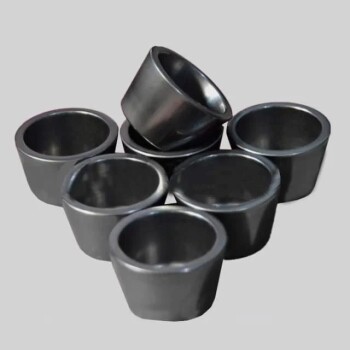
In a Self-propagating High-temperature Synthesis (SHS) casting apparatus, the graphite mold functions primarily as a thermal management system and a high-precision containment vessel. It physically confines the superheated melt to define the product's geometry while utilizing its high thermal conductivity to rapidly extract heat, driving the crystallization process under centrifugal force.
The graphite mold acts as the critical interface between the extreme thermal energy of the SHS reaction and the physical requirements of the final product, simultaneously managing containment, heat dissipation, and geometric precision.
Thermal Regulation and Solidification
Managing Extreme Thermal Loads
The SHS process generates a highly overheated melt through an exothermic reaction.
The graphite mold must withstand these extreme temperatures without degrading or reacting chemically with the alloy.
Its ability to absorb this initial thermal shock prevents catastrophic failure of the casting apparatus.
Controlling Crystallization
Graphite is selected specifically for its high thermal conductivity.
The mold does not simply hold the liquid; it actively draws heat away from the melt.
This rapid heat extraction is essential for promoting the crystallization of the alloy, ensuring the material solidifies with the desired microstructure.
Structural Integrity and Shaping
Precision Containment
The mold serves as the definitive negative for the final product, ensuring the alloy solidifies into a precise, predetermined shape.
It must maintain tight dimensional tolerances even when expanding due to the intense heat of the reaction.
Withstanding Centrifugal Forces
In many SHS casting setups, the process is aided by controlled centrifugal forces.
The graphite mold must possess sufficient mechanical strength to contain the dense, molten alloy as it is forced against the mold walls.
It ensures the fluid fills every detail of the cavity before solidification sets in.
Understanding the Operational Constraints
Thermal Shock Resistance
While graphite is thermally stable, the sudden temperature spike of an SHS reaction creates immense stress.
The mold's primary challenge is maintaining integrity during the rapid transition from ambient temperature to the extreme heat of the reaction.
Material Interaction limits
The mold acts as a barrier, but it is not indestructible.
Its function relies on remaining chemically inert relative to the specific alloy being cast (such as aluminum bronze).
If the melt temperature exceeds the graphite's threshold in an oxygen-rich environment, mold degradation can occur.
Making the Right Choice for Your Process
When designing or selecting graphite molds for SHS casting, you must balance thermal transfer with mechanical durability.
- If your primary focus is Dimensional Accuracy: Prioritize high-density graphite grades that can be machined to tight tolerances and resist deformation under centrifugal load.
- If your primary focus is Microstructure Control: Select graphite with specific thermal conductivity ratings to tune the cooling rate and optimize the crystallization of the alloy.
The success of SHS casting depends not just on the reaction chemistry, but on the mold's ability to precisely manage the thermal energy it releases.
Summary Table:
| Function | Description | Key Benefit |
|---|---|---|
| Thermal Management | Rapidly extracts heat from superheated melts | Controlled crystallization & microstructure |
| Containment | Physcially confines melt under centrifugal force | High dimensional accuracy and integrity |
| Thermal Stability | Withstands extreme SHS reaction temperatures | Prevents mold failure and chemical reaction |
| Shaping | Serves as a high-precision negative cavity | Ensures precise final product geometry |
Elevate Your Material Synthesis with KINTEK Precision
Unlock superior results in your SHS casting and high-temperature research with KINTEK’s industry-leading laboratory equipment. We specialize in high-performance graphite components, crucibles, and high-temperature furnaces designed to withstand the most demanding thermal environments.
Whether you are refining alloy microstructures or scaling up production, our comprehensive portfolio—including centrifugal casting aids, high-pressure reactors, and specialized ceramics—provides the durability and precision your lab requires.
Ready to optimize your thermal management and casting accuracy? Contact our technical experts today to discover how KINTEK can enhance your lab's efficiency and material quality.
References
- Zinnur T. Zagretdinov, L. R. Kharisov. Getting Aluminum Bronze Castings with SHS-Cast. DOI: 10.29042/2019-5191-5196
This article is also based on technical information from Kintek Solution Knowledge Base .
Related Products
- Special Shape Press Mold for Lab
- Assemble Square Lab Press Mold for Laboratory Applications
- Square Lab Press Mold for Laboratory Applications
- High Purity Pure Graphite Crucible for Electron Beam Evaporation
- High Purity Pure Graphite Crucible for Evaporation
People Also Ask
- How to use a press mold? Master the Art of Creating Consistent Ceramic Forms
- What is the press mould method? A Guide to Consistent, Detailed Ceramic Forms
- Why are pressure molds with non-conductive resin inner walls required for battery testing? Ensure Data Accuracy
- What is the purpose of specialized pressure devices in sulfide solid-state batteries? Ensure Chemo-Mechanical Stability
- What is the function of press molds during the preparation of SiCf/Ti-43Al-9V composites? Achieve Structural Precision