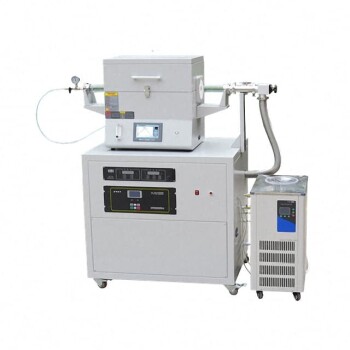
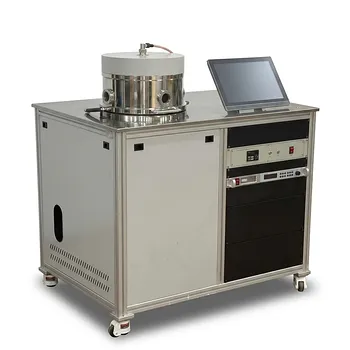
The high-vacuum tube furnace acts as the foundational reactor for synthesizing multi-layer graphene via Chemical Vapor Deposition (CVD). Its primary function is to establish a strictly controlled high-temperature environment—typically around 1000 °C—that facilitates the catalytic decomposition of liquid carbon sources, such as n-hexane, onto a copper foil substrate. Additionally, the furnace maintains a stable, vacuum-sealed workspace that is essential for the chemical purity and structural integrity of the final material.
The furnace is not merely a heater; it is a precision instrument that balances the thermal energy required for carbon atom migration with a pristine environment necessary to prevent lattice defects.
Creating the Necessary Thermal Dynamics
Facilitating Catalytic Decomposition
The furnace must achieve and sustain temperatures near 1000 °C.
This intense heat is required to thermally decompose liquid carbon source vapors (precursors). Without this specific thermal energy, the carbon will not separate effectively to interact with the copper catalyst.
Enabling Carbon Migration
Once the precursor decomposes, the released carbon atoms require significant energy to move.
The furnace provides the thermodynamics necessary for these atoms to migrate across the surface of the copper foil. This migration is the critical step where atoms rearrange themselves into the organized lattice structure of multi-layer graphene.
Ensuring Chemical Purity and Stability
Establishing a Stable Workspace
The "high-vacuum" aspect of the equipment is as critical as the heating element.
By creating a vacuum, the furnace effectively excludes air and other atmospheric gases. This prevents unwanted chemical reactions, such as oxidation, which would degrade the copper foil or the developing graphene layers.
Protecting Lattice Integrity
A stable chemical environment ensures the integrity of the crystal lattice structure.
The vacuum level minimizes impurities that could disrupt the hexagonal arrangement of carbon atoms. This results in a cleaner, higher-quality film with fewer structural defects.
Understanding the Trade-offs
The Balance of Temperature Control
While high heat is necessary, absolute precision is non-negotiable.
Fluctuations in the heating zone can lead to uneven growth rates or varying layer thicknesses. The furnace must offer programmable, automated control to maintain a uniform temperature profile throughout the synthesis window.
Vacuum vs. Process Pressure
Operating at high vacuum ensures purity, but the CVD process often requires specific pressure ranges to control growth kinetics.
The operator must balance the need for a clean, air-free environment with the specific pressure requirements needed to control the deposition rate of the carbon vapor.
Making the Right Choice for Your Goal
To maximize the effectiveness of your CVD setup, align your equipment usage with your specific synthesis targets:
- If your primary focus is Structural Perfection: Prioritize the vacuum capabilities of the furnace to eliminate air interference and minimize lattice defects.
- If your primary focus is Layer Uniformity: Focus on the precision of the thermal control system to ensure consistent carbon migration and rearrangement across the entire copper substrate.
The high-vacuum tube furnace is the variable that transforms raw chemical potential into ordered material reality.
Summary Table:
| Function | Role in CVD Process | Impact on Graphene Quality |
|---|---|---|
| Thermal Dynamics | Provides ~1000 °C for precursor decomposition | Facilitates efficient carbon atom migration |
| High-Vacuum Environment | Excludes atmospheric gases and oxygen | Prevents oxidation and minimizes lattice defects |
| Precise Temperature Control | Maintains uniform heating zones | Ensures consistent layer thickness and growth |
| Stable Workspace | Provides a sealed reactor environment | Guarantees chemical purity of the final film |
Elevate Your Materials Research with KINTEK Precision
Unlock the full potential of your CVD synthesis with KINTEK’s high-performance laboratory solutions. Whether you are developing multi-layer graphene or advanced nanomaterials, our specialized high-vacuum tube furnaces, CVD/PECVD systems, and vacuum technologies provide the stability and thermal precision required for defect-free results.
From high-temperature furnaces and crushing systems to high-pressure reactors and battery research consumables, KINTEK delivers the comprehensive tools needed for cutting-edge innovation. Partner with KINTEK today to achieve superior structural perfection in your lab—Contact us now to discuss your equipment needs!
References
- Abhishek Tiwari, R.K. Singh Raman. Durable Corrosion Resistance of Copper Due to Multi-Layer Graphene. DOI: 10.3390/ma10101112
This article is also based on technical information from Kintek Solution Knowledge Base .
Related Products
- Split Chamber CVD Tube Furnace with Vacuum Station Chemical Vapor Deposition System Equipment Machine
- Customer Made Versatile CVD Tube Furnace Chemical Vapor Deposition Chamber System Equipment
- Graphite Vacuum Furnace High Thermal Conductivity Film Graphitization Furnace
- Vertical High Temperature Graphite Vacuum Graphitization Furnace
- Ultra-High Temperature Graphite Vacuum Graphitization Furnace
People Also Ask
- What is the function of a tube furnace in CVD SiC synthesis? Achieving Ultra-Pure Silicon Carbide Powders
- What is a CVD tube furnace? A Complete Guide to Thin-Film Deposition
- What is the function of a high-temperature CVD tube furnace in 3D graphene foam prep? Master 3D Nanomaterial Growth
- How does a CVD tube furnace inhibit the sintering of silver supports? Boost Membrane Durability and Performance
- What functions does a tube CVD furnace perform during the stabilization and carbonization of composite fibers?