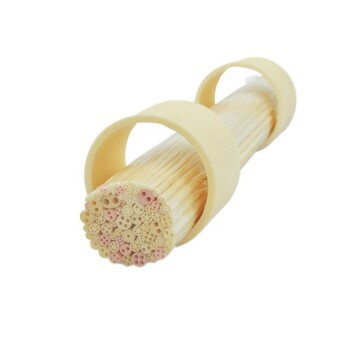
High-purity Alumina (Al2O3) tubes primarily function as protective barriers for sensitive instrumentation and conduits for atmospheric control within high-temperature molten salt corrosion test setups. Their specific roles are to shield thermocouples from chemical erosion caused by direct contact with molten salts and to serve as delivery channels for introducing mixed gases (such as Ar-O2) directly into the electrolyte to regulate the reaction atmosphere.
Core Takeaway Alumina tubes are critical for maintaining experimental integrity by protecting sensors from the aggressive molten environment and facilitating precise control over the chemical atmosphere. Their high refractoriness and chemical inertness ensure that the test environment remains free from contamination and that data collection is uninterrupted.
Safeguarding Instrumentation
Thermocouple Protection
In high-temperature corrosion testing, accurate temperature monitoring is vital but difficult due to the aggressive nature of molten salts.
Alumina tubes serve as a physical shield, encasing the thermocouple.
This prevents the molten salt from chemically eroding the sensor, ensuring the thermocouple survives the duration of the experiment and provides accurate thermal data.
Controlling the Chemical Environment
Precise Gas Delivery
Corrosion is rarely just about the liquid salt; the gaseous atmosphere often plays a significant role in the reaction kinetics.
Alumina tubes function as gas injection lances, delivering specific gas mixtures (like Argon-Oxygen) directly into the molten electrolyte.
This capability allows researchers to maintain a stable, controlled reaction atmosphere, which is essential for simulating specific industrial conditions.
The Material Advantage
Why Alumina is the Standard
The choice of Alumina for these tubes is not arbitrary; it is driven by the material's specific physical properties.
Alumina exhibits high refractoriness, meaning it retains its strength and form at the elevated temperatures required for these tests.
Chemical Inertness and Purity
Crucially, high-purity Alumina is chemically stable and generally does not react with metallic samples.
This inertness prevents the release of impurities into the corrosive atmosphere or the salt melt.
By eliminating external variables, researchers can be confident that observed corrosion is due solely to the interaction between the metal specimen and the molten salt, rather than contamination from the test rig itself.
Understanding the Trade-offs
Compatibility with Salt Types
While Alumina tubes are highly effective, the surrounding containment material (crucible) must also be matched to the specific salt chemistry to ensure total system integrity.
For molten nitrate salts (up to 600°C), Alumina is an excellent match for both tubes and crucibles due to its stability.
However, for aggressive fluoride salts, high-purity graphite is often the preferred containment material due to its superior resistance to fluoride erosion and ability to facilitate galvanic corrosion studies.
When designing the setup, ensure that your Alumina tubes are compatible with the specific salt chemistry to avoid unexpected leaching or degradation over long durations.
Making the Right Choice for Your Goal
Select your setup components based on the specific chemical interactions you intend to study.
- If your primary focus is precise atmospheric control: Prioritize high-purity Alumina tubes to deliver gas mixtures without introducing contaminants into the melt.
- If your primary focus is long-duration sensor reliability: Use Alumina tubes as sheaths to prevent thermocouple failure caused by direct exposure to the corrosive salt.
Ultimately, the integrity of your corrosion data depends on isolating the variables, and Alumina tubes are the industry standard for isolating your sensors and atmosphere from the chaotic molten environment.
Summary Table:
| Feature | Function in Molten Salt Tests | Benefit to Researcher |
|---|---|---|
| Thermocouple Sheath | Shields sensors from chemical erosion | Ensures accurate, long-term thermal data |
| Gas Delivery Lance | Directs Ar-O2 or mixed gases into melt | Maintains stable, controlled reaction kinetics |
| High Refractoriness | Maintains structural integrity at high heat | Prevents tube deformation during experiments |
| Chemical Inertness | Prevents leaching of impurities | Ensures corrosion data is free from contamination |
| Material Purity | Minimizes reaction with metallic samples | Isolates variables for precise material analysis |
Elevate Your High-Temperature Research with KINTEK
Precision in corrosion testing requires equipment that can withstand the most aggressive environments. KINTEK specializes in high-performance laboratory solutions, providing the high-purity Alumina (Al2O3) tubes, ceramic crucibles, and high-temperature furnaces essential for reliable molten salt studies.
Whether you are conducting battery research, material science experiments, or industrial simulation, our comprehensive portfolio—including high-temperature high-pressure reactors, muffle furnaces, and precision crushing systems—is designed to meet the strictest purity standards.
Ready to optimize your lab setup? Contact KINTEK today to discover how our premium consumables and equipment can enhance your experimental integrity and data accuracy.
References
- Wan-Bae Kim, Jong‐Hyeon Lee. High-Temperature Corrosion Behavior of Al-Coated Ni-Base Alloys in Lithium Molten Salt for Electroreduction. DOI: 10.3390/coatings11030328
This article is also based on technical information from Kintek Solution Knowledge Base .
Related Products
- High Temperature Alumina (Al2O3) Furnace Tube for Engineering Advanced Fine Ceramics
- High Temperature Aluminum Oxide (Al2O3) Protective Tube for Engineering Advanced Fine Ceramics
- High Temperature Wear-Resistant Alumina Al2O3 Plate for Engineering Advanced Fine Ceramics
- Engineering Advanced Fine Alumina Al2O3 Ceramic Rod Insulated for Industrial Applications
- High Purity Alumina Granulated Powder for Engineering Advanced Fine Ceramics
People Also Ask
- What is the primary function of an Alumina (Al2O3) tube in LLZTO sintering? Optimize Your Thermal Processing
- What role does a high-alumina furnace tube play in high-temperature nickel slag reduction? Ensure 1400°C Precision
- How does an alumina tube furnace with a controlled atmosphere simulate conditions in CSP environments? Master Accuracy.
- How do you clean an alumina tube furnace? Extend Tube Life with Proper Maintenance
- How to clean an alumina tube furnace? Extend Tube Life and Ensure Experimental Purity