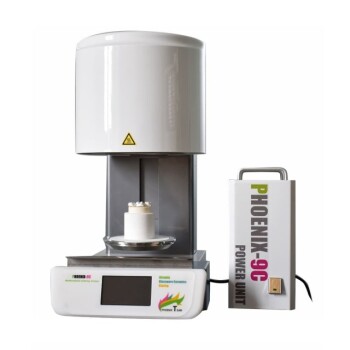
The specific objectives of the 900°C heat treatment in the LAGP manufacturing process are to ensure mechanical integrity and activate electrochemical performance. This annealing step serves as a dual-purpose phase, simultaneously relieving the internal thermal stresses caused by rapid quenching and driving the structural transformation from amorphous glass into a conductive crystalline ceramic.
The 900°C treatment is the critical bridge between raw processing and final performance, transforming a brittle, unstable glass precursor into a robust NASICON-type ceramic with the high ionic conductivity required for solid-state batteries.
Achieving Mechanical Stability
Eliminating Residual Stress
During the earlier stages of production, the material undergoes rapid quenching to freeze the melt into a solid state.
This rapid cooling traps significant internal thermal stresses within the material structure. The annealing furnace provides a controlled thermal environment that allows the material to relax, effectively eliminating these residual tensions.
Preventing Material Failure
If these internal stresses are not relieved, the material becomes structurally compromised.
By holding the temperature at 900°C, the process prevents material cracking and shattering. This ensures the physical durability required for the ceramic to be handled and utilized in battery assembly.
Enabling Electrochemical Performance
Inducing Controlled Crystallization
The material enters the annealing furnace as an amorphous glass, which lacks the specific structure needed for ion transport.
The 900°C heat treatment provides the thermal energy necessary to rearrange the atomic structure. It induces a controlled crystallization process, converting the disordered glass network into an ordered crystalline lattice.
Forming the NASICON Phase
The specific goal of this crystallization is to form the NASICON-type glass-ceramic phase (chemically defined as Li1.5Al0.5Ge1.5(PO4)3).
This specific phase is not merely a structural change; it is the functional prerequisite for the material's utility. Without this phase transformation, the material cannot achieve the high ionic conductivity required for effective lithium-ion transport.
Critical Process Dependencies
The Necessity of the Precursor State
The success of the 900°C annealing phase is entirely dependent on the quality of the incoming material.
As noted in the manufacturing context, the material must first be processed in a high-temperature box furnace at 1350°C. This initial step ensures the oxide powders are completely melted and liquefied into a uniform glass matrix without premature crystal precipitation.
The Risk of Incomplete Treatment
There is no middle ground in this thermal process.
If the annealing is insufficient, the material remains an insulating glass rather than a conductive ceramic. Conversely, without the stress relief provided by this specific thermal profile, the ceramic will be too brittle to function, regardless of its conductivity.
Optimizing the Manufacturing Workflow
To ensure high-quality LAGP glass-ceramic production, align your thermal parameters with your specific performance metrics:
- If your primary focus is mechanical yield: Prioritize the uniformity of the thermal environment to fully eliminate residual stresses and prevent cracking during the transition.
- If your primary focus is conductivity: Ensure the residence time at 900°C is sufficient to complete the phase transformation into the NASICON-type structure (Li1.5Al0.5Ge1.5(PO4)3).
Precise control over this annealing stage is the defining factor in producing a solid electrolyte that balances structural robustness with superior electrochemical efficiency.
Summary Table:
| Objective Category | Specific Goal | Resulting Benefit |
|---|---|---|
| Mechanical Integrity | Eliminating Residual Stress | Prevents material cracking and shattering during handling |
| Structural Phase | Controlled Crystallization | Transforms amorphous glass into an ordered crystalline lattice |
| Electrochemical | NASICON Phase Formation | Achieves high ionic conductivity for lithium-ion transport |
| Process Quality | Uniform Thermal Profile | Ensures high mechanical yield and consistent battery performance |
Elevate Your Solid-State Battery Research with KINTEK
Precision thermal processing is the cornerstone of high-performance LAGP glass-ceramics. At KINTEK, we specialize in the laboratory equipment essential for every stage of your manufacturing workflow. From 1350°C high-temperature box furnaces for glass melting to specialized annealing tube and atmosphere furnaces for precise NASICON-phase crystallization, our technology ensures your materials achieve peak ionic conductivity and mechanical stability.
Beyond furnaces, KINTEK offers a comprehensive suite of tools for battery innovation, including high-pressure reactors, crushing and milling systems, and hydraulic pellet presses for electrolyte preparation.
Ready to optimize your heat treatment parameters? Contact KINTEK today to discover how our advanced laboratory solutions can enhance your material yield and electrochemical efficiency.
Related Products
- Controlled Nitrogen Inert Hydrogen Atmosphere Furnace
- Vacuum Heat Treat Furnace with Ceramic Fiber Liner
- High Temperature Muffle Oven Furnace for Laboratory Debinding and Pre Sintering
- Laboratory Muffle Oven Furnace Bottom Lifting Muffle Furnace
- Graphite Vacuum Furnace High Thermal Conductivity Film Graphitization Furnace
People Also Ask
- What is the role of a hydrogen atmosphere furnace in diamond/copper composites? Enhance Your Material Purity
- Why is hydrogen used in furnaces? Achieve Superior Purity and Bright Finishes
- What are the characteristics and risks of a hydrogen atmosphere in a furnace? Master the Balance of Power and Control
- What is the use of hydrogen in furnace? A Key to Oxygen-Free High-Temperature Processing
- Can hydrogen be used in furnaces? Yes, for Oxide-Free Metal Processing & Rapid Heating