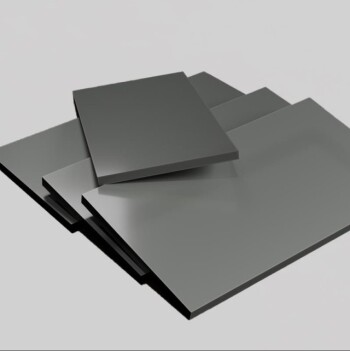
High-strength graphite molds serve a dual purpose during the vacuum hot pressing of Al/B4C composites: they act as the geometric shaping container and the primary load-bearing component. To ensure the production of a dense, disk-like bulk, these molds must maintain structural rigidity under external mechanical pressures up to 30 MPa while enduring processing temperatures around 680°C.
The core challenge in vacuum hot pressing is maintaining precise geometry while forcing liquid aluminum into the material's pores. The graphite mold provides the necessary rigidity to transmit high pressure without deformation, acting as a stable thermal conductor that ensures the composite achieves uniform density and structural homogeneity.
Mechanical Load Bearing and Stability
Withstanding Extreme Uniaxial Pressure
The primary function of the mold is to withstand significant external force. During sintering, the mold is subjected to uniaxial pressures reaching 30 MPa. The graphite must possess high mechanical strength to endure this load without fracturing or cracking.
Preventing Structural Deformation
Beyond simply not breaking, the mold must exhibit exceptional dimensional stability. At 680°C, the material must not creep or warp under the applied load. Rigidity is essential to ensure the final Al/B4C disk retains a regular, precise shape.
Facilitating Pore Infiltration
The pressure applied via the mold serves a critical micro-structural purpose. It forces liquid aluminum to fill the pores within the boron carbide (B4C) structure. If the mold deforms, pressure is lost, leading to incomplete infiltration and a porous, weak composite.
Thermal Dynamics and Process Efficiency
Uniform Pressure Transmission
The mold acts as the medium for transferring force from the hot press to the powder compact. High-quality graphite ensures this axial pressure is distributed uniformly across the sample surface. This prevents localized density gradients or uneven thickness in the final composite plate.
Efficient Heat Transfer
Graphite is selected for its superior thermal conductivity. The mold must transfer heat efficiently from the furnace elements to the inner composite sample. This ensures the sample reaches the sintering temperature (680°C) evenly, preventing thermal gradients that could cause internal stress.
Surface Interaction and Demolding
Chemical Stability in Vacuum
The mold must remain chemically inert when in contact with the aluminum matrix and B4C reinforcement. High-purity graphite is used because it does not react with these materials in a vacuum environment. This stability prevents surface contamination of the composite.
High-Temperature Lubrication
A functional requirement of the mold is to facilitate the removal of the finished part. Graphite possesses natural lubricity, which persists even at high temperatures. This property ensures easy demolding of the composite billets without damaging the surface finish.
Understanding the Trade-offs
Brittleness vs. Hardness
While graphite is excellent for high-temperature strength, it remains a brittle material. It handles compressive loads (squeezing) exceptionally well but has low tensile strength. Care must be taken during alignment; any misalignment of the press rams can introduce shear forces that may snap the mold.
Wear and Erosion
Graphite is softer than the B4C particles being sintered. Repeated cycles of pressing abrasive powders can erode the inner mold walls over time. This wear eventually compromises dimensional tolerance, requiring the mold to be resurfaced or replaced to maintain precision.
Making the Right Choice for Your Project
The specific grade of graphite you choose should depend on the most critical aspect of your sintering goals:
- If your primary focus is Maximum Density: Prioritize graphite with the highest compressive strength rating to safely sustain pressures at or above 30 MPa without deflection.
- If your primary focus is Dimensional Precision: Ensure the mold wall thickness is sufficient to prevent bowing, and use high-density graphite to resist deformation at 680°C.
- If your primary focus is Surface Quality: Select high-purity, fine-grain graphite to minimize porosity on the mold surface and ensure the cleanest possible demolding experience.
By treating the mold not just as a container, but as an active pressure-transmission tool, you ensure the structural integrity of your final Al/B4C composite.
Summary Table:
| Requirement Category | Key Specification | Functional Role |
|---|---|---|
| Mechanical Strength | Up to 30 MPa uniaxial pressure | Prevents mold fracture and ensures dense pore infiltration |
| Thermal Stability | Operational at 680°C | Maintains dimensional precision and resists creep/warping |
| Heat Transfer | High thermal conductivity | Ensures uniform temperature distribution and structural homogeneity |
| Surface Properties | Chemical inertness & natural lubricity | Prevents contamination and facilitates easy demolding of billets |
| Material Grade | High-purity, fine-grain graphite | Minimizes surface porosity and resists erosion from abrasive B4C |
Maximize Your Material Density with KINTEK Precision Solutions
Achieving the perfect Al/B4C composite requires more than just high temperatures; it demands high-performance tooling that withstands extreme mechanical stress. KINTEK specializes in advanced laboratory equipment and consumables designed for the most rigorous sintering environments.
Our expertise extends across a comprehensive range of high-temperature furnaces (muffle, vacuum, and atmosphere) and precision hydraulic presses, perfectly complemented by our high-purity ceramics, crucibles, and graphite consumables. Whether you are developing advanced composites or performing battery research, KINTEK provides the structural reliability and thermal precision your lab needs to succeed.
Ready to elevate your sintering process? Contact us today to discover how our specialized high-pressure systems and premium consumables can optimize your research outcomes!
Related Products
- 2200 ℃ Graphite Vacuum Heat Treat Furnace
- Graphite Vacuum Furnace Bottom Discharge Graphitization Furnace for Carbon Materials
- Horizontal High Temperature Graphite Vacuum Graphitization Furnace
- Ultra-High Temperature Graphite Vacuum Graphitization Furnace
- Ball Press Mold for Lab
People Also Ask
- Why do you heat treat in a vacuum? Achieve Perfect Surface Finish and Material Integrity
- How does heat transmit in a vacuum? Mastering Thermal Radiation for Purity & Precision
- What is the process of vacuum heat treating? Achieve Superior Hardening with a Clean, Bright Finish
- How does a vacuum heat treat furnace work? Achieve Pristine, Oxide-Free Metal Parts
- What is graphite heating? A Guide to Durable, High-Temp Industrial Furnace Solutions