Knowledge What are the structures of molds? Discover the Microscopic Filaments That Build a Colony
Author avatar

Tech Team · Kintek Solution

Updated 6 days ago

What are the structures of molds? Discover the Microscopic Filaments That Build a Colony


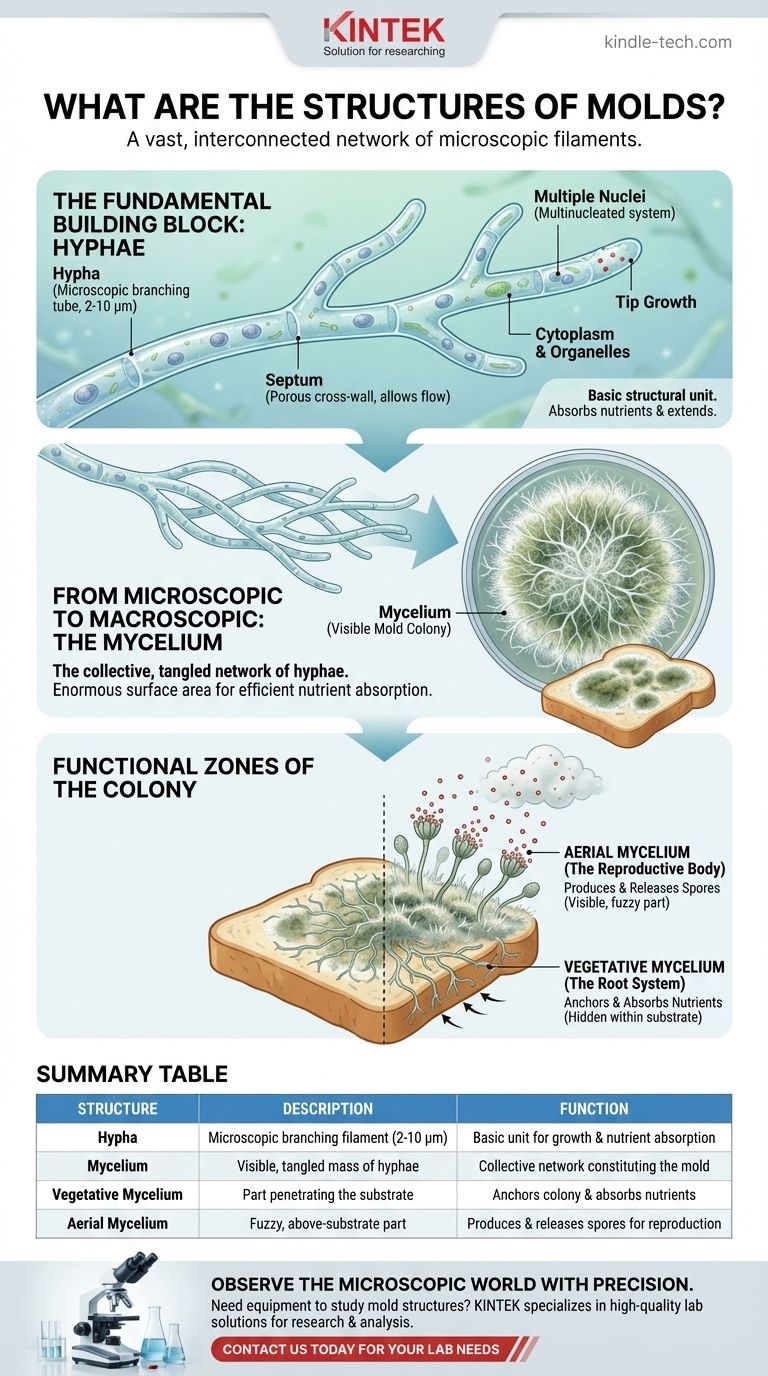
At its core, a mold is not a single entity but a vast, interconnected network of microscopic, thread-like filaments called hyphae. These individual hyphae branch and weave together to form the visible mass we recognize as a mold colony, which is technically known as a mycelium.

The fundamental structure of a mold is the hypha, a microscopic branching tube. The visible mold colony you see is the mycelium, which is simply a massive, tangled network of these individual hyphae.
What are the structures of molds? Discover the Microscopic Filaments That Build a Colony

The Fundamental Building Block: Hyphae

To understand a mold, you must first understand its individual components. The entire organism is built from repeating, simple units.

What is a Hypha?

A hypha (plural: hyphae) is the basic structural unit of a mold. It is a branching, tubular filament, similar to a single strand of thread.

These structures are microscopic, typically measuring only 2-10 micrometers in diameter. Their primary purpose is to grow, extend, and absorb nutrients from the environment.

Internal Divisions: Septa

Most hyphae are divided into cell-like compartments by internal cross-walls called septa.

These septa are not solid walls. They are perforated, allowing cytoplasm, organelles, and nutrients to flow freely between compartments, which facilitates rapid, coordinated growth across the entire network.

A Multinucleated System

Molds are multinucleated, meaning multiple nuclei can exist within a single compartment or share a common cytoplasm. This structure allows the organism to coordinate its functions and grow efficiently without having to form complete new cells for every extension.

From Microscopic to Macroscopic: The Mycelium

While a single hypha is invisible to the naked eye, their collective growth forms the structure we can easily see.

Defining the Mycelium

The mycelium is the term for the entire mass of intertwined hyphae that constitutes the mold colony.

When you see a fuzzy patch of mold on bread or a damp wall, you are looking at the mycelium—a vast, three-dimensional network of filaments.

Why This Structure is So Effective

The filamentous network of the mycelium is incredibly efficient at its job: absorbing nutrients.

This structure creates an enormous surface area, allowing the mold to make maximum contact with its food source and secrete digestive enzymes externally. This is why molds are such effective decomposers.

The Functional Parts of a Mold Colony

Not all parts of the mycelium perform the same function. The colony is typically organized into two distinct operational zones.

Vegetative Mycelium: The Root System

The portion of the mycelium that penetrates the food source (the substrate) is called the vegetative mycelium.

Its function is analogous to the roots of a plant. It anchors the colony and is primarily responsible for absorbing water and nutrients. This part is often hidden from view within the material the mold is growing on.

Aerial Mycelium: The Reproductive Body

The aerial mycelium grows upward, away from the substrate, and rises into the air. This is the fuzzy, often colorful part of the mold we are most familiar with.

Its primary function is reproduction. This part of the mycelium develops specialized structures that produce and release microscopic spores, which can then travel through the air to establish new colonies.

Key Structural Concepts at a Glance

Understanding these structural layers is key to understanding how molds function and grow.

  • If your primary focus is the microscopic level: The key structure is the hypha, the individual, branching filament that absorbs nutrients.
  • If your primary focus is the visible colony: You are observing the mycelium, which is the collective, tangled mass of countless hyphae.
  • If your primary focus is the mold's lifecycle: Distinguish between the vegetative mycelium for feeding and the aerial mycelium for reproduction via spores.

This simple, repeating filamentous structure is what allows a microscopic spore to develop into a large, complex, and highly effective organism.

Summary Table:

Structure Description Function
Hypha A microscopic, branching, tubular filament (2-10 μm in diameter) The basic unit for growth and nutrient absorption
Mycelium The visible, tangled mass of hyphae forming the colony The collective network that constitutes the mold
Vegetative Mycelium The part that penetrates the substrate (food source) Anchors the colony and absorbs nutrients
Aerial Mycelium The fuzzy, above-substrate part of the mycelium Produces and releases spores for reproduction

Need precise equipment to study microscopic structures like mold hyphae? KINTEK specializes in high-quality lab equipment and consumables for all your laboratory needs. Whether you're in research, education, or quality control, our tools help you observe, analyze, and understand complex biological systems with accuracy and ease. Contact us today to find the perfect solution for your lab!

Visual Guide
What are the structures of molds? Discover the Microscopic Filaments That Build a Colony Visual Guide

Related Products

People Also Ask

Related Products

Isostatic Molding Pressing Molds for Lab

Isostatic Molding Pressing Molds for Lab

Explore high-performance isostatic pressing molds for advanced material processing. Ideal for achieving uniform density and strength in manufacturing.

Customizable XRD Sample Holders for Diverse Research Applications

Customizable XRD Sample Holders for Diverse Research Applications

High-transparency XRD sample holders with zero impurity peaks. Available in square and round designs, and customizable to fit Bruker, Shimadzu, PANalytical, and Rigaku diffractometers.

Laboratory Disc Rotary Mixer for Efficient Sample Mixing and Homogenization

Laboratory Disc Rotary Mixer for Efficient Sample Mixing and Homogenization

Efficient Laboratory Disc Rotary Mixer for Precise Sample Mixing, Versatile for Various Applications, DC Motor and Microcomputer Control, Adjustable Speed and Angle.

Three-dimensional electromagnetic sieving instrument

Three-dimensional electromagnetic sieving instrument

KT-VT150 is a desktop sample processing instrument for both sieving and grinding. Grinding and sieving can be used both dry and wet. The vibration amplitude is 5mm and the vibration frequency is 3000-3600 times/min.

High Temperature Muffle Oven Furnace for Laboratory Debinding and Pre Sintering

High Temperature Muffle Oven Furnace for Laboratory Debinding and Pre Sintering

KT-MD High temperature debinding and pre-sintering furnace for ceramic materials with various molding processes. Ideal for electronic components such as MLCC and NFC.

1800℃ Muffle Oven Furnace for Laboratory

1800℃ Muffle Oven Furnace for Laboratory

KT-18 muffle furnace with Japan Al2O3 polycrystalline fibe and Silicon Molybdenum heating element, up to 1900℃, PID temperature control and 7" smart touch screen. Compact design, low heat loss, and high energy efficiency. Safety interlock system and versatile functions.

Custom PTFE Teflon Parts Manufacturer for Hollow Etching Flower Basket ITO FTO Developing Glue Removal

Custom PTFE Teflon Parts Manufacturer for Hollow Etching Flower Basket ITO FTO Developing Glue Removal

PTFE adjustable height flower basket (Teflon flower baskets) are made of high-purity experimental grade PTFE, with excellent chemical stability, corrosion resistance, sealing and high and low temperature resistance.

Platinum Sheet Electrode for Laboratory and Industrial Applications

Platinum Sheet Electrode for Laboratory and Industrial Applications

Elevate your experiments with our Platinum Sheet Electrode. Crafted with quality materials, our safe and durable models can be tailored to fit your needs.

Rubber Vulcanizer Vulcanizing Machine Plate Vulcanizing Press for Lab

Rubber Vulcanizer Vulcanizing Machine Plate Vulcanizing Press for Lab

The Plate vulcanizing press is a kind of equipment used in the production of rubber products, mainly used for the vulcanization of rubber products. Vulcanization is a key step in rubber processing.

Custom PTFE Teflon Parts Manufacturer Adjustable Height Flower Basket

Custom PTFE Teflon Parts Manufacturer Adjustable Height Flower Basket

The flower basket is made of PTFE, which is a chemically inert material. This makes it resistant to most acids and bases, and it can be used in a wide variety of applications.

1200℃ Split Tube Furnace with Quartz Tube Laboratory Tubular Furnace

1200℃ Split Tube Furnace with Quartz Tube Laboratory Tubular Furnace

KT-TF12 split tube furnace: high-purity insulation, embedded heating wire coils, and max. 1200C. Widely used for new materials and chemical vapour deposition.

Quartz Electrolytic Electrochemical Cell for Electrochemical Experiments

Quartz Electrolytic Electrochemical Cell for Electrochemical Experiments

Looking for a reliable quartz electrochemical cell? Our product boasts excellent corrosion resistance and complete specifications. With high-quality materials and good sealing, it's both safe and durable. Customize to meet your needs.

Silicon Carbide (SIC) Ceramic Sheet Wear-Resistant Engineering Advanced Fine Ceramics

Silicon Carbide (SIC) Ceramic Sheet Wear-Resistant Engineering Advanced Fine Ceramics

Silicon carbide (sic) ceramic sheet is composed of high-purity silicon carbide and ultra-fine powder, which is formed by vibration molding and high-temperature sintering.

Zirconia Ceramic Gasket Insulating Engineering Advanced Fine Ceramics

Zirconia Ceramic Gasket Insulating Engineering Advanced Fine Ceramics

Zirconia insulating ceramic gasket has high melting point, high resistivity, low thermal expansion coefficient and other properties, making it an important high temperature resistant material, ceramic insulating material and ceramic sunscreen material.

Automatic Laboratory Heat Press Machine

Automatic Laboratory Heat Press Machine

Precision automatic heat press machines for labs—ideal for material testing, composites, and R&D. Customizable, safe, and efficient. Contact KINTEK today!

Precision Machined Zirconia Ceramic Ball for Engineering Advanced Fine Ceramics

Precision Machined Zirconia Ceramic Ball for Engineering Advanced Fine Ceramics

zirconia ceramic ball have the characteristics of high strength, high hardness, PPM wear level, high fracture toughness, good wear resistance, and high specific gravity.

1400℃ Muffle Oven Furnace for Laboratory

1400℃ Muffle Oven Furnace for Laboratory

Get precise high-temperature control up to 1500℃ with KT-14M Muffle furnace. Equipped with a smart touch screen controller and advanced insulation materials.

1400℃ Laboratory Quartz Tube Furnace with Alumina Tube Tubular Furnace

1400℃ Laboratory Quartz Tube Furnace with Alumina Tube Tubular Furnace

Looking for a tube furnace for high-temperature applications? Our 1400℃ Tube Furnace with Alumina Tube is perfect for research and industrial use.

1700℃ Laboratory Quartz Tube Furnace with Alumina Tube Tubular Furnace

1700℃ Laboratory Quartz Tube Furnace with Alumina Tube Tubular Furnace

Looking for a high-temperature tube furnace? Check out our 1700℃ Tube Furnace with Alumina Tube. Perfect for research and industrial applications up to 1700C.

Laboratory Muffle Oven Furnace Bottom Lifting Muffle Furnace

Laboratory Muffle Oven Furnace Bottom Lifting Muffle Furnace

Efficiently produce batches with excellent temperature uniformity using our Bottom Lifting Furnace. Features two electric lifting stages and advanced temperature control up to 1600℃.


Leave Your Message