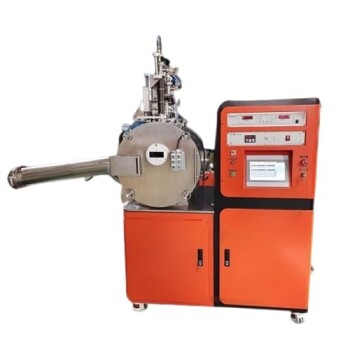
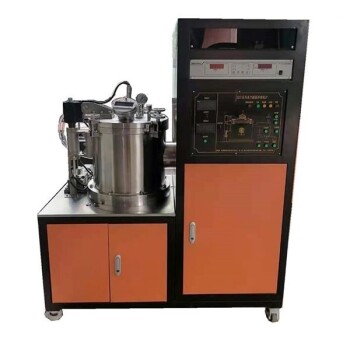
The technical advantage of using a vacuum induction melting (VIM) furnace for Zirconium-Chromium alloys centers on its ability to strictly control chemical purity while ensuring microstructural uniformity. By utilizing electromagnetic induction within a controlled vacuum or inert gas environment, the furnace facilitates the rapid and homogeneous mixing of the Zirconium matrix with Chromium additives. This process is essential for neutralizing the high reactivity of Zirconium and preventing contamination from atmospheric impurities.
Core Takeaway The VIM process is not merely about melting; it is a critical conditioning step that defines the alloy's final performance. By stabilizing the chemical structure of second-phase particles (SPPs) during the melt, VIM enables the formation of high-quality ZrO2/Cr2O3 heteroconjunction interfaces during subsequent oxidation processes.
Controlling Reactivity and Purity
Mitigating Zirconium Reactivity
Zirconium is an inherently highly reactive metal. The primary function of the VIM furnace is to isolate the melt in a high-vacuum or inert gas environment. This strictly limits the intake of impurities that would otherwise react with the Zirconium.
Elimination of Gaseous Impurities
The vacuum environment significantly enhances material properties by reducing interstitial elements. Specifically, it allows for the removal of harmful dissolved gases such as oxygen (O2), nitrogen (N2), and hydrogen (H2) from the liquid molten metal.
Removal of Trace Contaminants
Beyond gases, the process is effective at eliminating low-melting-point metallic impurities. Volatile elements such as lead (Pb), bismuth (Bi), and antimony (Sb) can be evaporated and removed from the melt, ensuring a cleaner alloy baseline.
Enhancing Microstructural Homogeneity
Electromagnetic Stirring
The furnace utilizes an intermediate frequency power supply to generate electromagnetic induction. This mechanism does not just heat the material; it induces a natural stirring action within the molten pool.
Uniform Dispersion of Additives
This stirring action ensures the rapid and uniform mixing of the Chromium additives into the Zirconium matrix. Achieving a homogeneous melt is a prerequisite for consistent material performance across the alloy.
Stabilization of Second-Phase Particles (SPPs)
The uniformity achieved during melting directly influences the alloy's behavior after it cools. This process ensures that the second-phase particles precipitated after alloy quenching possess a stable chemical structure.
Impact on Final Material Performance
Enabling Advanced Oxidation Properties
The stability of the SPPs is not an end in itself; it serves a deeper purpose. A well-prepared melt is critical for forming high-quality ZrO2/Cr2O3 heteroconjunction interfaces during subsequent oxidation. This interface quality is often the deciding factor in the alloy's corrosion resistance and longevity.
Preventing Inclusion Reactions
Operating in a vacuum prevents chemical reactions between the molten alloy and non-metallic inclusions. By maintaining this separation, the furnace ensures the final material is free from defects that could compromise mechanical integrity.
Operational Considerations and Trade-offs
Equipment Complexity vs. Output Quality
While VIM furnaces offer high heating rates and energy efficiency, they require specialized power supplies and vacuum systems. The complexity of maintaining a high-vacuum environment is a trade-off accepted to achieve the necessary purity levels for reactive metals like Zirconium.
The Role of Post-Processing
It is important to note that the VIM furnace prepares the chemistry, but the final phase structure often requires subsequent steps. The VIM process sets the stage for solution treatments and rapid quenching (often in separate high-vacuum heat treatment furnaces) to achieve specific martensitic or metastable phases.
Optimizing Your Alloy Preparation Strategy
To extract the maximum value from a VIM furnace for Zirconium alloys, align your process parameters with your specific performance goals:
- If your primary focus is Oxidation Resistance: Prioritize the stability of the melt to ensure the formation of robust ZrO2/Cr2O3 heteroconjunctions.
- If your primary focus is Mechanical Purity: Leverage the vacuum capability to maximize the removal of interstitial gases (O2, N2) and low-melting-point impurities.
- If your primary focus is Production Efficiency: Utilize the fast heating and high limiting temperatures of the intermediate frequency power supply for consistent, long-term operation.
The ultimate value of vacuum induction melting lies in its ability to transform a highly reactive mixture into a chemically stable, homogeneous substrate ready for high-performance applications.
Summary Table:
| Feature | Advantage for Zr-Cr Alloys | Impact on Final Performance |
|---|---|---|
| Vacuum/Inert Environment | Eliminates O2, N2, and H2 contamination | Enhances corrosion resistance and mechanical integrity |
| Electromagnetic Stirring | Ensures uniform dispersion of Chromium additives | Promotes microstructural homogeneity and stable SPPs |
| Impurity Volatilization | Removes low-melting-point metals (Pb, Bi, Sb) | Results in a cleaner, high-performance alloy baseline |
| Precise Temperature Control | Prevents reaction with non-metallic inclusions | Facilitates high-quality ZrO2/Cr2O3 interfaces |
Elevate Your Materials Research with KINTEK
Ready to achieve superior chemical purity and microstructural uniformity in your alloys? KINTEK specializes in advanced laboratory equipment, offering high-performance vacuum induction melting furnaces, high-temperature reactors, and precision crushing systems tailored for the most demanding Zirconium and reactive metal applications.
From battery research tools and consumables to high-pressure autoclaves and ceramic crucibles, our comprehensive portfolio is designed to optimize your laboratory's efficiency and output quality. Let our experts help you select the ideal furnace or thermal solution to stabilize your second-phase particles and enhance oxidation resistance.
Contact KINTEK experts today to discuss your specific laboratory needs!
References
- Jing Yang, Bilge Yildiz. Predicting point defect equilibria across oxide hetero-interfaces: model system of ZrO<sub>2</sub>/Cr<sub>2</sub>O<sub>3</sub>. DOI: 10.1039/c6cp04997d
This article is also based on technical information from Kintek Solution Knowledge Base .
Related Products
- Lab-Scale Vacuum Induction Melting Furnace
- Vacuum Induction Melting Spinning System Arc Melting Furnace
- Vacuum Heat Treat Furnace and Levitation Induction Melting Furnace
- Vacuum Arc Induction Melting Furnace
- Non Consumable Vacuum Arc Induction Melting Furnace
People Also Ask
- How do vacuum induction or arc melting furnaces facilitate the synthesis of U-Al-C MAX phases? Precision Heat & Purity
- What types of metals are typically processed in a vacuum induction melting furnace? High-Purity Alloys for Critical Applications
- Why use VIM for rare earth steel? Essential Precision for Melting Reactive Lanthanum and Cerium
- What is the primary function of a vacuum induction melting furnace in Ni-Mo-Cr-Fe master alloy prep? Ensure High Purity
- What are the key components inside the vacuum chamber of a vacuum induction melting furnace? A Guide to the Core Melting Assembly