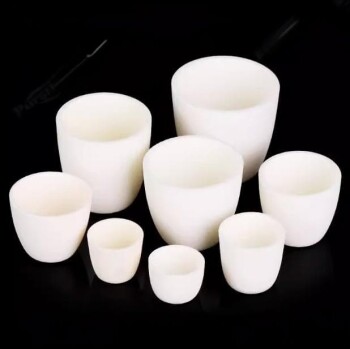
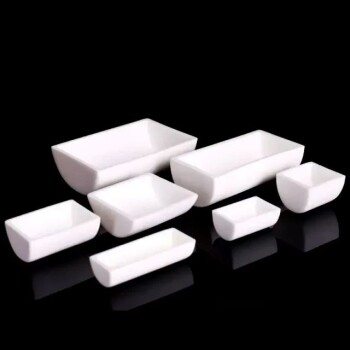
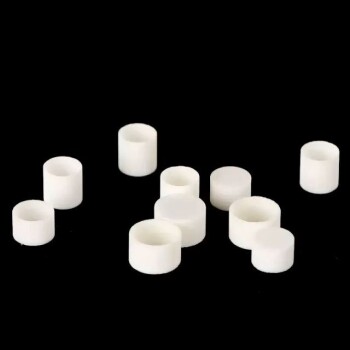
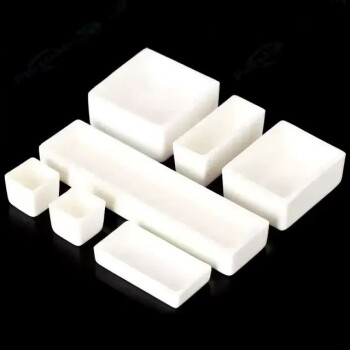
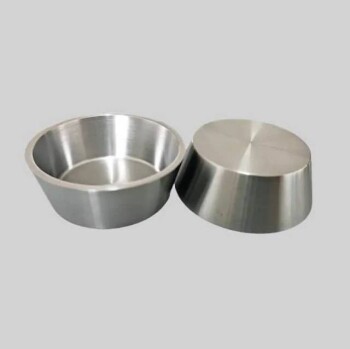
Alumina crucibles serve as the technical foundation for reliable high-temperature aluminization by providing a chemically inert and structurally stable environment. Their primary advantage is the ability to withstand temperatures around 950°C (and up to 1000°C+) without reacting with the aluminum source, halide activators, or inert fillers used in the pack cementation mixture. This ensures the purity of the coating process while maintaining the physical geometry required for a uniform processing atmosphere.
Core Takeaway The critical value of alumina crucibles lies in their dual ability to chemically isolate the reactive coating mixture from contaminants and physically support heavy powder loads at high heat. This guarantees that the aluminizing atmosphere remains consistent and the final coating maintains its intended stoichiometry.
Chemical Inertness and Process Purity
Resistance to Reactive Activators
The aluminization process relies on aggressive chemical agents to transfer aluminum to the substrate.
Alumina demonstrates exceptional resistance to these agents. It remains inert in the presence of the aluminum source and, critically, resists attack from the fluoride or chloride activators typically used to generate the coating vapor.
Preventing Cross-Contamination
A major risk in high-temperature coating is impurity leaching.
Alumina crucibles act as a barrier, preventing reactions between the pack mixture and the furnace lining. By eliminating chemical interference, alumina ensures the protective layer forms exactly as designed, without the introduction of foreign elements that could compromise coating performance.
Structural Integrity at Elevated Temperatures
Load-Bearing Stability
Pack cementation involves burying parts in a heavy mixture of powders.
Alumina crucibles maintain high structural strength at temperatures ranging from 950°C to over 1000°C. They can support the significant weight of the pack-cementation mixture without deforming or collapsing, which is essential for protecting the parts buried within.
Ensuring Atmosphere Uniformity
The geometry of the container dictates the flow and concentration of the reactive gas.
Because alumina retains its shape during prolonged heat treatment, it ensures the "controlled container space" remains constant. This stability allows the aluminizing atmosphere to distribute uniformly around the part, leading to consistent coating thickness and quality.
Understanding the Trade-offs
Thermal Shock Considerations
While alumina possesses good thermal shock resistance, it is ultimately a ceramic material.
Rapid temperature changes—heating up or cooling down too quickly—can induce stress fractures. Operators must adhere to controlled ramp rates to prevent crucible cracking, which would lead to atmosphere leakage and process failure.
Purity Grade Requirements
Not all alumina is created equal.
To achieve the results described above, high-purity alumina is strictly necessary. Lower-grade alternatives may contain binders or impurities that could react with the halide activators or degrade at the required 1000°C operating ceiling.
Making the Right Choice for Your Goal
Selecting the correct crucible material depends on your specific process constraints and quality requirements.
- If your primary focus is coating purity: Choose high-purity alumina to prevent any reaction between chloride/fluoride activators and the container walls.
- If your primary focus is process consistency: Rely on alumina’s high-temperature rigidity to maintain a uniform gas atmosphere volume throughout long heat treatment cycles.
By leveraging the inertness and strength of alumina, you ensure that the only reaction occurring in your furnace is the one you intended.
Summary Table:
| Feature | Technical Advantage in Aluminization | Impact on Performance |
|---|---|---|
| Chemical Inertness | Resists aggressive halide activators (F/Cl) | Prevents contamination; ensures coating purity |
| High Thermal Ceiling | Stable up to and exceeding 1000°C | Enables high-temperature pack cementation |
| Structural Rigidity | High load-bearing strength at heat | Supports heavy powder loads without deformation |
| Atmospheric Control | Maintains fixed container geometry | Ensures uniform gas distribution and coating thickness |
| Material Purity | Low leaching of foreign elements | Protects stoichiometry of the protective layer |
Elevate Your Material Research with KINTEK Precision Solutions
Don't let crucible degradation compromise your high-temperature processes. KINTEK specializes in premium laboratory equipment and high-performance consumables designed for the most demanding environments. Whether you are performing complex aluminization, battery research, or advanced material synthesis, our high-purity alumina crucibles and ceramics provide the chemical inertness and structural integrity you need.
From our industry-leading high-temperature furnaces (muffle, vacuum, CVD) to our specialized high-pressure reactors, hydraulic presses, and crushing systems, KINTEK is committed to delivering precision and durability to labs worldwide.
Ready to optimize your coating uniformity and process purity? Contact our technical experts today to find the perfect solution for your laboratory needs.
References
- Xiaver Ledoux, Marc Wanger. Development of Chromium and Aluminum Coatings on Superalloys by Pack-Cementation Technique. DOI: 10.4028/www.scientific.net/amr.278.491
This article is also based on technical information from Kintek Solution Knowledge Base .
Related Products
- Arc-Shaped Alumina Ceramic Crucible High Temperature Resistant for Engineering Advanced Fine Ceramics
- Alumina Al2O3 Ceramic Crucible Semicircle Boat with Lid for Engineering Advanced Fine Ceramics
- Engineering Advanced Fine Ceramics Alumina Al2O3 Crucible With Lid Cylindrical Laboratory Crucible
- Engineering Advanced Fine Ceramics Alumina Crucibles (Al2O3) for Thermal Analysis TGA DTA
- Engineering Advanced Fine Alumina Al2O3 Ceramic Crucible for Laboratory Muffle Furnace
People Also Ask
- Why Use Alumina Crucibles & Powder Burial for NaSICON? Ensure Phase Purity and Prevent Elemental Volatilization
- What is the primary purpose of using alumina crucibles for LLTO ceramics? Optimize Your High-Temperature Sintering
- Why are alumina crucibles and mother powder essential for LATP sintering? Optimize Your Solid Electrolyte Performance
- Why are high-purity alumina crucibles used for liquid lead corrosion experiments? Ensure Data Accuracy at 550°C
- Primary considerations for choosing alumina crucibles and quartz tubes in indium intercalation: Ensure Material Purity