Knowledge What are the technical advantages of using an automated mortar and pestle? Precision in Mechanochemical Synthesis
Author avatar

Tech Team · Kintek Solution

Updated 1 day ago

What are the technical advantages of using an automated mortar and pestle? Precision in Mechanochemical Synthesis


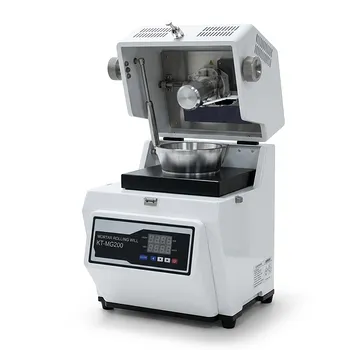
The primary advantage of automation is consistency. An automated mortar and pestle eliminates the variability of human operation, delivering constant grinding frequency and pressure that manual methods cannot achieve. This shift from manual to automated processing is critical for transforming solid-phase reactions from labor-intensive tasks into reproducible scientific processes.

Automated grinding systems solve the core problems of manual synthesis: poor reproducibility and physical fatigue. By standardizing mechanical force and duration, these tools provide the reliable data necessary for preliminary feasibility testing of solid-state reactions.

Overcoming Manual Limitations

Eliminating Human Variability

Manual grinding is inherently inconsistent. The force, speed, and angle applied by a human operator fluctuate naturally, leading to poor reproducibility between batches.

An automated system removes the operator from the equation. It applies mechanical force in a strictly controlled manner, ensuring that the results of a synthesis can be replicated exactly by other researchers or in future experiments.

Reducing Labor Intensity

Traditional mechanochemistry is physically demanding. Manual grinding requires significant effort and cannot be sustained without breaks, which introduces inconsistencies.

Automated units operate without fatigue. This drastically reduces the labor intensity of the process, allowing researchers to focus on analysis rather than physical exertion.

Enhancing Reaction Quality

Constant Pressure and Frequency

The quality of a mechanochemical reaction depends on the energy input. Automated systems provide constant grinding frequency and pressure throughout the entire process.

This steady energy input ensures that the reaction kinetics remain stable. It prevents the "peaks and valleys" of force that occur when a human operator gets tired or changes their grip.

Ensuring Thorough Homogenization

Effective solid-phase reactions require intimate contact between reactants. Automated pestles ensure thorough contact and homogenization of raw materials.

By systematically grinding the material, the system creates a uniform mixture. This uniformity is often difficult to achieve manually, where "dead zones" in the mortar might be missed.

Enabling Continuous Long-Term Reactions

Some solid-state reactions require extended periods of mechanical processing to complete. Manual operation is incapable of maintaining continuous reactions over long periods.

Automation allows for uninterrupted processing. This capability is essential for reactions that are kinetically slow and require sustained mechanical activation to reach completion.

Understanding the Scope

The Role in Feasibility Testing

It is important to view the automated mortar and pestle as a specific tool for a specific phase of research. The primary reference highlights its role as essential for preliminary feasibility testing.

While superior to manual methods, these systems are generally designed for screening and validating solid-state reactions on a small scale. They act as the bridge between concept and larger-scale processing, proving that a reaction works before it is moved to higher-energy equipment like ball mills.

Making the Right Choice for Your Goal

To maximize the effectiveness of your mechanochemical synthesis, align your equipment choice with your specific research objectives.

  • If your primary focus is experimental reproducibility: Rely on automation to standardize grinding pressure and frequency, eliminating human error from your data.
  • If your primary focus is reaction feasibility: Use an automated system to perform the preliminary testing required to validate solid-state reactions before scaling up.
  • If your primary focus is complex, slow kinetics: Choose automation to enable the long, continuous reaction times that are physically impossible with manual operation.

Automation turns the variable art of grinding into a precise, controlled scientific technique.

Summary Table:

Feature Manual Operation Automated System
Consistency Highly variable (human error) Precise & constant frequency
Pressure Control Fluctuating and unstable Uniform and adjustable
Labor Intensity High physical fatigue Effortless operation
Reaction Time Limited by endurance Capable of long-term continuous use
Homogenization Prone to "dead zones" Thorough and systematic mixing
Reproducibility Low across batches High (standardized scientific data)

Elevate Your Research with KINTEK Precision

Don't let manual inconsistency compromise your mechanochemical results. KINTEK specializes in advanced laboratory solutions designed to transform labor-intensive tasks into reproducible scientific breakthroughs. From our high-performance crushing and milling systems to our precise high-temperature furnaces and hydraulic presses, we provide the tools researchers need for reliable feasibility testing and material synthesis.

Whether you require specialized ceramics and crucibles or sophisticated battery research tools, our comprehensive portfolio ensures your lab achieves peak efficiency. Contact KINTEK today to discover how our automated systems can deliver the consistent energy input and stability your solid-state reactions demand.

References

  1. Ophélie Bento, Frédéric Lamaty. Sustainable Mechanosynthesis of Biologically Active Molecules. DOI: 10.1002/ejoc.202101516

This article is also based on technical information from Kintek Solution Knowledge Base .

Related Products

People Also Ask

Related Products

High Energy Planetary Ball Mill for Laboratory Horizontal Tank Type Milling Machine

High Energy Planetary Ball Mill for Laboratory Horizontal Tank Type Milling Machine

KT-P4000H uses the unique Y-axis planetary motion trajectory, and utilizes the collision, friction and gravity between the sample and the grinding ball to have a certain anti-sinking ability, which can obtain better grinding or mixing effects and further improve the sample output.

Laboratory Ten-Body Horizontal Jar Mill for Lab Use

Laboratory Ten-Body Horizontal Jar Mill for Lab Use

The Ten-body horizontal jar mill is for 10 ball mill pots (3000ml or less). It has frequency conversion control, rubber roller movement, and PE protective cover.

High Energy Planetary Ball Mill Milling Machine for Laboratory

High Energy Planetary Ball Mill Milling Machine for Laboratory

The biggest feature is that the high energy planetary ball mill can not only perform fast and effective grinding, but also has good crushing ability

Laboratory Jaw Crusher

Laboratory Jaw Crusher

Discover the small jaw crusher for efficient, flexible, and affordable crushing in labs and small mines. Ideal for coal, ores, and rocks. Learn more now!

Automatic Heated Hydraulic Press Machine with Heated Plates for Laboratory Hot Press 25T 30T 50T

Automatic Heated Hydraulic Press Machine with Heated Plates for Laboratory Hot Press 25T 30T 50T

Efficiently prepare your samples with our Automatic Heated Lab Press. With a pressure range up to 50T and precise control, it's perfect for various industries.

Twin Screw Extruder Plastic Granulation Machine

Twin Screw Extruder Plastic Granulation Machine

Twin screw extruder plastic granulation machine is designed for the mixing and processing experiments of engineering plastics, modified plastics, waste plastics and masterbatches.

Laboratory manual slicer

Laboratory manual slicer

Manual microtome is a high-precision cutting device designed for laboratories, industry and medical fields. It is suitable for the preparation of thin slices of various materials such as paraffin samples, biological tissues, battery materials, food, etc.

Laboratory Test Sieves and Vibratory Sieve Shaker Machine

Laboratory Test Sieves and Vibratory Sieve Shaker Machine

Efficiently process powders, granules, and small blocks with a high-frequency vibration sieve. Control vibration frequency, screen continuously or intermittently, and achieve accurate particle size determination, separation, and classification.

Benchtop Laboratory Freeze Dryer for Lab Use

Benchtop Laboratory Freeze Dryer for Lab Use

Premium benchtop laboratory freeze dryer for lyophilization, preserving samples with ≤ -60°C cooling. Ideal for pharmaceuticals & research.

Lab Blown Film Extrusion Three Layer Co-Extrusion Film Blowing Machine

Lab Blown Film Extrusion Three Layer Co-Extrusion Film Blowing Machine

Lab blown film extrusion is mainly used to detect the feasibility of film blowing of polymer materials and the colloid condition in the materials, as well as the dispersion of colored dispersions, controlled mixtures, and extrudates;

Vacuum Hot Press Furnace Machine for Lamination and Heating

Vacuum Hot Press Furnace Machine for Lamination and Heating

Experience clean and precise lamination with Vacuum Lamination Press. Perfect for wafer bonding, thin-film transformations, and LCP lamination. Order now!

Vibratory Sieve Shaker Machine Dry Three-Dimensional Vibrating Sieve

Vibratory Sieve Shaker Machine Dry Three-Dimensional Vibrating Sieve

The KT-V200 product focuses on solving common sieving tasks in the laboratory. It is suitable for sieving 20g-3kg dry samples.

Manual High Temperature Heated Hydraulic Press Machine with Heated Plates for Lab

Manual High Temperature Heated Hydraulic Press Machine with Heated Plates for Lab

The High Temperature Hot Press is a machine specifically designed for pressing, sintering and processing materials in a high temperature environment. It is capable of operating in the range of hundreds of degrees Celsius to thousands of degrees Celsius for a variety of high temperature process requirements.

HFCVD Machine System Equipment for Drawing Die Nano-Diamond Coating

HFCVD Machine System Equipment for Drawing Die Nano-Diamond Coating

The nano-diamond composite coating drawing die uses cemented carbide (WC-Co) as the substrate, and uses the chemical vapor phase method ( CVD method for short ) to coat the conventional diamond and nano-diamond composite coating on the surface of the inner hole of the mold.

Small Injection Molding Machine for Lab Use

Small Injection Molding Machine for Lab Use

The small injection molding machinehas fast and stable movements; good controllability and repeatability, super energy saving; the product can be automatically dropped and formed; the machine body is low, convenient for feeding, easy to maintain, and no height restrictions on the installation site.

Custom PTFE Teflon Parts Manufacturer for PTFE Mesh F4 Sieve

Custom PTFE Teflon Parts Manufacturer for PTFE Mesh F4 Sieve

PTFE mesh sieve is a specialized test sieve designed for particle analysis in various industries, featuring a non-metallic mesh woven from PTFE filament. This synthetic mesh is ideal for applications where metal contamination is a concern . PTFE sieves are crucial for maintaining the integrity of samples in sensitive environments, ensuring accurate and reliable results in particle size distribution analysis.

Electric Split Lab Cold Isostatic Press CIP Machine for Cold Isostatic Pressing

Electric Split Lab Cold Isostatic Press CIP Machine for Cold Isostatic Pressing

Split cold isostatic presses are capable of providing higher pressures, making them suitable for testing applications that require high pressure levels.

High Pressure Laboratory Vacuum Tube Furnace Quartz Tubular Furnace

High Pressure Laboratory Vacuum Tube Furnace Quartz Tubular Furnace

KT-PTF High Pressure Tube Furnace: Compact split tube furnace with strong positive pressure resistance. Working temp up to 1100°C and pressure up to 15Mpa. Also works under controller atmosphere or high vacuum.

Shaking Incubators for Diverse Laboratory Applications

Shaking Incubators for Diverse Laboratory Applications

Precision lab shaking incubators for cell culture & research. Quiet, reliable, customizable. Get expert advice today!

Small Vacuum Heat Treat and Tungsten Wire Sintering Furnace

Small Vacuum Heat Treat and Tungsten Wire Sintering Furnace

The small vacuum tungsten wire sintering furnace is a compact experimental vacuum furnace specially designed for universities and scientific research institutes. The furnace features a CNC welded shell and vacuum piping to ensure leak-free operation. Quick-connect electrical connections facilitate relocation and debugging, and the standard electrical control cabinet is safe and convenient to operate.


Leave Your Message