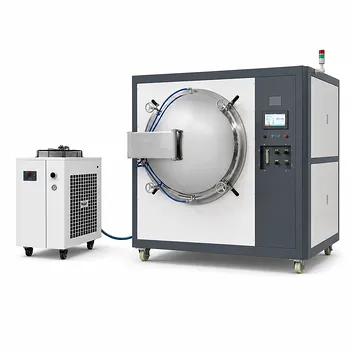
To produce high-density Silicon Carbide (SiC)/Zirconia Toughened Alumina (ZTA) composites, a vacuum hot pressing furnace integrates three critical process conditions: simultaneous high thermal energy, axial mechanical pressure, and a protective vacuum atmosphere.
The core mechanism involves applying axial mechanical pressure (e.g., 40 MPa) directly to the material while it is heated. This pressure acts as the primary driving force for sintering, enabling the composite to achieve full density at temperatures significantly lower than conventional pressureless sintering requires. Simultaneously, the vacuum environment is strictly maintained to prevent the oxidation and decomposition of the non-oxide Silicon Carbide components.
Core Takeaway: Vacuum hot pressing replaces thermal energy with mechanical force as the primary driver for densification. This allows SiC/ZTA composites to reach near-theoretical density without the grain coarsening or chemical degradation that typically occurs at the extreme temperatures required by pressureless sintering.
The Role of Mechanical Pressure
Overcoming Sintering Resistance
Silicon Carbide is inherently difficult to sinter due to its covalent bonding and low self-diffusion coefficients.
A vacuum hot pressing furnace overcomes this by applying uniaxial mechanical pressure alongside heat. This pressure physically forces particle rearrangement and closes pores that thermal energy alone cannot eliminate.
Lowering Thermal Requirements
The application of external pressure significantly reduces the temperature required for densification.
By lowering the processing temperature, the furnace preserves the material's microstructure. This prevents the deleterious effects of extreme heat often required in other methods.
Inhibiting Grain Growth
Achieving high density often comes at the cost of grain growth, which weakens the ceramic.
Because the furnace allows for sintering at lower temperatures, it effectively inhibits abnormal grain growth in the alumina matrix. This results in a fine-grained, nanocrystalline microstructure that exhibits superior mechanical properties.
The Criticality of the Vacuum Environment
Preventing Oxidation and Decomposition
Silicon Carbide is a non-oxide ceramic that is highly susceptible to oxidation at sintering temperatures.
The vacuum environment is essential to prevent the oxidation of SiC particles. Without this protection, the material would decompose, compromising the phase composition and structural integrity of the final composite.
Purifying Grain Boundaries
Beyond preventing oxidation, the vacuum actively assists in material purification.
The vacuum environment lowers gas resistance within the pores and removes adsorbed gases and volatile impurities. This purification cleans the grain boundaries, ensuring stronger bonding between the SiC and ZTA layers.
Understanding the Trade-offs
Geometry Limitations
The pressure in these furnaces is typically applied axially (uniaxially).
This limits the production capabilities to simple shapes, such as plates or discs. Producing complex, near-net-shape components is generally not possible with this specific method due to the directional nature of the pressure.
Throughput vs. Quality
Vacuum hot pressing is a batch process that prioritizes material quality over volume.
While it produces superior density and mechanical properties, the cycle times are longer and the throughput is lower compared to continuous sintering methods. It is a process optimized for high-performance requirements, not mass commodity production.
Making the Right Choice for Your Goal
When evaluating vacuum hot pressing for SiC/ZTA composites, align the process capabilities with your specific engineering targets:
- If your primary focus is Maximum Density: The combination of axial pressure and vacuum is the most reliable method to eliminate porosity in difficult-to-sinter SiC composites.
- If your primary focus is Microstructural Control: The ability to sinter at lower temperatures is critical for maintaining fine grain sizes and maximizing fracture toughness.
- If your primary focus is Chemical Stability: The vacuum atmosphere is non-negotiable to prevent the degradation of non-oxide components like SiC.
By leveraging mechanical pressure to lower thermal stress, this process delivers the optimal balance of density, purity, and strength.
Summary Table:
| Process Condition | Role in SiC/ZTA Production | Key Benefit |
|---|---|---|
| Axial Mechanical Pressure | Acts as the primary driving force for densification. | Enables full density at lower temperatures. |
| Vacuum Atmosphere | Prevents oxidation and removes volatile impurities. | Protects SiC stability and purifies grain boundaries. |
| Thermal Energy | Provides the heat necessary for particle bonding. | Maintains fine-grained microstructure without coarsening. |
| Sintering Mechanism | Replaces high heat with mechanical force. | Inhibits grain growth and prevents chemical degradation. |
Elevate your material synthesis with KINTEK’s precision vacuum hot pressing furnaces. Specializing in advanced laboratory equipment, KINTEK provides high-performance solutions for high-temperature and high-pressure research. Whether you are developing SiC/ZTA composites or exploring battery research, our range of vacuum furnaces, crushing systems, and hydraulic presses ensures near-theoretical density and optimal microstructural control for your ceramics. Contact us today to find the perfect solution for your lab!
Related Products
- Vacuum Hot Press Furnace Heated Vacuum Press Machine Tube Furnace
- 600T Vacuum Induction Hot Press Furnace for Heat Treat and Sintering
- Vacuum Hot Press Furnace Machine Heated Vacuum Press
- Vacuum Hot Press Furnace Machine for Lamination and Heating
- Vacuum Heat Treat and Pressure Sintering Furnace for High Temperature Applications
People Also Ask
- What advantages does a vacuum hot press furnace provide for LSLBO ceramic electrolytes? Achieve 94% Relative Density
- What role does a Vacuum Hot Press (VHP) furnace play in the densification of austenitic stainless steel 316 composites?
- What are the advantages of using a vacuum hot pressing furnace? Superior Densification for 2024Al/Gr/SiC Composites
- What are the advantages of a vacuum hot press furnace for LTPO solid electrolytes? Boost Density and Conductivity
- What core processing conditions does a vacuum hot press furnace provide? Achieve High-Density Cu-SiC/Diamond Composites