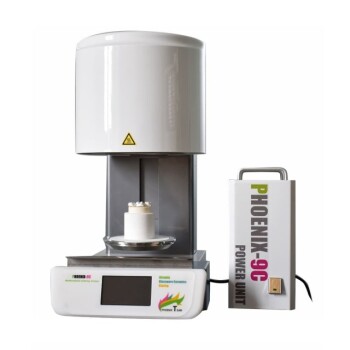
Beyond simple material curing, the critical physical effect provided by the sintering furnace is the controlled shrinkage of the external reinforcement layer.
As the furnace heats the composite ceramic tube, the outer Oxide Ceramic Matrix Composite (OCMC) layer contracts, applying a predetermined radial compressive stress to the internal dense ceramic tube and the metal heating layer. This process effectively "shrink-wraps" the inner components, creating a mechanically pre-stressed structure before the unit ever sees operational use.
Core Insight Sintering is not a passive hardening process; it is an active mechanical assembly technique. By utilizing the natural shrinkage of the outer layer, the manufacturing process engineers a compressive pre-stress state that fundamentally alters how the ceramic withstands forces, transforming a brittle material into a robust composite system.
The Mechanism of Induced Compression
Controlled Shrinkage
During the sintering phase, the external OCMC layer is subjected to precise thermal conditions that force it to contract.
This is not accidental deformation; it is a calculated reduction in volume designed to interact with the layers beneath it.
Radial Compressive Stress
Because the external layer shrinks around the internal dense ceramic tube and metal heating layer, it exerts a squeezing force inward.
This generates a permanent radial compressive stress on the internal components, locking them together under pressure.
Why Pre-Stress Improves Performance
Leveraging Ceramic Properties
Ceramic materials possess a distinct mechanical asymmetry: they are significantly stronger under compression (being squeezed) than under tension (being pulled apart).
By pre-loading the ceramic components with compressive stress, the design plays to the material's inherent strengths while shielding it from its weaknesses.
Offsetting Operational Loads
When the tube is in operation, high temperatures cause materials to expand, which typically generates dangerous tensile forces that can crack ceramics.
The pre-existing compressive stress acts as a buffer. As the tube heats up and attempts to expand, it must first overcome the "squeeze" applied during sintering, effectively cancelling out the harmful tension and enhancing thermal shock resistance.
Understanding the Engineering Constraints
The Necessity of Precision
While beneficial, this process relies entirely on the shrinkage being "predetermined" and exact.
If the shrinkage is calculated incorrectly or the furnace conditions fluctuate, the compressive force could become excessive, crushing the internal components.
Material Compatibility
The success of this technique depends on the specific interaction between the OCMC layer and the internal layers.
The materials must have compatible thermal expansion coefficients to ensure the pre-stress remains effective throughout the component's lifecycle, rather than relaxing or intensifying unpredictably.
Making the Right Choice for Your Application
To maximize the longevity of ceramic composite components, you must evaluate how the manufacturing process addresses mechanical stress.
- If your primary focus is Thermal Shock Resistance: Prioritize designs where the external reinforcement layer is specifically engineered to induce compressive pre-stress, as this buffers against rapid temperature changes.
- If your primary focus is Mechanical Stability: Ensure the manufacturer controls the sintering shrinkage precisely to lock internal components (like heating layers) firmly in place without crushing them.
By utilizing the physics of sintering shrinkage, engineers turn the brittle nature of ceramics into a predictable, durable asset.
Summary Table:
| Physical Effect | Mechanism | Engineering Benefit |
|---|---|---|
| Controlled Shrinkage | Calculated volume reduction of the OCMC layer | Active mechanical assembly of layers |
| Radial Compressive Stress | Inward "squeezing" force on internal components | Permanent locking of inner layers |
| Mechanical Pre-loading | Pre-stressing the ceramic before operational use | Converts brittle materials into robust systems |
| Thermal Stress Buffering | Offsetting tensile expansion with pre-compression | Significantly enhanced thermal shock resistance |
Elevate Your Material Engineering with KINTEK Precision
At KINTEK, we understand that sintering is an active mechanical process, not just a heating stage. Our advanced range of high-temperature furnaces (muffle, tube, vacuum, and atmosphere) and CVD/PECVD systems provides the precise thermal control necessary to engineer predictable shrinkage and compressive pre-stress in your ceramic composites.
Whether you are developing advanced OCMC layers or require high-performance crushing and milling systems or hydraulic presses for your lab, KINTEK offers the comprehensive tools and expert support needed to turn brittle materials into durable assets.
Ready to optimize your manufacturing results? Contact our laboratory specialists today to discover how our specialized equipment can enhance your research and production efficiency.
References
- Jörn Matthies, Ulrich Nieken. Electrically Heated Oxide Ceramic Tubes for High Temperature Reactions. DOI: 10.1002/cite.202200186
This article is also based on technical information from Kintek Solution Knowledge Base .
Related Products
- Vacuum Heat Treat and Sintering Furnace with 9MPa Air Pressure
- Spark Plasma Sintering Furnace SPS Furnace
- Vacuum Heat Treat and Molybdenum Wire Sintering Furnace for Vacuum Sintering
- Small Vacuum Heat Treat and Tungsten Wire Sintering Furnace
- Dental Porcelain Zirconia Sintering Ceramic Vacuum Press Furnace
People Also Ask
- What is the process of pressure sintering? Achieve Superior Density and Strength for High-Performance Parts
- What is the effect of pressure during sintering? Achieve Higher Density and Finer Microstructures Faster
- Why must green bodies produced via binder jetting undergo treatment in a vacuum sintering furnace?
- What is a vacuum sintering furnace? Unlock Purity and Performance in Advanced Materials
- How does the vacuum environment impact sintering of diamond-copper composites? Protect Against Thermal Damage