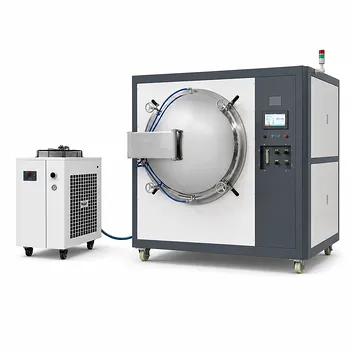
To produce high-density VC/Cu (Vanadium Carbide/Copper) composites, a vacuum hot pressing sintering furnace provides the critical simultaneous application of high thermal energy (specifically around 950°C) and external mechanical pressure (such as 3 MPa). This combination creates an environment that drives atomic diffusion while physically forcing particle rearrangement, ensuring densification that thermal sintering alone cannot achieve.
The Core Takeaway Achieving high density in VC/Cu composites requires more than just heat; it requires the dual action of thermal diffusion and mechanical force. By applying pressure during the sintering phase, the furnace eliminates the large pores that naturally form between particles, resulting in a relative density of up to 94.0% and a fine-grained microstructure.
The Mechanism of Dual-Action Densification
To understand why this equipment is necessary, you must look beyond the temperature settings and understand the physics occurring at the particle level.
Thermal Energy and Atomic Diffusion
The furnace establishes a high-temperature environment, typically reaching 950°C.
At this thermal level, the atoms within the copper and vanadium carbide begin to vibrate and move more freely. This promotes atomic diffusion, the process where atoms migrate across grain boundaries to bond the materials together. However, for VC/Cu composites, heat alone is often insufficient to close the largest gaps between particles.
Mechanical Pressure and Plastic Sliding
The defining feature of this process is the application of external pressure (e.g., 3 MPa) simultaneously with the heat.
While heat starts the bonding process, the physical pressure forces plastic sliding between the powder particles. This mechanical force physically pushes the particles into voids and gaps. It effectively eliminates the large pores that diffusion alone cannot close, ensuring the material reaches a high structural integrity.
Resulting Microstructure
The combination of these forces allows for densification at lower temperatures than would be required for pressureless sintering.
This lower temperature profile is critical because it restricts grain growth. The result is a fine-grained microstructure, which generally correlates with superior mechanical properties in the final composite.
The Critical Role of the Vacuum Environment
Beyond heat and pressure, the "vacuum" component of the furnace plays two essential roles in processing VC/Cu composites.
Enhancing Wettability
In a standard atmosphere, liquid copper does not easily spread over ceramic particles like Vanadium Carbide (VC).
The vacuum environment significantly improves the wettability between the two phases. Specifically, the wetting angle between VC particles and liquid copper can improve to approximately 40 degrees in a vacuum. This allows the copper to flow more easily around the VC particles, filling microscopic voids.
Preventing Matrix Oxidation
Copper and Vanadium Carbide are susceptible to oxidation at high processing temperatures.
A controlled vacuum environment removes oxygen from the chamber. This prevents the formation of oxide layers that would otherwise weaken the bond between the copper matrix and the VC reinforcement. It ensures a clean, strong interfacial bond between the components.
Understanding the Trade-offs
While vacuum hot pressing is superior for density, it introduces specific constraints you must account for.
Process Complexity vs. Throughput
This is a batch process, not a continuous one.
Because the furnace must cycle through vacuum creation, heating, pressing, and cooling for each batch, production speed is significantly lower than conventional sintering. It is a high-precision method, not a high-volume one.
Geometric Limitations
The application of uniaxial pressure generally limits part geometry.
The force is typically applied in one direction (top-down). This makes the process ideal for simple shapes like plates or discs but unsuitable for complex, net-shape components with undercuts or intricate internal features.
Making the Right Choice for Your Goal
Vacuum hot pressing is not a universal solution, but it is the definitive solution for specific material challenges.
- If your primary focus is Maximum Density: Use this process to achieve relative densities up to 94.0% by eliminating large pores through mechanical pressure.
- If your primary focus is Microstructural Integrity: Rely on this method to maintain a fine-grained structure by sintering at lower temperatures (950°C) than pressureless alternatives.
- If your primary focus is Interfacial Strength: The vacuum environment is non-negotiable to prevent oxidation and ensure the copper matrix properly wets the VC particles.
Ultimately, use vacuum hot pressing when the performance cost of porosity outweighs the operational cost of the equipment.
Summary Table:
| Condition | Parameter | Critical Role in VC/Cu Production |
|---|---|---|
| Sintering Temperature | 950°C | Promotes atomic diffusion and bonding between phases. |
| Mechanical Pressure | ~3 MPa | Drives plastic sliding to eliminate large pores and voids. |
| Atmosphere | Vacuum | Improves wettability (40° angle) and prevents matrix oxidation. |
| Microstructure | Fine-grained | Lower temp limits grain growth for superior mechanical properties. |
| Density Goal | Up to 94.0% | Achieved through simultaneous thermal and mechanical action. |
Elevate Your Material Performance with KINTEK
Precision in sintering is the difference between failure and high-performance structural integrity. KINTEK specializes in advanced laboratory equipment, providing the high-temperature vacuum hot pressing furnaces, crushing and milling systems, and hydraulic presses necessary to master VC/Cu composite production.
Whether you require high-temperature high-pressure reactors, specialized ceramics and crucibles, or precise cooling solutions, our expertise ensures your research and production meet the highest density and microstructural standards.
Ready to optimize your sintering process? Contact our technical experts today to find the perfect equipment solution for your laboratory's needs.
Related Products
- 600T Vacuum Induction Hot Press Furnace for Heat Treat and Sintering
- Vacuum Heat Treat and Pressure Sintering Furnace for High Temperature Applications
- Vacuum Heat Treat and Sintering Furnace with 9MPa Air Pressure
- Vacuum Hot Press Furnace Heated Vacuum Press Machine Tube Furnace
- Vacuum Hot Press Furnace Machine Heated Vacuum Press
People Also Ask
- What role does an induction vacuum hot pressing furnace play in sintering? Achieve 98% Density in Carbide Blocks
- What advantages does a vacuum hot press furnace provide for LSLBO ceramic electrolytes? Achieve 94% Relative Density
- What role does a Vacuum Hot Press (VHP) furnace play in the densification of austenitic stainless steel 316 composites?
- What are the advantages of a vacuum hot press furnace for W-50%Cu? Achieve 99.6% Density at Lower Temperatures
- What role does mechanical pressure play during the vacuum diffusion bonding of tungsten and copper? Keys to Solid Bonding