Knowledge What does carbon coating do? Enhance Battery Performance with a Multifunctional Layer
Author avatar

Tech Team · Kintek Solution

Updated 5 days ago

What does carbon coating do? Enhance Battery Performance with a Multifunctional Layer


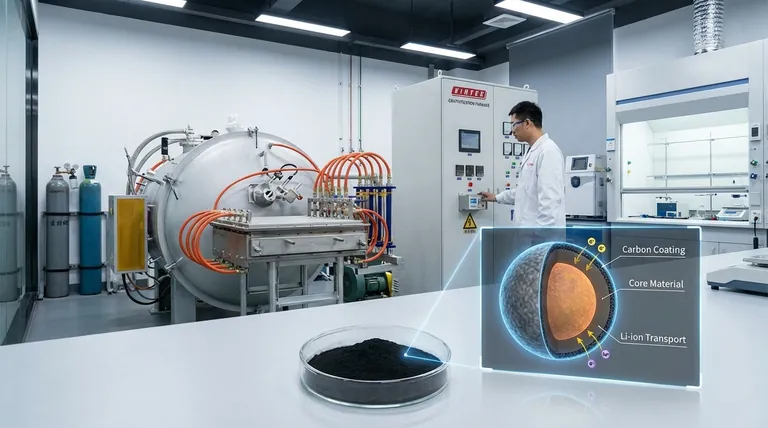
In materials science, a carbon coating is not merely a passive layer but an active component designed to solve several fundamental problems at once. It fundamentally improves a material's performance by enhancing its chemical stability, reinforcing its physical structure, and boosting its ability to transport ions and electrons.

A carbon coating acts as a multifunctional interface. It simultaneously protects the core material from unwanted chemical reactions, holds it together during physical stress, and creates a conductive highway for energy transfer, but its benefits must be balanced against its inherent trade-offs.
What does carbon coating do? Enhance Battery Performance with a Multifunctional Layer

The Core Functions of a Carbon Coating

At its heart, carbon coating is a strategy to compensate for the inherent weaknesses of many high-performance materials, particularly within batteries. It addresses three critical areas.

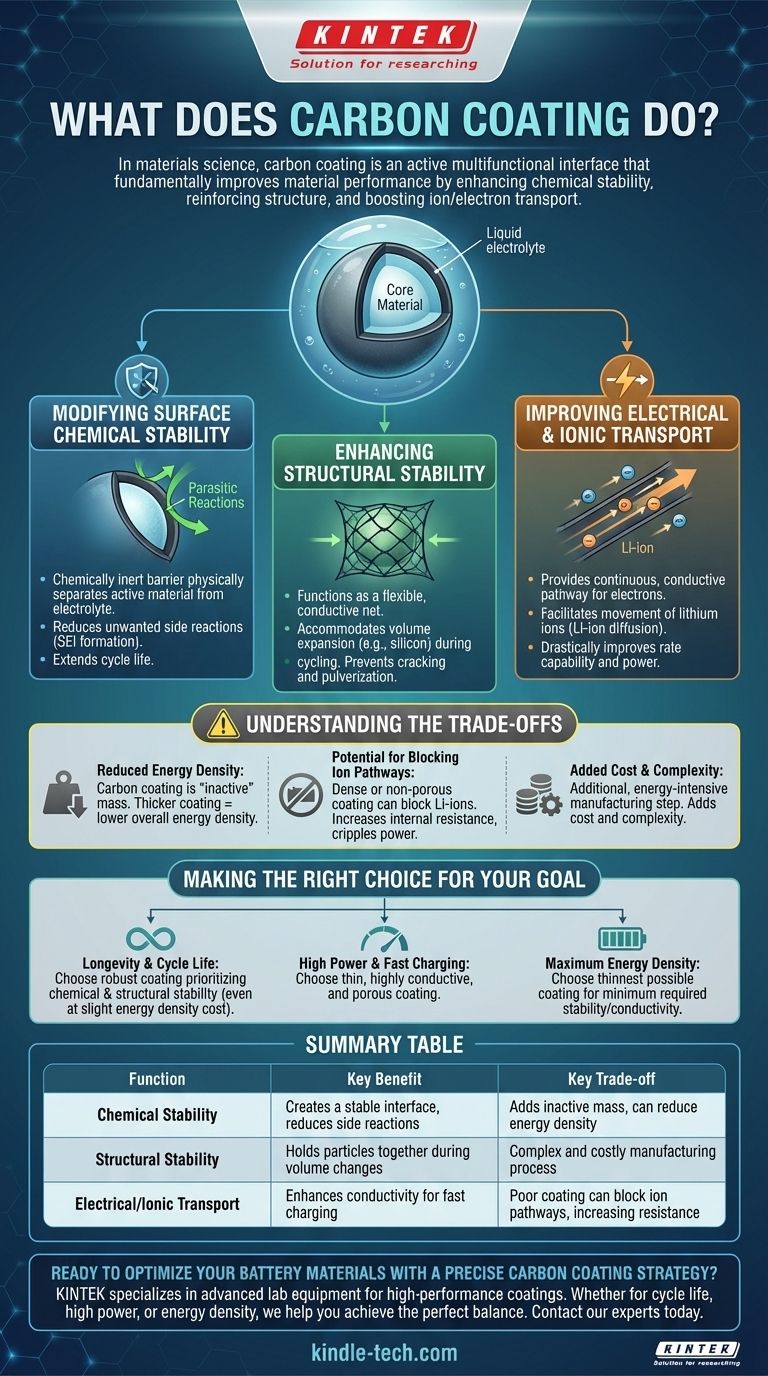
Modifying Surface Chemical Stability

Many advanced electrode materials are highly reactive with the liquid electrolyte inside a battery.

This reactivity leads to unwanted side reactions, forming an unstable layer known as the Solid Electrolyte Interphase (SEI). An unstable SEI consumes active lithium and degrades battery life.

A carbon coating acts as a chemically inert barrier, physically separating the active material from the electrolyte. This creates a more stable and controlled interface, dramatically reducing parasitic reactions and extending the material's cycle life.

Enhancing Structural Stability

Certain high-capacity materials, like silicon or metal oxides, undergo massive volume expansion and contraction during charging and discharging.

This repeated stress can cause the material particles to crack, pulverize, and lose electrical contact with the rest of the electrode, leading to rapid capacity fade.

The carbon coating functions like a flexible, conductive net. It mechanically holds the particles together, accommodates the volume changes, and ensures the electrical pathways remain intact even after hundreds of cycles.

Improving Electrical and Ionic Transport

Many promising battery materials are poor electrical conductors, essentially acting as insulators. This limits how quickly a battery can charge and discharge.

Carbon, in forms like amorphous carbon or graphite, is an excellent electrical conductor. The coating provides a continuous, conductive pathway for electrons to reach the active material, drastically improving the rate capability, or power output.

Furthermore, a well-designed porous carbon coating can facilitate the movement of lithium ions (Li-ion diffusion) from the electrolyte to the surface of the active material, ensuring the entire particle is utilized efficiently.

Understanding the Trade-offs

While highly effective, applying a carbon coating is a delicate balancing act with clear downsides if implemented incorrectly.

Reduced Energy Density

The carbon coating itself does not store energy. It is considered an "inactive" component.

Every bit of mass dedicated to the coating is mass that is not being used by the "active" energy-storing material. An overly thick coating will increase stability but will reduce the battery's overall energy density (the amount of energy stored per unit of weight or volume).

Potential for Blocking Ion Pathways

The primary goal is to improve performance, but a poor coating can do the opposite.

If the carbon layer is too dense or non-porous, it can act as a barrier that physically blocks lithium ions from reaching the active material. This increases internal resistance and cripples the battery's power performance.

Added Cost and Complexity

Applying a uniform, high-quality carbon coating is an additional, energy-intensive step in the manufacturing process.

This inevitably adds cost and complexity, which must be justified by a significant improvement in performance and lifespan.

Making the Right Choice for Your Goal

The ideal carbon coating strategy depends entirely on the primary performance target for the material.

  • If your primary focus is longevity and cycle life: A robust coating that prioritizes chemical and structural stability is the correct choice, even at a slight cost to energy density.
  • If your primary focus is high power and fast charging: The key is a thin, highly conductive, and porous coating that maximizes electron and ion transport.
  • If your primary focus is maximum energy density: You must use the thinnest possible coating that still provides the minimum required stability and conductivity to avoid excessive "dead weight."

Ultimately, carbon coating is a powerful tool for unlocking the potential of next-generation materials by turning their inherent weaknesses into strengths.

Summary Table:

Function Key Benefit Key Trade-off
Chemical Stability Creates a stable interface, reduces side reactions Adds inactive mass, can reduce energy density
Structural Stability Holds particles together during volume changes Complex and costly manufacturing process
Electrical/Ionic Transport Enhances conductivity for fast charging/discharging Poor coating can block ion pathways, increasing resistance

Ready to optimize your battery materials with a precise carbon coating strategy?

At KINTEK, we specialize in providing the advanced lab equipment and consumables needed for developing and testing high-performance coatings. Whether your goal is maximizing cycle life, achieving high power, or optimizing energy density, our solutions can help you achieve the perfect balance.

Contact our experts today via our Contact Form to discuss how we can support your research and development in materials science.

Visual Guide
What does carbon coating do? Enhance Battery Performance with a Multifunctional Layer Visual Guide

Related Products

People Also Ask

Related Products

Graphite Vacuum Continuous Graphitization Furnace

Graphite Vacuum Continuous Graphitization Furnace

High-temperature graphitization furnace is a professional equipment for graphitization treatment of carbon materials. It is a key equipment for the production of high-quality graphite products. It has high temperature, high efficiency and uniform heating. It is suitable for various high-temperature treatments and graphitization treatments. It is widely used in metallurgy, electronics, aerospace, etc. industry.

Vertical High Temperature Graphite Vacuum Graphitization Furnace

Vertical High Temperature Graphite Vacuum Graphitization Furnace

Vertical high temperature graphitization furnace for carbonization and graphitization of carbon materials up to 3100℃.Suitable for shaped graphitization of carbon fiber filaments and other materials sintered in a carbon environment.Applications in metallurgy, electronics, and aerospace for producing high-quality graphite products like electrodes and crucibles.

Ultra-High Temperature Graphite Vacuum Graphitization Furnace

Ultra-High Temperature Graphite Vacuum Graphitization Furnace

The ultra-high temperature graphitization furnace utilizes medium frequency induction heating in a vacuum or inert gas environment. The induction coil generates an alternating magnetic field, inducing eddy currents in the graphite crucible, which heats up and radiates heat to the workpiece, bringing it to the desired temperature. This furnace is primarily used for graphitization and sintering of carbon materials, carbon fiber materials, and other composite materials.

Customer Made Versatile CVD Tube Furnace Chemical Vapor Deposition Chamber System Equipment

Customer Made Versatile CVD Tube Furnace Chemical Vapor Deposition Chamber System Equipment

Get your exclusive CVD furnace with KT-CTF16 Customer Made Versatile Furnace. Customizable sliding, rotating, and tilting functions for precise reactions. Order now!

1200℃ Split Tube Furnace with Quartz Tube Laboratory Tubular Furnace

1200℃ Split Tube Furnace with Quartz Tube Laboratory Tubular Furnace

KT-TF12 split tube furnace: high-purity insulation, embedded heating wire coils, and max. 1200C. Widely used for new materials and chemical vapour deposition.

Split Chamber CVD Tube Furnace with Vacuum Station Chemical Vapor Deposition System Equipment Machine

Split Chamber CVD Tube Furnace with Vacuum Station Chemical Vapor Deposition System Equipment Machine

Efficient split chamber CVD furnace with vacuum station for intuitive sample checking and quick cooling. Up to 1200℃ max temperature with accurate MFC mass flowmeter control.

Laboratory Quartz Tube Furnace Tubular RTP Heating Furnace

Laboratory Quartz Tube Furnace Tubular RTP Heating Furnace

Get lightning-fast heating with our RTP Rapid Heating Tube Furnace. Designed for precise, high-speed heating and cooling with convenient sliding rail and TFT touch screen controller. Order now for ideal thermal processing!

High Temperature Muffle Oven Furnace for Laboratory Debinding and Pre Sintering

High Temperature Muffle Oven Furnace for Laboratory Debinding and Pre Sintering

KT-MD High temperature debinding and pre-sintering furnace for ceramic materials with various molding processes. Ideal for electronic components such as MLCC and NFC.

1700℃ Laboratory Quartz Tube Furnace with Alumina Tube Tubular Furnace

1700℃ Laboratory Quartz Tube Furnace with Alumina Tube Tubular Furnace

Looking for a high-temperature tube furnace? Check out our 1700℃ Tube Furnace with Alumina Tube. Perfect for research and industrial applications up to 1700C.

Vertical Laboratory Quartz Tube Furnace Tubular Furnace

Vertical Laboratory Quartz Tube Furnace Tubular Furnace

Elevate your experiments with our Vertical Tube Furnace. Versatile design allows for operation under various environments and heat treatment applications. Order now for precise results!

1400℃ Laboratory Quartz Tube Furnace with Alumina Tube Tubular Furnace

1400℃ Laboratory Quartz Tube Furnace with Alumina Tube Tubular Furnace

Looking for a tube furnace for high-temperature applications? Our 1400℃ Tube Furnace with Alumina Tube is perfect for research and industrial use.

1800℃ Muffle Oven Furnace for Laboratory

1800℃ Muffle Oven Furnace for Laboratory

KT-18 muffle furnace with Japan Al2O3 polycrystalline fibe and Silicon Molybdenum heating element, up to 1900℃, PID temperature control and 7" smart touch screen. Compact design, low heat loss, and high energy efficiency. Safety interlock system and versatile functions.

1700℃ Muffle Oven Furnace for Laboratory

1700℃ Muffle Oven Furnace for Laboratory

Get superior heat control with our 1700℃ Muffle Furnace. Equipped with intelligent temperature microprocessor, TFT touch screen controller & advanced insulation materials for precise heating up to 1700C. Order now!

Vacuum Induction Melting Spinning System Arc Melting Furnace

Vacuum Induction Melting Spinning System Arc Melting Furnace

Develop metastable materials with ease using our Vacuum Melt Spinning System. Ideal for research and experimental work with amorphous and microcrystalline materials. Order now for effective results.

Electric Rotary Kiln Small Rotary Furnace for Activated Carbon Regeneration

Electric Rotary Kiln Small Rotary Furnace for Activated Carbon Regeneration

Revitalize your activated carbon with KinTek's Electric Regeneration Furnace. Achieve efficient and cost-effective regeneration with our highly automated rotary kiln and intelligent thermal controller.

Laboratory Vacuum Tilt Rotary Tube Furnace Rotating Tube Furnace

Laboratory Vacuum Tilt Rotary Tube Furnace Rotating Tube Furnace

Discover the versatility of Laboratory Rotary Furnace: Ideal for calcination, drying, sintering, and high-temperature reactions. Adjustable rotating and tilting functions for optimal heating. Suitable for vacuum and controlled atmosphere environments. Learn more now!

Vacuum Sealed Continuous Working Rotary Tube Furnace Rotating Tube Furnace

Vacuum Sealed Continuous Working Rotary Tube Furnace Rotating Tube Furnace

Experience efficient material processing with our vacuum-sealed rotary tube furnace. Perfect for experiments or industrial production, equipped with optional features for controlled feeding and optimized results. Order now.

1400℃ Controlled Atmosphere Furnace with Nitrogen and Inert Atmosphere

1400℃ Controlled Atmosphere Furnace with Nitrogen and Inert Atmosphere

Achieve precise heat treatment with KT-14A controlled atmosphere furnace. Vacuum sealed with a smart controller, it's ideal for lab and industrial use up to 1400℃.

1200℃ Controlled Atmosphere Furnace Nitrogen Inert Atmosphere Furnace

1200℃ Controlled Atmosphere Furnace Nitrogen Inert Atmosphere Furnace

Discover our KT-12A Pro Controlled atmosphere furnace - high precision, heavy duty vacuum chamber, versatile smart touch screen controller, and excellent temperature uniformity up to 1200C. Ideal for both laboratory and industrial application.

Vacuum Heat Treat Sintering Brazing Furnace

Vacuum Heat Treat Sintering Brazing Furnace

A vacuum brazing furnace is a type of industrial furnace used for brazing, a metalworking process that joins two pieces of metal using a filler metal that melts at a lower temperature than the base metals. Vacuum brazing furnaces are typically used for high-quality applications where a strong, clean joint is required.


Leave Your Message