The primary equipment used for the heat treatment of steel is the industrial furnace. These furnaces come in a wide range of types and sizes, but they can be broadly categorized into batch furnaces, which process one load at a time, and continuous furnaces, designed for high-volume production. The specific furnace chosen depends entirely on the metallurgical process required (such as annealing or hardening), the size and shape of the steel parts, and the required production throughput.
Choosing the right heat treatment equipment is less about the furnace type itself and more about matching the equipment's capabilities—such as its processing environment, size, and heating method—to the desired metallurgical outcome and production scale.
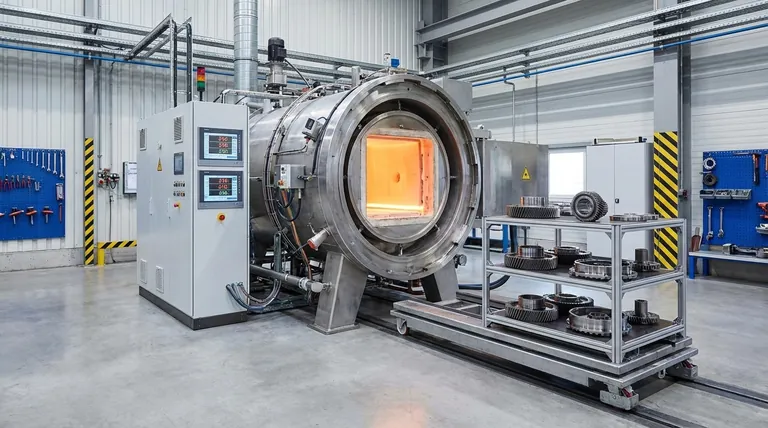
Batch Furnaces: The Workhorses of Heat Treatment
Batch furnaces are the most common type of heat treatment equipment due to their flexibility. They are ideal for handling a wide variety of part shapes, sizes, and batch quantities, making them suitable for job shops and operations with diverse needs.
Box-Type Furnace
This is the most general-purpose furnace. It features a simple chamber with a single door for loading and unloading parts, making it a versatile and common choice for a wide range of heat treatment processes.
Bogie-Hearth Furnace
Also known as a car bottom furnace, this design is used for treating extremely large or heavy steel components. The furnace floor (the "bogie" or "hearth") is mounted on wheels and can be rolled out of the chamber for easy loading and unloading with an overhead crane.
Muffle Furnace
A muffle furnace uses a special ceramic tube or "muffle" to isolate the steel parts from direct flame and combustion gases. This creates a controlled atmosphere, which is critical for processes where surface chemistry must be protected. Due to their typically smaller size, they are often used in laboratories for testing or for treating small, high-value parts.
Pit Furnace
As the name suggests, these are vertical furnaces constructed in a pit below floor level. They are ideal for heat treating long, slender parts like shafts, tubes, and rods, which can be suspended vertically to minimize distortion during heating.
Bell Furnace
This design consists of a stationary base and a removable cover, or "bell." Parts are stacked on the base, and the furnace bell is lowered over them. This configuration is efficient for treating large coils of steel wire or stacked sheets.
Specialized Furnaces for Specific Processes
Beyond the general-purpose batch furnaces, several types of equipment are designed around a specific heating medium or process, offering unique advantages for certain applications.
Salt Bath Furnaces
In these furnaces, steel parts are immersed in a bath of molten salt, which serves as the heat transfer medium. This method provides extremely rapid and uniform heating, minimizing part distortion and protecting the surface from oxidation.
Fluidized-Bed Furnaces
These furnaces use a bed of fine, sand-like particles (such as aluminum oxide) that are "fluidized" by a flow of hot gas from below. When parts are placed in this bed, they are heated quickly and evenly, similar to a liquid bath but without the potential for salt drag-out on the parts.
Vacuum Furnaces
Vacuum furnaces are essential for high-performance applications where surface integrity is paramount. By heating the steel in a vacuum, the process prevents all surface reactions, such as oxidation and decarburization. This results in bright, clean parts with superior mechanical and chemical properties, making it a common choice for aerospace and medical components.
Understanding the Key Trade-offs
Selecting the right equipment involves balancing process requirements, production volume, and cost. Understanding these trade-offs is crucial for making an informed decision.
Batch vs. Continuous Processing
Batch furnaces offer maximum flexibility for low-volume, high-mix production. Continuous furnaces, which move parts through various heating and cooling zones on a conveyor, are built for high-volume, standardized production where efficiency and consistency are the primary goals.
Atmosphere Control
The furnace's atmosphere is a critical process variable. An uncontrolled atmosphere (air) will cause scale and oxidation. Controlled atmospheres, like those in a muffle or vacuum furnace, protect the steel's surface or can even be used to intentionally alter it, as in carburizing.
Heating Method and Uniformity
The way heat is transferred to the part affects the outcome. Direct-fired furnaces are simple, but indirect heating or immersion in a salt or fluidized bed provides superior temperature uniformity. This uniformity is critical for preventing internal stresses and distortion in complex parts.
Making the Right Choice for Your Application
Your choice of equipment should always be driven by the final properties you need in the steel component and your operational constraints.
- If your primary focus is low-volume production or treating varied parts: A box furnace offers the most flexibility for general-purpose work.
- If your primary focus is treating long, slender parts prone to distortion: A pit furnace is the ideal choice to maintain straightness.
- If your primary focus is maximum surface quality and performance: A vacuum furnace is essential to prevent oxidation and achieve precise results.
- If your primary focus is high-volume, standardized production: You should investigate continuous furnace systems, which are optimized for efficiency at scale.
Ultimately, the equipment serves the metallurgical process, and understanding this relationship is key to achieving the desired properties in your steel components.
Summary Table:
| Furnace Type | Best For | Key Feature |
|---|---|---|
| Box Furnace | General-purpose, low-volume, varied parts | Maximum flexibility, simple chamber |
| Bogie-Hearth Furnace | Extremely large or heavy components | Roll-out hearth for easy crane loading |
| Pit Furnace | Long, slender parts (shafts, tubes) | Vertical orientation minimizes distortion |
| Vacuum Furnace | High-performance applications (aerospace, medical) | Prevents oxidation, ensures superior surface quality |
| Salt Bath Furnace | Rapid, uniform heating with minimal distortion | Molten salt medium for excellent heat transfer |
Achieve precise metallurgical outcomes for your steel components.
The right heat treatment equipment is critical to the performance and quality of your steel parts. KINTEK specializes in lab equipment and consumables, serving laboratory needs with a range of industrial furnaces. Our experts can help you select the perfect furnace—whether a versatile box furnace for R&D or a high-performance vacuum furnace for critical applications—to ensure your process meets exact specifications.
Contact us today to discuss your heat treatment requirements and discover how KINTEK's solutions can enhance your lab's efficiency and results.
Visual Guide

Related Products
- 600T Vacuum Induction Hot Press Furnace for Heat Treat and Sintering
- Vacuum Heat Treat Sintering Brazing Furnace
- 1200℃ Controlled Atmosphere Furnace Nitrogen Inert Atmosphere Furnace
- 1400℃ Controlled Atmosphere Furnace with Nitrogen and Inert Atmosphere
- 1700℃ Controlled Atmosphere Furnace Nitrogen Inert Atmosphere Furnace
People Also Ask
- What role does mechanical pressure play during the vacuum diffusion bonding of tungsten and copper? Keys to Solid Bonding
- What role does a Vacuum Hot Press (VHP) furnace play in the densification of austenitic stainless steel 316 composites?
- Why is a high-precision temperature control system in a vacuum hot press furnace critical? Perfect Cu-Ti3SiC2 Synthesis
- What role does an induction vacuum hot pressing furnace play in sintering? Achieve 98% Density in Carbide Blocks
- What role does the high vacuum environment play in sintering graphite film/aluminum composites? Optimize Your Bonding