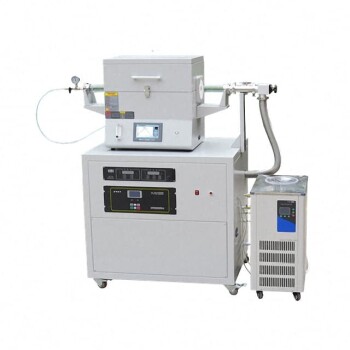
The Chemical Vapor Deposition (CVD) system serves as the primary reactor for growing and securing silicon nanofibers onto an anode substrate. By decomposing gaseous precursors at high temperatures, the system facilitates the precise synthesis of one-dimensional nanostructures that can withstand the mechanical stresses of lithium-ion battery cycling. It simultaneously enables the deposition of protective coatings, such as silicon carbide, which are vital for the structural longevity of the battery.
A CVD system provides the thermal and chemical environment necessary to transform volatile precursors into solid silicon nanofibers fixed to a graphite substrate. This process is essential for creating high-capacity anodes that maintain structural integrity and efficient lithium-ion diffusion pathways through multiple charge-discharge cycles.
The Role of CVD in Nanofiber Synthesis
Precursor Decomposition and VLS Growth
The CVD system introduces volatile precursors into a reaction chamber where they undergo thermally induced chemical reactions. This environment is specifically designed to support the Vapor-Liquid-Solid (VLS) growth mechanism, where a catalyst facilitates the directional growth of well-aligned silicon nanofibers.
Fixing Nanofibers to the Substrate
Unlike simple deposition, a CVD system ensures that the synthesized silicon nanofibers are permanently fixed to a graphite substrate. This secure attachment is critical for electrical conductivity and ensures that the active material does not detach during the physical expansion and contraction of the battery.
Control of Geometric Parameters
Modern CVD equipment allows for the precise regulation of gas flow rates, temperature, and reaction time. This control enables engineers to dictate the length, diameter, and density of the silicon nanofibers, which directly influences the energy density of the resulting anode.
Enhancing Anode Performance and Durability
Formation of Silicon Carbide (SiC) Coatings
During the deposition process, the CVD system facilitates the formation of a silicon carbide (SiC) coating. This layer provides the necessary structural strength to prevent the silicon from pulverizing as it expands during lithiation.
Optimization of Diffusion Channels
The CVD process ensures that silicon nanofibers are arranged to form a large number of diffusion channels. These channels allow lithium ions to move rapidly through the anode structure, maintaining high specific capacity and enabling faster charging rates.
Maintaining Structural Integrity
By controlling the interface between the nanofibers and the substrate, the CVD system mitigates the risk of structural failure. The resulting multicomponent hybrid structures are more resilient than traditional thin films, allowing for a longer battery cycle life.
Understanding the Trade-offs
Technical Complexity and Cost
CVD systems require precise thermal management and sophisticated gas handling equipment, which increases the initial capital investment. The need for high-purity precursor gases also contributes to a higher cost per gram of material compared to mechanical milling methods.
Safety and Environmental Hazards
The precursors used in silicon CVD, such as silane gas, are often pyrophoric or toxic. This necessitates rigorous safety protocols and specialized abatement systems to handle exhaust gases, adding layers of operational complexity.
Throughput Limitations
While CVD offers unparalleled control over nanostructure quality, it can face challenges in mass-production scaling. Achieving uniform deposition across large-area substrates or high-volume batches requires complex reactor designs to avoid variations in nanofiber quality.
Applying CVD Technology to Silicon Anode Development
To successfully integrate CVD technology into your battery material workflow, consider your primary performance objectives.
- If your primary focus is maximizing cycle life: Prioritize the CVD parameters that optimize the thickness and uniformity of the silicon carbide (SiC) structural coating.
- If your primary focus is high-rate performance: Focus on the VLS growth conditions within the CVD system to maximize the density of lithium-ion diffusion channels.
- If your primary focus is cost-effective scaling: Evaluate fluidized bed CVD reactors or continuous-feed systems to increase the throughput of silicon-coated graphite.
The precision of a CVD system is the foundational tool required to transform silicon from a high-expansion liability into a high-performance anode asset.
Summary Table:
| Function | Mechanism | Key Benefit |
|---|---|---|
| Nanofiber synthesis | VLS growth via precursor decomposition | Precise 1D nanostructures for cycling stress |
| Substrate Attachment | Permanent fixation to graphite substrate | Enhanced conductivity and material retention |
| Surface Engineering | In-situ silicon carbide (SiC) coating | Prevents pulverization during lithiation |
| Geometric Control | Precise regulation of gas, temp, and time | Optimized energy density and charging rates |
Elevate Your Battery Material Research with KINTEK
Precision is the key to transforming silicon into a high-performance anode asset. KINTEK specializes in advanced laboratory solutions, offering a comprehensive range of CVD systems (including PECVD and MPCVD) and high-temperature atmosphere furnaces specifically designed for the rigorous demands of nanomaterial synthesis.
Whether you are optimizing VLS growth conditions or developing protective SiC coatings, our portfolio—from battery research tools and consumables to high-pressure reactors and vacuum furnaces—provides the thermal and chemical control you need to achieve breakthrough results.
Ready to scale your synthesis or refine your anode performance? Contact KINTEK today to discover how our high-precision equipment and expert support can accelerate your battery R&D workflow.
References
- L. Li. Advancements in anode and cathode nanomaterials for high-performance Li-ion batteries. DOI: 10.54254/2755-2721/26/20230830
This article is also based on technical information from Kintek Solution Knowledge Base .
Related Products
- Chemical Vapor Deposition CVD Equipment System Chamber Slide PECVD Tube Furnace with Liquid Gasifier PECVD Machine
- Customer Made Versatile CVD Tube Furnace Chemical Vapor Deposition Chamber System Equipment
- HFCVD Machine System Equipment for Drawing Die Nano-Diamond Coating
- Split Chamber CVD Tube Furnace with Vacuum Station Chemical Vapor Deposition System Equipment Machine
- Multi Heating Zones CVD Tube Furnace Machine Chemical Vapor Deposition Chamber System Equipment
People Also Ask
- What are the advantages of chemical vapor deposition? Achieve Superior Thin Films for Your Lab
- What types of substrates are used in CVD to facilitate graphene films? Optimize Graphene Growth with the Right Catalyst
- What is the chemical vapor deposition growth process? Build Superior Thin Films from the Atom Up
- How expensive is chemical vapor deposition? Understanding the True Cost of High-Performance Coating
- Why is Chemical Vapor Deposition (CVD) equipment uniquely suited for constructing hierarchical superhydrophobic structures?