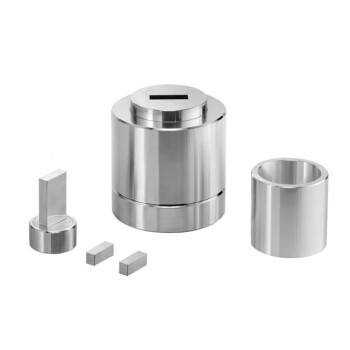
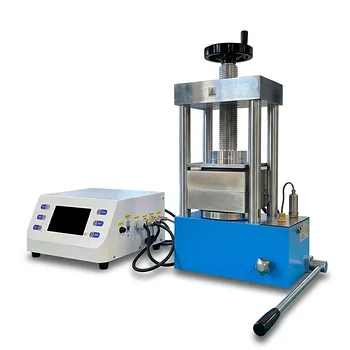
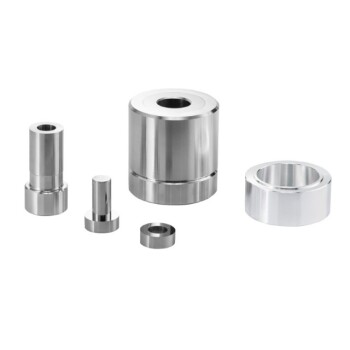
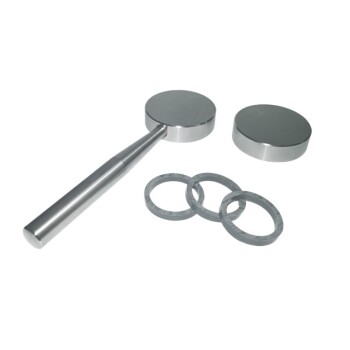
The laboratory hydraulic press is the critical mechanical interface that transforms loose chromium-doped uranium dioxide powder into a structurally sound "green body." By applying precise, uniform axial pressure, the press facilitates particle rearrangement and bonding to establish the specific density and geometric shape required for subsequent processing.
The primary function of the hydraulic press is to eliminate internal density gradients and maximize particle-to-particle contact. This creates the ideal physical foundation for solid-phase diffusion and uniform grain growth during the high-temperature sintering stage.
Achieving Structural Integrity and Uniformity
The press serves as the bridge between raw chemical powders and a manageable solid component.
Eliminating Internal Density Gradients
Precise control of molding pressure is essential to ensure that the density is consistent throughout the entire pellet. Without this uniformity, the pellet is highly susceptible to internal stresses that lead to cracking or deformation during the cooling and heating cycles of sintering. By delivering a stable axial force, the press ensures that the internal structure is homogenous before it ever enters a furnace.
Facilitating Particle Rearrangement and Bonding
Under high pressure, loose powder particles are forced to slide and rotate into a more efficient packing arrangement. This mechanical compression causes inter-particle bonding, providing the green pellet with the preliminary mechanical strength needed for handling and transport. The press essentially converts a bulk powder into a "green body" that maintains its shape without the need for immediate chemical binders.
Optimizing the Sintering Environment
The physical state of the green pellet directly dictates how it will behave during thermal treatment.
Shortening Solid-State Diffusion Paths
High-pressure compaction—often ranging from 10 MPa to 700 MPa depending on the specific material—increases the contact density between particles. This close contact is critical for solid-state reactions, as it significantly shortens the paths that atoms must travel to bond. In chromium-doped UO2, this facilitates the rapid and uniform recombination of phases, which is necessary to achieve the desired refined microstructure.
Promoting Uniform Grain Growth
The press provides the "initial conditions" that allow chromium dopants to effectively manage grain size. By reducing inter-particle porosity and increasing initial packing density, the press enables the solid-phase diffusion required for high-density results. This ensures that the final fuel pellets meet the strict geometric tolerances and structural integrity standards required for nuclear applications.
Understanding the Trade-offs
While high pressure is beneficial, it must be balanced against mechanical and material limitations.
Pressure Sensitivity and Capping
Applying excessive pressure can lead to "capping," where the top of the pellet delaminates due to stored elastic energy. If the pressure is too high, the air trapped between particles may not escape, creating micro-voids that expand and cause structural failure during sintering. Conversely, insufficient pressure results in high residual porosity, leading to a weak final product that fails to meet density specifications.
Mold Wear and Friction
The friction between the powder and the mold walls can cause uneven pressure distribution, especially in taller pellets. This "wall effect" can lead to a density gradient where the center of the pellet is less dense than the ends. High-precision hydraulic systems must be used in conjunction with wall lubricants or specific mold geometries to mitigate these mechanical inconsistencies.
Applying Compaction Principles to Your Process
To achieve the best results with chromium-doped uranium dioxide, the pressing strategy must align with your final density goals.
- If your primary focus is maximizing final density: Utilize higher compaction pressures (near the upper limit of the material's tolerance) to minimize initial porosity and shorten diffusion paths.
- If your primary focus is geometric precision: Prioritize the elimination of density gradients through slower, more controlled pressure application to prevent warping during sintering.
- If your primary focus is microstructural refinement: Ensure uniform particle contact through high-precision axial force to allow chromium dopants to distribute evenly during the solid-phase reaction.
The laboratory hydraulic press is ultimately responsible for setting the "physical blueprint" that determines the success or failure of the subsequent chemical and thermal transformations.
Summary Table:
| Key Function | Mechanical Mechanism | Impact on Sintering & Quality |
|---|---|---|
| Structural Formation | Particle rearrangement & axial bonding | Creates a stable "green body" for handling |
| Density Uniformity | Elimination of internal gradients | Prevents cracking and warping during heating |
| Diffusion Optimization | High-pressure compaction (10-700 MPa) | Shortens solid-state diffusion paths |
| Microstructure Control | Maximizing particle-to-particle contact | Promotes uniform grain growth and phase recombination |
Achieve Precision in Nuclear Material Research with KINTEK
High-performance materials like chromium-doped uranium dioxide demand the highest levels of structural integrity. KINTEK specializes in advanced laboratory solutions designed to meet these rigorous standards. Our high-precision hydraulic presses (pellet, hot, and isostatic) provide the uniform axial force necessary to eliminate density gradients and ensure successful sintering.
Beyond compaction, KINTEK offers a comprehensive ecosystem for material science, including:
- High-Temperature Furnaces: Muffle, tube, and vacuum furnaces for precise sintering.
- Material Processing: Crushing, milling, and sieving systems for powder preparation.
- Advanced Reactors: High-temperature high-pressure reactors and autoclaves.
- Lab Essentials: High-purity ceramics, crucibles, and PTFE consumables.
Ready to optimize your pellet production and achieve superior microstructural refinement? Contact our technical experts today to discuss how our laboratory equipment can enhance your research outcomes.
References
- Gabriel L. Murphy, Nina Huittinen. Deconvoluting Cr states in Cr-doped UO2 nuclear fuels via bulk and single crystal spectroscopic studies. DOI: 10.1038/s41467-023-38109-0
This article is also based on technical information from Kintek Solution Knowledge Base .
Related Products
- Automatic Laboratory Hydraulic Pellet Press Machine for Lab Use
- Laboratory Manual Hydraulic Pellet Press for Lab Use
- Laboratory Manual Hydraulic Pellet Press for Lab Use
- kbr pellet press 2t
- Laboratory Hydraulic Pellet Press for XRF KBR FTIR Lab Applications
People Also Ask
- What is the role of a laboratory hydraulic pellet press and stainless steel molds in the fabrication of RuO2/NbC anodes?
- What role does a laboratory pellet press play in the enhancement of biomass energy products? Optimize Fuel Efficiency
- What is the purpose of using a laboratory pellet press when evaluating the electronic conductivity of carbon powders? Guide
- How does a laboratory hydraulic pellet press contribute to SiCw/2024 aluminum composite preforms? Optimize Densification
- What is the significance of applying 200 MPa of pressure with a laboratory hydraulic pellet press for composite ceramics?