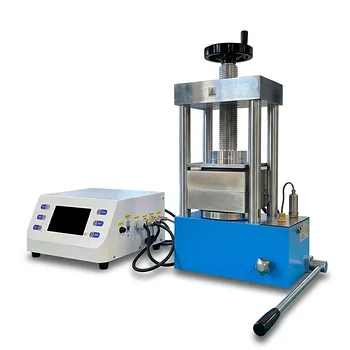
The primary function of a laboratory hydraulic press in nuclear fuel production is the precise compaction of loose powder into a solid form. Specifically, it applies uniform axial pressure to nuclear fuel powder to create a "green body"—a compacted pellet with defined geometry and sufficient mechanical strength to withstand handling before thermal treatment.
Core Takeaway The hydraulic press does more than simply shape the material; it is the primary instrument for controlling internal density. By minimizing density gradients during compaction, the press prevents catastrophic defects like cracking or warping during the subsequent high-temperature sintering process.
The Mechanics of Green Body Formation
The formation stage is the bridge between raw material preparation and the final densification of the fuel. The hydraulic press serves two distinct mechanical functions during this phase.
Geometric Definition and Consolidation
The immediate role of the press is to transform loose nuclear fuel powder into a cohesive unit. By applying axial pressure, the press forces powder particles closer together.
This mechanical compaction increases the contact area between particles. It results in a "green body" that holds a specific shape and possesses enough structural integrity to be moved to a furnace without crumbling.
Minimizing Internal Density Gradients
Achieving a specific shape is secondary to achieving uniform internal density. The primary reference emphasizes that high-precision pressure control is essential here.
If pressure is applied unevenly, the pellet will have areas of high and low density. The hydraulic press must deliver consistent force to ensure the density is homogenous throughout the entire volume of the pellet.
The Critical Link to Sintering Success
The work performed by the hydraulic press dictates the success of the sintering (heating) stage. The physical properties established by the press are permanent; they cannot be corrected once the heating process begins.
Preventing Deformation and Cracking
Sintering involves high temperatures that shrink the pellet as it densifies. If the "green body" formed by the press has uneven density gradients, the pellet will shrink unevenly.
This differential shrinkage causes internal stress. The result is often deformation (warping) or cracking, rendering the fuel pellet unusable. The press prevents this by establishing a uniform starting point.
Ensuring Final Dimensional Tolerances
Nuclear fuel pellets must meet extremely tight geometric tolerances to fit inside fuel rods.
By controlling the initial compaction forces with high precision, the press ensures the final sintered product maintains the required dimensions. It reduces the porosity between particles to a predictable level, ensuring the final structure is both dense and dimensionally accurate.
Common Pitfalls to Avoid
While the hydraulic press is a robust tool, its effectiveness relies on proper application. Understanding the risks of improper pressure application is vital for process integrity.
The Risk of Density Gradients
The most significant risk is the creation of density gradients. This occurs when pressure is not applied uniformly across the axial direction.
A pellet with a dense outer shell and a porous core (or vice versa) will fail during sintering. The press must be calibrated to apply pressure that penetrates the entire depth of the powder bed equally.
Balancing Strength and Integrity
There is a delicate balance between compacting the powder enough to hold its shape and over-compacting it.
Insufficient pressure results in a fragile green body that breaks during handling. However, the focus must remain on uniformity rather than just maximum force. Brute force without precision leads to stress fractures within the green body itself.
Making the Right Choice for Your Goal
The selection and operation of a laboratory hydraulic press should be dictated by the specific quality metrics of your fuel pellet production.
- If your primary focus is Geometric Tolerance: Prioritize a press with high-precision axial pressure control to ensure predictable shrinkage rates during sintering.
- If your primary focus is Structural Integrity: Focus on the uniformity of pressure application to eliminate internal density gradients and prevent cracking.
The hydraulic press is not merely a shaping tool; it is the gatekeeper of quality, determining whether the fuel powder will successfully transform into a viable, high-performance ceramic pellet.
Summary Table:
| Stage of Production | Role of Hydraulic Press | Impact on Final Product |
|---|---|---|
| Powder Consolidation | Transforms loose powder into a cohesive "green body" | Determines initial geometry and mechanical strength |
| Density Control | Eliminates internal density gradients via uniform axial pressure | Prevents warping, deformation, and cracking during sintering |
| Dimensional Accuracy | High-precision compaction force control | Ensures pellets meet strict tolerances for fuel rod insertion |
| Integrity Management | Balances structural strength with particle contact | Minimizes porosity and ensures predictable thermal shrinkage |
Elevate Your Nuclear Material Research with KINTEK
Precision is paramount when dealing with nuclear fuel production. KINTEK specializes in high-performance laboratory equipment, including manual, automatic, and isostatic hydraulic presses designed to eliminate density gradients and ensure the structural integrity of your pellets.
Our comprehensive range of crushing, milling, and high-temperature furnace solutions—including vacuum and atmosphere-controlled systems—provides the end-to-end reliability your lab requires for advanced material science. Whether you are producing nuclear fuel pellets or conducting complex battery research, KINTEK delivers the durability and precision you need.
Ready to optimize your compaction process? Contact our laboratory specialists today to find the perfect hydraulic press and consumables for your research goals.
References
- Daniel de Souza Gomes, Marcelo Ramos Martins. Evaluation of corrosion on the fuel performance of stainless steel cladding. DOI: 10.1051/epjn/2016033
This article is also based on technical information from Kintek Solution Knowledge Base .
Related Products
- Automatic Laboratory Hydraulic Press for XRF & KBR Pellet Press
- Laboratory Hydraulic Pellet Press for XRF KBR FTIR Lab Applications
- Automatic Laboratory Hydraulic Pellet Press Machine for Lab Use
- Laboratory Manual Hydraulic Pellet Press for Lab Use
- Laboratory Hydraulic Press Lab Pellet Press Machine for Glove Box
People Also Ask
- What is the significance of applying 200 MPa of pressure with a laboratory hydraulic pellet press for composite ceramics?
- What is the role of a laboratory hydraulic pellet press and stainless steel molds in the fabrication of RuO2/NbC anodes?
- What is the necessity of using a laboratory hydraulic pellet press in the preparation of biomass fuel pellets? Guide
- How does a laboratory hydraulic pellet press contribute to SiCw/2024 aluminum composite preforms? Optimize Densification
- What role does a laboratory hydraulic pellet press play in fly ash utilization? Enhancing Adsorption and Flow Control