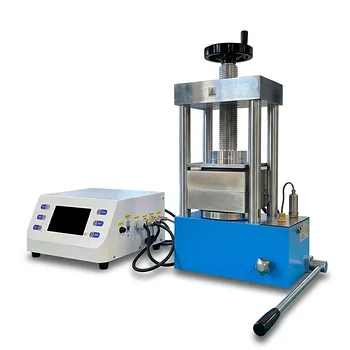
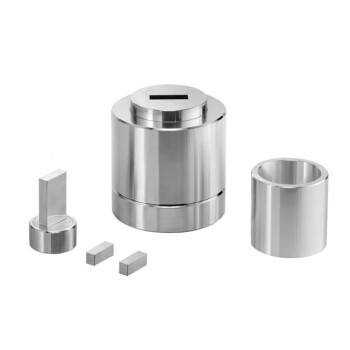
A laboratory hydraulic press functions as the primary consolidation tool in the powder metallurgy process. It works in conjunction with steel molds to apply high mechanical pressure, typically around 42 MPa, to loose boron carbide powder mixtures. This compaction transforms the loose powder into a cohesive "green body" with a specific geometric shape and sufficient structural strength to withstand handling before it enters the sintering furnace.
The hydraulic press serves as the bridge between raw powder and the final ceramic component. By mechanically forcing particle rearrangement, it establishes the initial packing density and physical integrity necessary for the material to survive and succeed in the subsequent high-temperature sintering process.
The Mechanics of Consolidation
Increasing Initial Packing Density
The primary technical objective of the hydraulic press is to drastically reduce the volume of the loose powder. By applying uniaxial pressure, the press forces the boron carbide particles to rearrange and pack tightly together.
This increase in initial packing density is critical. It reduces the distance between particles, establishing the physical contact required for the mass transport mechanisms that occur later during sintering.
Achieving Green Strength
Raw ceramic powder has no structural integrity. The hydraulic press compacts the material until it achieves green strength—the mechanical strength of the un-sintered body.
This strength is indispensable for logistics. It ensures the green body remains intact during ejection from the mold, manual handling, and transfer into the sintering furnace, preventing breakage or crumbling.
Defining Geometric Geometry
The press allows for the production of near-net-shape components. By using specific steel molds, the loose mixed powders are compacted into precise shapes, such as discs or rectangles.
This establishes the final form of the ceramic early in the process, minimizing the need for extensive machining after the material has been hardened by sintering.
The Role in Defect Elimination
Eliminating Macro-Defects
Loose powder often contains air pockets and uneven distributions. The stable pressure of the hydraulic press forces the removal of these macro-defects.
By overcoming mechanical friction between particles, the press creates a uniform structure. This reduces the risk of large voids that could lead to catastrophic failure in the final ceramic part.
Controlling Porosity
While the primary goal is densification, the press also regulates the pore structure. The pressure applied dictates the remaining open porosity within the green body.
In processes involving infiltration (such as infiltrating molten silicon), maintaining a specific network of capillary channels is essential. The hydraulic press ensures these channels remain open and uniform to guide fluid movement.
Understanding the Trade-offs
The Balance of Pressure
Applying pressure is not simply "the higher, the better." While the primary reference cites 42 MPa as a standard for this application, pressures must be calibrated precisely.
Insufficient pressure results in a weak green body that crumbles upon handling. Conversely, excessive pressure can cause density gradients or closed pores that trap gases, leading to defects like bloating or cracking during the sintering phase.
Density Gradients
A common pitfall in uniaxial pressing is uneven density distribution. Friction between the powder and the die walls can cause the edges of the green body to be denser than the center.
This variation can lead to warping or non-uniform shrinkage during sintering. The operation of the hydraulic press must be smooth and controlled to minimize these internal density variations.
Making the Right Choice for Your Goal
To maximize the effectiveness of a laboratory hydraulic press for boron carbide production, align your pressure parameters with your downstream processing needs:
- If your primary focus is Handling and Logistics: Prioritize achieving sufficient green strength (typically via pressures around 42 MPa) to ensure the body can be moved to the furnace without damage.
- If your primary focus is Sintering Density: Focus on maximizing initial packing density to reduce particle gaps, which facilitates faster and more complete densification at high temperatures.
- If your primary focus is Infiltration Processing: Calibrate pressure to maintain specific open porosity (e.g., ~30%) to allow for the smooth capillary action of molten infiltrants.
Ultimately, the laboratory hydraulic press transforms undefined potential into a structured reality, laying the indispensable foundation for a high-performance ceramic product.
Summary Table:
| Function | Description | Key Benefit |
|---|---|---|
| Powder Consolidation | Applies mechanical pressure (e.g., 42 MPa) to loose powder. | Transforms loose powder into a cohesive green body. |
| Densification | Reduces particle distance via uniaxial compression. | Increases initial packing density for better sintering. |
| Shape Formation | Uses steel molds to define specific geometric forms. | Produces near-net-shape components, reducing machining. |
| Defect Removal | Eliminates air pockets and macro-voids. | Ensures a uniform structure and prevents material failure. |
| Porosity Control | Calibrates pressure to maintain capillary channels. | Essential for successful molten silicon infiltration processes. |
Elevate Your Material Research with KINTEK Precision
Precision in the green body stage is the foundation of high-performance ceramics. KINTEK specializes in advanced laboratory equipment designed to meet the rigorous demands of powder metallurgy. Our high-precision manual and automatic hydraulic presses (pellet, hot, and isostatic) ensure uniform density and superior green strength for your boron carbide projects.
From high-temperature furnaces and vacuum systems to specialized crushing and milling equipment, KINTEK provides the comprehensive tools needed for every stage of your research. Partner with us for reliable performance and expert support.
Consult with a KINTEK Specialist Today
Related Products
- Automatic Laboratory Hydraulic Press for XRF & KBR Pellet Press
- Laboratory Hydraulic Press Split Electric Lab Pellet Press
- Automatic Laboratory Hydraulic Pellet Press Machine for Lab Use
- Laboratory Hydraulic Pellet Press for XRF KBR FTIR Lab Applications
- Heated Hydraulic Press Machine with Integrated Manual Heated Plates for Lab Use
People Also Ask
- What is the significance of applying 200 MPa of pressure with a laboratory hydraulic pellet press for composite ceramics?
- What is the role of a laboratory hydraulic pellet press and stainless steel molds in the fabrication of RuO2/NbC anodes?
- What is the necessity of using a laboratory hydraulic pellet press in the preparation of biomass fuel pellets? Guide
- How does a laboratory hydraulic pellet press contribute to SiCw/2024 aluminum composite preforms? Optimize Densification
- What role does a laboratory hydraulic pellet press play in fly ash utilization? Enhancing Adsorption and Flow Control