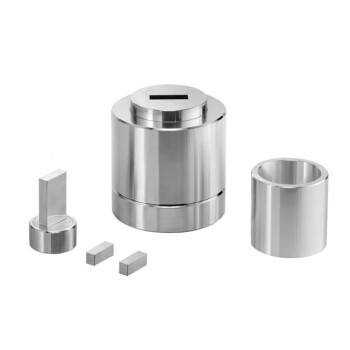
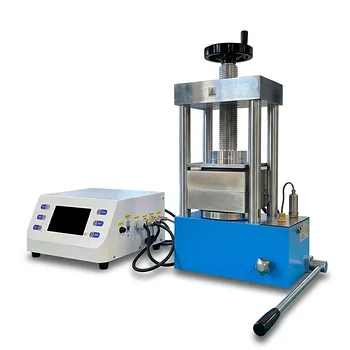
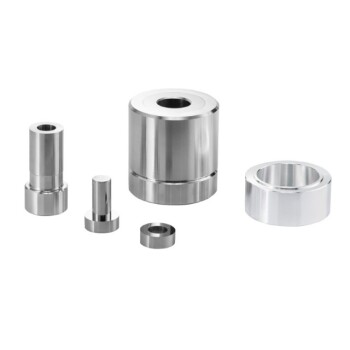
The primary function of this equipment pairing is to execute a high-pressure densification process that transforms loose sulfide powder into a solid, conductive electrolyte layer. A laboratory hydraulic press applies massive uniaxial pressure—often reaching 500 MPa—while high-strength titanium molds contain this force to define the pellet's geometry. This combination is essential for minimizing porosity, maximizing ionic conductivity, and creating a physical barrier strong enough to block lithium dendrites.
Core Takeaway Achieving high performance in solid-state batteries relies on eliminating the voids found in loose powders. The hydraulic press and titanium molds work together to force particles into a tightly packed arrangement, reducing grain boundary resistance and creating a dense shield necessary for safe, efficient ion transport.
The Role of the Hydraulic Press: Densification
Applying Extreme Uniaxial Pressure
The hydraulic press is the engine of the process, capable of delivering forces up to 500 MPa. This extreme pressure is necessary to overcome the natural friction between powder particles.
Eliminating Internal Porosity
Loose sulfide powders naturally contain voids and air gaps. The press compacts the material to achieve relative densities often exceeding 80%. This reduction in porosity is critical for creating a continuous solid rather than a loose aggregate.
Reducing Grain Boundary Resistance
For a battery to function, ions must move freely between particles. High pressure forces particles into intimate contact, significantly lowering grain boundary resistance. This ensures efficient ionic transport throughout the pellet.
Establishing Mechanical Integrity
Pressure transforms fragile powder into a mechanically robust pellet. This structural strength is required not only for handling the material during testing but also for ensuring the electrolyte can withstand internal stresses during battery operation.
The Role of Titanium Molds: Containment and Precision
Withstanding High-Stress Loads
Standard molds may deform or fail under the 500 MPa loads required for sulfide electrolytes. High-strength titanium molds are utilized specifically to maintain structural rigidity and safety under these extreme conditions.
Defining Geometric Precision
The mold confines the powder to specific dimensions. This containment ensures the final pellet has a consistent thickness and diameter, which is vital for calculating conductivity metrics accurately.
Ensuring Surface Flatness
The internal finish of the titanium mold dictates the surface quality of the pellet. A highly precise mold produces a perfectly flat surface, which is essential for establishing tight physical contact between the electrolyte and the lithium metal anode.
Distributing Pressure Uniformly
Titanium molds ensure the force from the press is applied evenly across the entire surface area of the powder. Uniform distribution prevents density gradients, where one part of the pellet is denser (and more conductive) than another.
Critical Impacts on Battery Performance
Inhibiting Lithium Dendrites
One of the deep needs addressed by this equipment is safety. A highly densified pellet acts as a physical barrier against lithium dendrites—metallic spikes that can penetrate porous electrolytes and cause short circuits.
Eliminating Micro-Cracks
Insufficient pressure often leads to surface and internal cracks. The high-pressure capability of this setup forces particles into a locked arrangement, healing potential defects that would otherwise compromise the battery's lifespan.
Understanding the Trade-offs
The Risk of Insufficient Pressure
If the hydraulic press cannot achieve the upper limits of pressure (e.g., stopping at 10-12 MPa used for green pellets rather than 300+ MPa for densification), the electrolyte will remain porous. This results in poor conductivity and high susceptibility to dendrite penetration.
Mold Material Constraints
While titanium is excellent for strength, one must always ensure chemical compatibility. The primary value of titanium here is its high strength-to-weight ratio and ability to resist deformation, ensuring the applied pressure translates directly to densification rather than mold expansion.
Making the Right Choice for Your Goal
To maximize the utility of your hydraulic press and titanium molds, align your process parameters with your specific research objectives:
- If your primary focus is maximizing Ionic Conductivity: Prioritize pressures near the 500 MPa limit to minimize grain boundary resistance and maximize particle-to-particle contact.
- If your primary focus is Interface Stability: Focus on the precision and surface finish of the titanium mold to ensure the flattest possible contact area with the anode.
- If your primary focus is Dendrite Suppression: Ensure your process achieves high relative density (>80%) to eliminate the pore pathways that dendrites typically follow.
The synergy between high-tonnage pressing and precision molding is the deciding factor in converting raw sulfide powder into a viable, high-performance solid-state electrolyte.
Summary Table:
| Component | Primary Function | Impact on Battery Performance |
|---|---|---|
| Hydraulic Press | Applies extreme uniaxial pressure (up to 500 MPa) | Eliminates porosity and reduces grain boundary resistance. |
| Titanium Molds | Containment and high-stress load distribution | Defines geometry and ensures surface flatness for anode contact. |
| Synergy | High-pressure densification | Inhibits lithium dendrites and creates a robust physical barrier. |
Elevate Your Battery Research with KINTEK Precision
Achieving high-density electrolyte pellets requires equipment that can withstand extreme pressure without compromising precision. KINTEK specializes in advanced laboratory solutions, offering high-tonnage hydraulic presses (pellet, hot, isostatic) and high-strength milling systems designed for the rigors of solid-state battery development. Our portfolio includes everything from titanium molds and crucibles to high-temperature furnaces and vacuum systems, ensuring your materials meet the strict density and conductivity standards required for next-generation energy storage.
Ready to eliminate porosity and maximize ionic conductivity? Contact KINTEK today to find the perfect equipment for your lab!
Related Products
- Automatic Laboratory Hydraulic Pellet Press Machine for Lab Use
- Automatic Laboratory Hydraulic Press for XRF & KBR Pellet Press
- Laboratory Hydraulic Pellet Press for XRF KBR FTIR Lab Applications
- kbr pellet press 2t
- Laboratory Manual Hydraulic Pellet Press for Lab Use
People Also Ask
- What is the role of a laboratory hydraulic pellet press and stainless steel molds in the fabrication of RuO2/NbC anodes?
- What role does a laboratory pellet press play in the enhancement of biomass energy products? Optimize Fuel Efficiency
- What is the purpose of using a laboratory pellet press when evaluating the electronic conductivity of carbon powders? Guide
- How does a laboratory hydraulic pellet press contribute to SiCw/2024 aluminum composite preforms? Optimize Densification
- What is the significance of applying 200 MPa of pressure with a laboratory hydraulic pellet press for composite ceramics?