Knowledge lab furnace accessories What is a hot zone in a vacuum furnace? The Engineered Heart of Your Thermal Process
Author avatar

Tech Team · Kintek Solution

Updated 2 months ago

What is a hot zone in a vacuum furnace? The Engineered Heart of Your Thermal Process


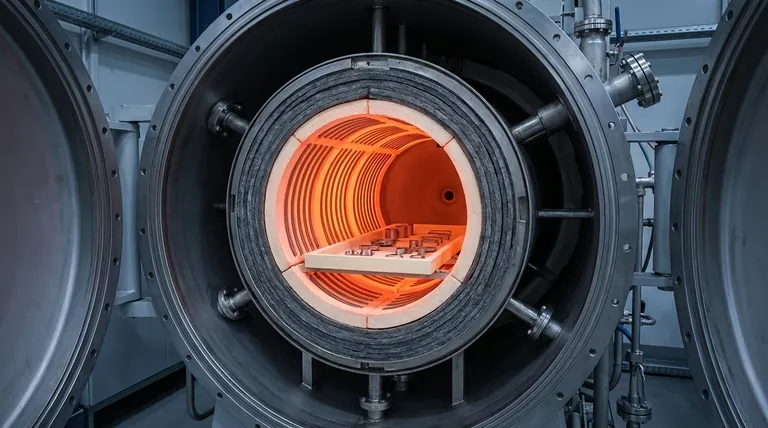
At its core, the hot zone is the insulated, high-temperature heart of a vacuum furnace. It is a distinct internal chamber that contains the heating elements and the workpiece, effectively creating a furnace within the larger vacuum vessel to concentrate thermal energy and perform the actual heating process.

The hot zone is not just the area that gets hot; it is an engineered thermal and insulation system designed to deliver precise, uniform heat to a workpiece while protecting the outer furnace shell from extreme temperatures.
What is a hot zone in a vacuum furnace? The Engineered Heart of Your Thermal Process

The Purpose of the Hot Zone: A Furnace Within a Furnace

A vacuum furnace's main body is a water-cooled steel vessel designed to hold a vacuum. The hot zone is a separate assembly suspended inside this "cold wall" shell. This design is critical for several reasons.

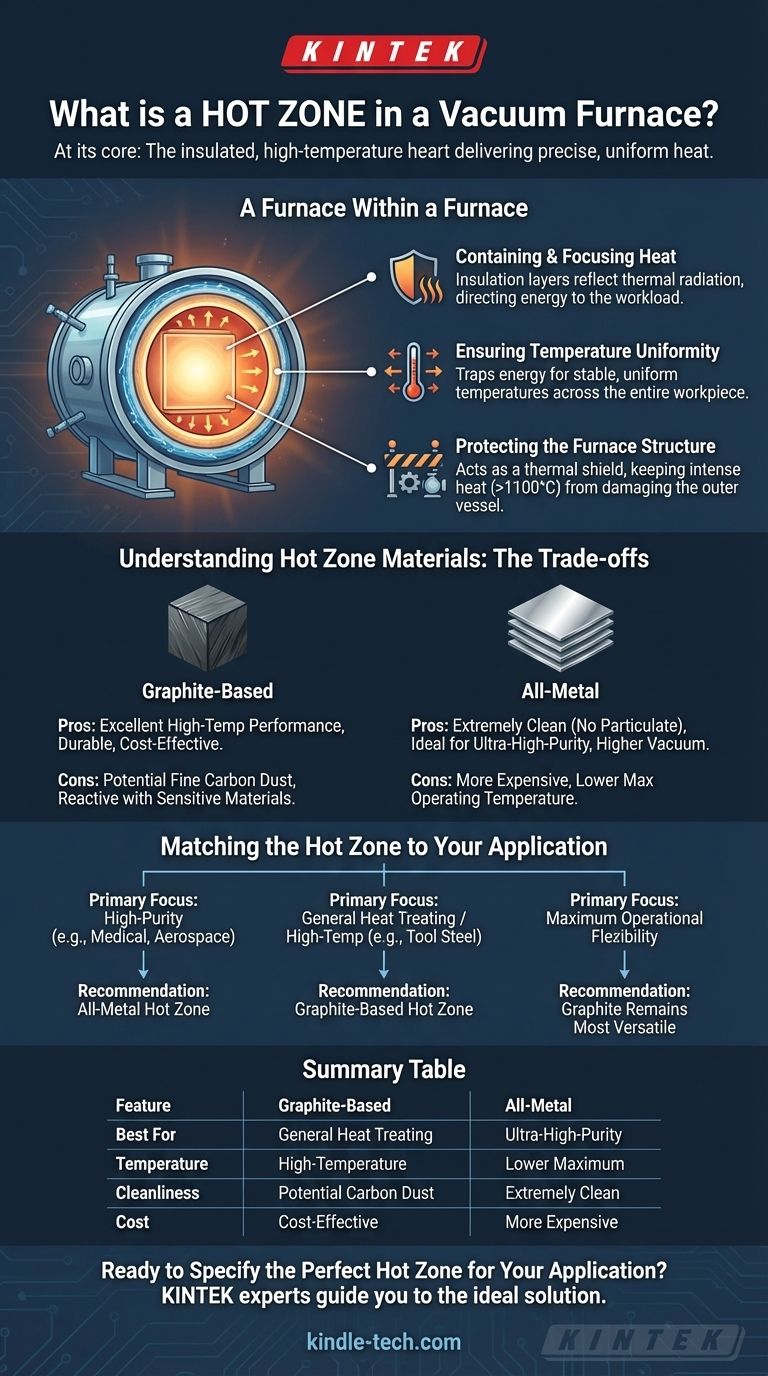
Containing and Focusing Heat

The primary function of the hot zone is insulation. It is constructed from layers of materials that reflect thermal radiation and prevent heat from escaping.

This creates an incredibly efficient environment, ensuring that the energy produced by the heating elements is directed at the workload, not lost to the surrounding furnace structure.

Ensuring Temperature Uniformity

By effectively trapping thermal energy, the hot zone allows for extremely stable and uniform temperatures across the entire workpiece.

This uniformity is non-negotiable for high-performance applications like brazing, sintering, and annealing, where even small temperature deviations can compromise the material's final properties.

Protecting the Furnace Structure

The outer furnace shell must remain cool to maintain its structural integrity and the vacuum-tight seals.

The hot zone acts as a thermal shield, keeping the intense heat (often exceeding 2000°F / 1100°C) contained and preventing it from damaging the vessel, controls, and vacuum pumps.

Understanding the Trade-offs: Hot Zone Materials

The materials used to construct a hot zone dictate its performance characteristics, cleanliness, and cost. The two most common designs are graphite-based and all-metal.

Graphite-Based Hot Zones

Graphite insulation (often rigid felt or board) and graphite heating elements are the industry standard for many applications.

  • Pros: Excellent high-temperature performance, durable, and relatively cost-effective.
  • Cons: Can produce fine carbon dust, which may not be suitable for ultra-high-purity applications. Can also react with certain sensitive materials.

All-Metal Hot Zones

These hot zones are built using layers of reflective metal sheets (like molybdenum or tungsten) as radiation shields, along with metallic heating elements.

  • Pros: Extremely clean, producing no particulate, making them ideal for medical, electronic, and aerospace components. They can also achieve a higher vacuum level.
  • Cons: Generally more expensive and have a lower maximum operating temperature compared to some graphite designs.

Matching the Hot Zone to Your Application

Choosing the right furnace begins with understanding your process requirements, which directly map to the hot zone design.

  • If your primary focus is high-purity processing (e.g., medical implants, aerospace brazing): An all-metal hot zone is the superior choice to avoid any potential carbon contamination.
  • If your primary focus is general heat treating or high-temperature processing (e.g., tool steel hardening, sintering): A graphite-based hot zone offers the best combination of high-temperature capability, durability, and cost-effectiveness.
  • If your primary focus is maximum operational flexibility: Graphite remains the most versatile option, covering the widest range of temperatures and processes for most industrial applications.

Ultimately, understanding the hot zone's design and material is fundamental to controlling the outcome of your thermal process.

Summary Table:

Feature Graphite-Based Hot Zone All-Metal Hot Zone
Best For General heat treating, high-temperature sintering Medical, aerospace, ultra-high-purity applications
Temperature High-temperature capability Lower maximum temperature
Cleanliness Potential for carbon dust Extremely clean, no particulate
Cost Cost-effective More expensive

Ready to Specify the Perfect Hot Zone for Your Application?

The right hot zone is critical for achieving precise temperature control, uniform results, and material integrity in your lab. KINTEK specializes in lab equipment and consumables, offering expert guidance to match your vacuum furnace's hot zone—whether graphite or all-metal—to your specific thermal processing needs, from research and development to high-volume production.

Contact our experts today to discuss your requirements and ensure your furnace delivers peak performance.

Visual Guide
What is a hot zone in a vacuum furnace? The Engineered Heart of Your Thermal Process Visual Guide

Related Products

People Also Ask

Related Products

2200 ℃ Tungsten Vacuum Heat Treat and Sintering Furnace

2200 ℃ Tungsten Vacuum Heat Treat and Sintering Furnace

Experience the ultimate refractory metal furnace with our Tungsten vacuum furnace. Capable of reaching 2200℃, perfect for sintering advanced ceramics and refractory metals. Order now for high-quality results.

Vacuum Hot Press Furnace Heated Vacuum Press Machine Tube Furnace

Vacuum Hot Press Furnace Heated Vacuum Press Machine Tube Furnace

Reduce forming pressure & shorten sintering time with Vacuum Tube Hot Press Furnace for high-density, fine-grain materials. Ideal for refractory metals.

Vacuum Hot Press Furnace Machine Heated Vacuum Press

Vacuum Hot Press Furnace Machine Heated Vacuum Press

Discover the advantages of Vacuum Hot Press Furnace! Manufacture dense refractory metals & compounds, ceramics, and composites under high temp and pressure.

600T Vacuum Induction Hot Press Furnace for Heat Treat and Sintering

600T Vacuum Induction Hot Press Furnace for Heat Treat and Sintering

Discover the 600T Vacuum Induction Hot Press Furnace, designed for high-temperature sintering experiments in vacuum or protected atmospheres. Its precise temperature and pressure control, adjustable working pressure, and advanced safety features make it ideal for nonmetal materials, carbon composites, ceramics, and metal powders.

Vacuum Heat Treat and Pressure Sintering Furnace for High Temperature Applications

Vacuum Heat Treat and Pressure Sintering Furnace for High Temperature Applications

Vacuum pressure sintering furnaces are designed for high temperature hot pressing applications in metal and ceramic sintering. Its advanced features ensure precise temperature control, reliable pressure maintenance, and a robust design for seamless operation.

Multi Heating Zones CVD Tube Furnace Machine Chemical Vapor Deposition Chamber System Equipment

Multi Heating Zones CVD Tube Furnace Machine Chemical Vapor Deposition Chamber System Equipment

KT-CTF14 Multi Heating Zones CVD Furnace - Precise Temperature Control and Gas Flow for Advanced Applications. Max temp up to 1200℃, 4 channels MFC mass flow meter, and 7" TFT touch screen controller.

2200 ℃ Graphite Vacuum Heat Treat Furnace

2200 ℃ Graphite Vacuum Heat Treat Furnace

Discover the power of the KT-VG Graphite Vacuum Furnace - with a maximum working temperature of 2200℃, it's perfect for vacuum sintering of various materials. Learn more now.

Vacuum Heat Treat Furnace with Ceramic Fiber Liner

Vacuum Heat Treat Furnace with Ceramic Fiber Liner

Vacuum furnace with polycrystalline ceramic fiber insulation liner for excellent heat insulation and uniform temperature field. Choose from 1200℃ or 1700℃ max. working temperature with high vacuum performance and precise temperature control.

1400℃ Controlled Atmosphere Furnace with Nitrogen and Inert Atmosphere

1400℃ Controlled Atmosphere Furnace with Nitrogen and Inert Atmosphere

Achieve precise heat treatment with KT-14A controlled atmosphere furnace. Vacuum sealed with a smart controller, it's ideal for lab and industrial use up to 1400℃.

Molybdenum Vacuum Heat Treat Furnace

Molybdenum Vacuum Heat Treat Furnace

Discover the benefits of a high-configuration molybdenum vacuum furnace with heat shield insulation. Ideal for high-purity, vacuum environments like sapphire crystal growth and heat treatment.

Horizontal High Temperature Graphite Vacuum Graphitization Furnace

Horizontal High Temperature Graphite Vacuum Graphitization Furnace

Horizontal Graphitization Furnace: This type of furnace is designed with the heating elements placed horizontally, allowing for uniform heating of the sample. It's well-suited for graphitizing large or bulky samples that require precise temperature control and uniformity.

Rotary Tube Furnace Split Multi Heating Zone Rotating Tube Furnace

Rotary Tube Furnace Split Multi Heating Zone Rotating Tube Furnace

Multi zone rotary furnace for high-precision temperature control with 2-8 independent heating zones. Ideal for lithium ion battery electrode materials and high-temperature reactions. Can work under vacuum and controlled atmosphere.

Vacuum Heat Treat Furnace and Levitation Induction Melting Furnace

Vacuum Heat Treat Furnace and Levitation Induction Melting Furnace

Experience precise melting with our Vacuum Levitation Melting Furnace. Ideal for high melting point metals or alloys, with advanced technology for effective smelting. Order now for high-quality results.

1700℃ Controlled Atmosphere Furnace Nitrogen Inert Atmosphere Furnace

1700℃ Controlled Atmosphere Furnace Nitrogen Inert Atmosphere Furnace

KT-17A Controlled atmosphere furnace: 1700℃ heating, vacuum sealing technology, PID temperature control, and versatile TFT smart touch screen controller for laboratory and industrial use.

Vacuum Heat Treat and Molybdenum Wire Sintering Furnace for Vacuum Sintering

Vacuum Heat Treat and Molybdenum Wire Sintering Furnace for Vacuum Sintering

A vacuum molybdenum wire sintering furnace is a vertical or bedroom structure, which is suitable for withdrawal, brazing, sintering and degassing of metal materials under high vacuum and high temperature conditions. It is also suitable for dehydroxylation treatment of quartz materials.

Vacuum Heat Treat Sintering Brazing Furnace

Vacuum Heat Treat Sintering Brazing Furnace

A vacuum brazing furnace is a type of industrial furnace used for brazing, a metalworking process that joins two pieces of metal using a filler metal that melts at a lower temperature than the base metals. Vacuum brazing furnaces are typically used for high-quality applications where a strong, clean joint is required.

Ultra-High Temperature Graphite Vacuum Graphitization Furnace

Ultra-High Temperature Graphite Vacuum Graphitization Furnace

The ultra-high temperature graphitization furnace utilizes medium frequency induction heating in a vacuum or inert gas environment. The induction coil generates an alternating magnetic field, inducing eddy currents in the graphite crucible, which heats up and radiates heat to the workpiece, bringing it to the desired temperature. This furnace is primarily used for graphitization and sintering of carbon materials, carbon fiber materials, and other composite materials.

Multi-zone Laboratory Tube Furnace

Multi-zone Laboratory Tube Furnace

Experience precise, efficient thermal testing with our Multi Zone Tube Furnace. Independent heating zones and temperature sensors allow for controlled high-temperature gradient heating fields. Order now for advanced thermal analysis!

Small Vacuum Heat Treat and Tungsten Wire Sintering Furnace

Small Vacuum Heat Treat and Tungsten Wire Sintering Furnace

The small vacuum tungsten wire sintering furnace is a compact experimental vacuum furnace specially designed for universities and scientific research institutes. The furnace features a CNC welded shell and vacuum piping to ensure leak-free operation. Quick-connect electrical connections facilitate relocation and debugging, and the standard electrical control cabinet is safe and convenient to operate.

Vertical High Temperature Graphite Vacuum Graphitization Furnace

Vertical High Temperature Graphite Vacuum Graphitization Furnace

Vertical high temperature graphitization furnace for carbonization and graphitization of carbon materials up to 3100℃.Suitable for shaped graphitization of carbon fiber filaments and other materials sintered in a carbon environment.Applications in metallurgy, electronics, and aerospace for producing high-quality graphite products like electrodes and crucibles.


Leave Your Message