Knowledge What is an example of electron beam welding? Precision Joining for Bi-Metal Saw Blades
Author avatar

Tech Team · Kintek Solution

Updated 6 days ago

What is an example of electron beam welding? Precision Joining for Bi-Metal Saw Blades


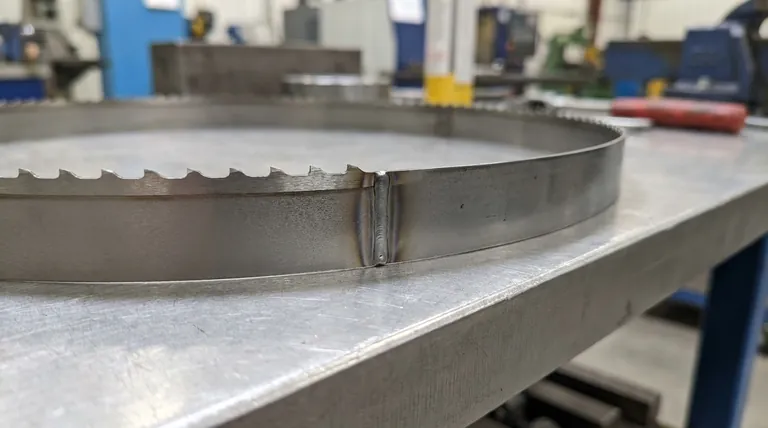
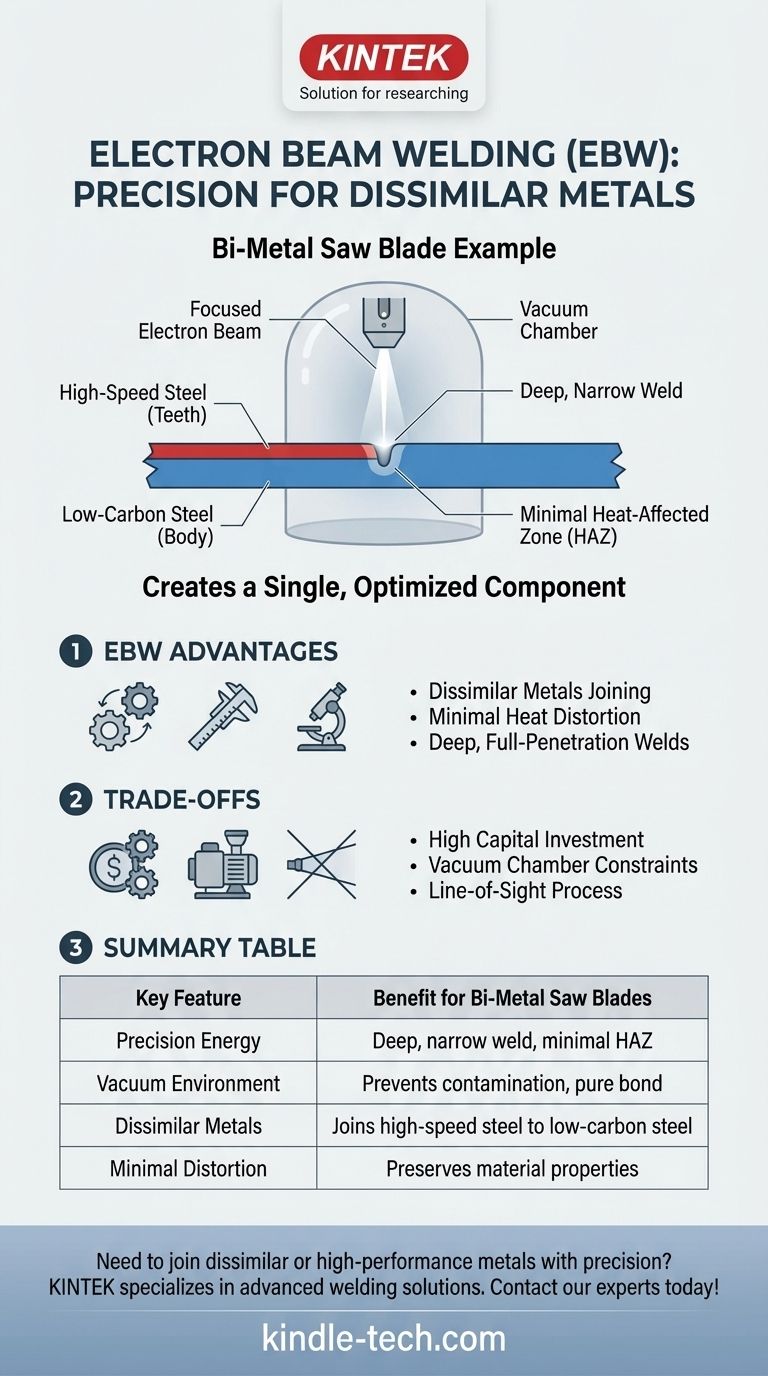
A classic example of electron beam welding is the mass production of bi-metal saw blades. This process joins a narrow strip of hard, high-speed steel for the cutting teeth to a flexible, low-carbon steel body for the main part of the blade. The result is a single, optimized component that leverages the best properties of two different materials.

Electron Beam Welding (EBW) is not just a joining method; it's a precision manufacturing process that enables the fusion of otherwise incompatible materials. The bi-metal saw blade example perfectly illustrates its core value: creating a single, superior component from two specialized metals.
What is an example of electron beam welding? Precision Joining for Bi-Metal Saw Blades

Why Bi-Metal Saw Blades Depend on EBW

The bi-metal saw blade is a perfect case study because it presents a manufacturing challenge that conventional welding methods cannot easily solve. EBW provides a unique solution by fundamentally changing how energy is applied to the materials.

The Challenge of Dissimilar Metals

Joining high-speed steel to low-carbon steel is notoriously difficult. Their different thermal properties and melting points mean that traditional welding would create a wide, brittle, and weak joint, rendering the blade useless.

The Precision of the Electron Beam

EBW uses a highly focused beam of high-velocity electrons to deliver intense energy to a very small spot. This creates an extremely deep and narrow weld with a minimal heat-affected zone (HAZ). The surrounding material remains relatively cool, preserving its original properties.

The Benefit of a Vacuum

The entire process occurs within a vacuum chamber. This is critical because it prevents atmospheric gases like oxygen and nitrogen from contaminating the molten metal. This ensures a pure, strong, and defect-free bond, which is essential when joining dissimilar or reactive metals.

Understanding the Trade-offs of EBW

While powerful, Electron Beam Welding is a specialized process with significant operational considerations. It is not a universal replacement for other welding techniques.

High Capital Investment

EBW systems, which include the electron gun, high-voltage power supply, and vacuum chamber, are significantly more expensive than standard arc welding equipment. This makes the process best suited for high-value or mass-production applications where the cost can be justified.

The Vacuum Requirement

The need for a vacuum chamber introduces a time delay for pumping down the chamber before welding can begin. It also places a physical limit on the size of the parts that can be processed, which is dictated by the chamber dimensions.

Line-of-Sight Process

The electron beam travels in a straight line. It cannot weld around corners or reach obstructed areas, which places constraints on joint design and part geometry.

Making the Right Choice for Your Goal

Understanding when to specify EBW comes down to the unique demands of your application. It excels where other processes fall short.

  • If your primary focus is joining dissimilar materials: EBW offers an unparalleled ability to create clean, strong welds between metals that are difficult or impossible to join with other methods.
  • If your primary focus is minimizing heat distortion: The highly focused energy of EBW is ideal for delicate components or assemblies where maintaining tight dimensional tolerances after welding is critical.
  • If your primary focus is achieving deep, narrow welds: EBW can produce weld depths that are far greater than its width, which is perfect for applications requiring strong, full-penetration joints with a single pass.

By understanding its specific strengths, you can leverage Electron Beam Welding to solve manufacturing challenges that are out of reach for conventional processes.

Summary Table:

Key Feature Benefit for Bi-Metal Saw Blades
Precision Energy Creates a deep, narrow weld with a minimal heat-affected zone.
Vacuum Environment Prevents contamination, ensuring a pure, strong bond.
Dissimilar Metals Joins high-speed steel (teeth) to low-carbon steel (body) effectively.
Minimal Distortion Preserves the properties of the surrounding material.

Need to join dissimilar or high-performance metals with precision? KINTEK specializes in advanced welding and thermal processing solutions for laboratory and manufacturing needs. Our expertise in technologies like electron beam welding can help you create stronger, more reliable components. Contact our experts today to discuss how we can optimize your manufacturing process!

Visual Guide
What is an example of electron beam welding? Precision Joining for Bi-Metal Saw Blades Visual Guide

Related Products

People Also Ask

Related Products

Vacuum Cold Mounting Machine for Sample Preparation

Vacuum Cold Mounting Machine for Sample Preparation

Vacuum Cold Mounting Machine for precise sample prep. Handles porous, fragile materials with -0.08MPa vacuum. Ideal for electronics, metallurgy, and failure analysis.

Electric Heated Hydraulic Vacuum Heat Press for Lab

Electric Heated Hydraulic Vacuum Heat Press for Lab

The Electric Vacuum Heat Press is a specialized heat press equipment that operates in a vacuum environment, utilizing advanced infrared heating and precise temperature control for high quality, rugged and reliable performance.

Ultra-High Temperature Graphite Vacuum Graphitization Furnace

Ultra-High Temperature Graphite Vacuum Graphitization Furnace

The ultra-high temperature graphitization furnace utilizes medium frequency induction heating in a vacuum or inert gas environment. The induction coil generates an alternating magnetic field, inducing eddy currents in the graphite crucible, which heats up and radiates heat to the workpiece, bringing it to the desired temperature. This furnace is primarily used for graphitization and sintering of carbon materials, carbon fiber materials, and other composite materials.

Vacuum Heat Treat and Molybdenum Wire Sintering Furnace for Vacuum Sintering

Vacuum Heat Treat and Molybdenum Wire Sintering Furnace for Vacuum Sintering

A vacuum molybdenum wire sintering furnace is a vertical or bedroom structure, which is suitable for withdrawal, brazing, sintering and degassing of metal materials under high vacuum and high temperature conditions. It is also suitable for dehydroxylation treatment of quartz materials.

30T 40T Split Automatic Heated Hydraulic Press Machine with Heated Plates for Laboratory Hot Press

30T 40T Split Automatic Heated Hydraulic Press Machine with Heated Plates for Laboratory Hot Press

Discover our split automatic heated lab press 30T/40T for precise sample preparation in material research, pharmacy, ceramics, and electronics industries. With a small footprint and heating up to 300°C, it's perfect for processing under vacuum environment.

2200 ℃ Tungsten Vacuum Heat Treat and Sintering Furnace

2200 ℃ Tungsten Vacuum Heat Treat and Sintering Furnace

Experience the ultimate refractory metal furnace with our Tungsten vacuum furnace. Capable of reaching 2200℃, perfect for sintering advanced ceramics and refractory metals. Order now for high-quality results.

Graphite Vacuum Furnace High Thermal Conductivity Film Graphitization Furnace

Graphite Vacuum Furnace High Thermal Conductivity Film Graphitization Furnace

The high thermal conductivity film graphitization furnace has uniform temperature, low energy consumption and can operate continuously.

Vacuum Sealed Continuous Working Rotary Tube Furnace Rotating Tube Furnace

Vacuum Sealed Continuous Working Rotary Tube Furnace Rotating Tube Furnace

Experience efficient material processing with our vacuum-sealed rotary tube furnace. Perfect for experiments or industrial production, equipped with optional features for controlled feeding and optimized results. Order now.

600T Vacuum Induction Hot Press Furnace for Heat Treat and Sintering

600T Vacuum Induction Hot Press Furnace for Heat Treat and Sintering

Discover the 600T Vacuum Induction Hot Press Furnace, designed for high-temperature sintering experiments in vacuum or protected atmospheres. Its precise temperature and pressure control, adjustable working pressure, and advanced safety features make it ideal for nonmetal materials, carbon composites, ceramics, and metal powders.

Graphite Vacuum Continuous Graphitization Furnace

Graphite Vacuum Continuous Graphitization Furnace

High-temperature graphitization furnace is a professional equipment for graphitization treatment of carbon materials. It is a key equipment for the production of high-quality graphite products. It has high temperature, high efficiency and uniform heating. It is suitable for various high-temperature treatments and graphitization treatments. It is widely used in metallurgy, electronics, aerospace, etc. industry.

Vertical High Temperature Graphite Vacuum Graphitization Furnace

Vertical High Temperature Graphite Vacuum Graphitization Furnace

Vertical high temperature graphitization furnace for carbonization and graphitization of carbon materials up to 3100℃.Suitable for shaped graphitization of carbon fiber filaments and other materials sintered in a carbon environment.Applications in metallurgy, electronics, and aerospace for producing high-quality graphite products like electrodes and crucibles.

Graphite Vacuum Furnace IGBT Experimental Graphitization Furnace

Graphite Vacuum Furnace IGBT Experimental Graphitization Furnace

IGBT experimental graphitization furnace, a tailored solution for universities and research institutions, with high heating efficiency, user-friendliness, and precise temperature control.

High Pressure Laboratory Vacuum Tube Furnace Quartz Tubular Furnace

High Pressure Laboratory Vacuum Tube Furnace Quartz Tubular Furnace

KT-PTF High Pressure Tube Furnace: Compact split tube furnace with strong positive pressure resistance. Working temp up to 1100°C and pressure up to 15Mpa. Also works under controller atmosphere or high vacuum.

Large Vertical Graphite Vacuum Graphitization Furnace

Large Vertical Graphite Vacuum Graphitization Furnace

A large vertical high-temperature graphitization furnace is a type of industrial furnace used for the graphitization of carbon materials, such as carbon fiber and carbon black. It is a high-temperature furnace that can reach temperatures of up to 3100°C.

Desktop Fast Laboratory Autoclave Sterilizer 35L 50L 90L for Lab Use

Desktop Fast Laboratory Autoclave Sterilizer 35L 50L 90L for Lab Use

The desktop fast steam sterilizer is a compact and reliable device used for rapid sterilization of medical, pharmaceutical, and research items. It efficiently sterilizes surgical instruments, glassware, medicines, and resistant materials, making it suitable for various applications.

Dental Porcelain Zirconia Sintering Ceramic Vacuum Press Furnace

Dental Porcelain Zirconia Sintering Ceramic Vacuum Press Furnace

Get precise dental results with Dental Vacuum Press Furnace. Automatic temperature calibration, low noise tray, and touch screen operation. Order now!

Small Vacuum Heat Treat and Tungsten Wire Sintering Furnace

Small Vacuum Heat Treat and Tungsten Wire Sintering Furnace

The small vacuum tungsten wire sintering furnace is a compact experimental vacuum furnace specially designed for universities and scientific research institutes. The furnace features a CNC welded shell and vacuum piping to ensure leak-free operation. Quick-connect electrical connections facilitate relocation and debugging, and the standard electrical control cabinet is safe and convenient to operate.

Laboratory High Pressure Horizontal Autoclave Steam Sterilizer for Lab Use

Laboratory High Pressure Horizontal Autoclave Steam Sterilizer for Lab Use

The horizontal autoclave steam sterilizer adopts the gravity displacement method to remove the cold air in the inner chamber, so that the inner steam and cold air content is less, and the sterilization is more reliable.

KF ISO Stainless Steel Vacuum Flange Blind Plate for High Vacuum Systems

KF ISO Stainless Steel Vacuum Flange Blind Plate for High Vacuum Systems

Discover KF/ISO stainless steel vacuum flange blind plates, ideal for high vacuum systems in semiconductor, photovoltaic, and research labs. High-quality materials, efficient sealing, and easy installation.<|end▁of▁sentence|>

304 316 Stainless Steel Vacuum Ball Valve Stop Valve for High Vacuum Systems

304 316 Stainless Steel Vacuum Ball Valve Stop Valve for High Vacuum Systems

Discover 304/316 stainless steel vacuum ball valves, Ideal for high vacuum systems, Ensure precise control and durability. Explore now!


Leave Your Message