Knowledge atmosphere furnace What is annealing in air atmosphere? A Simple Guide to Cost-Effective Metal Softening
Author avatar

Tech Team · Kintek Solution

Updated 2 months ago

What is annealing in air atmosphere? A Simple Guide to Cost-Effective Metal Softening


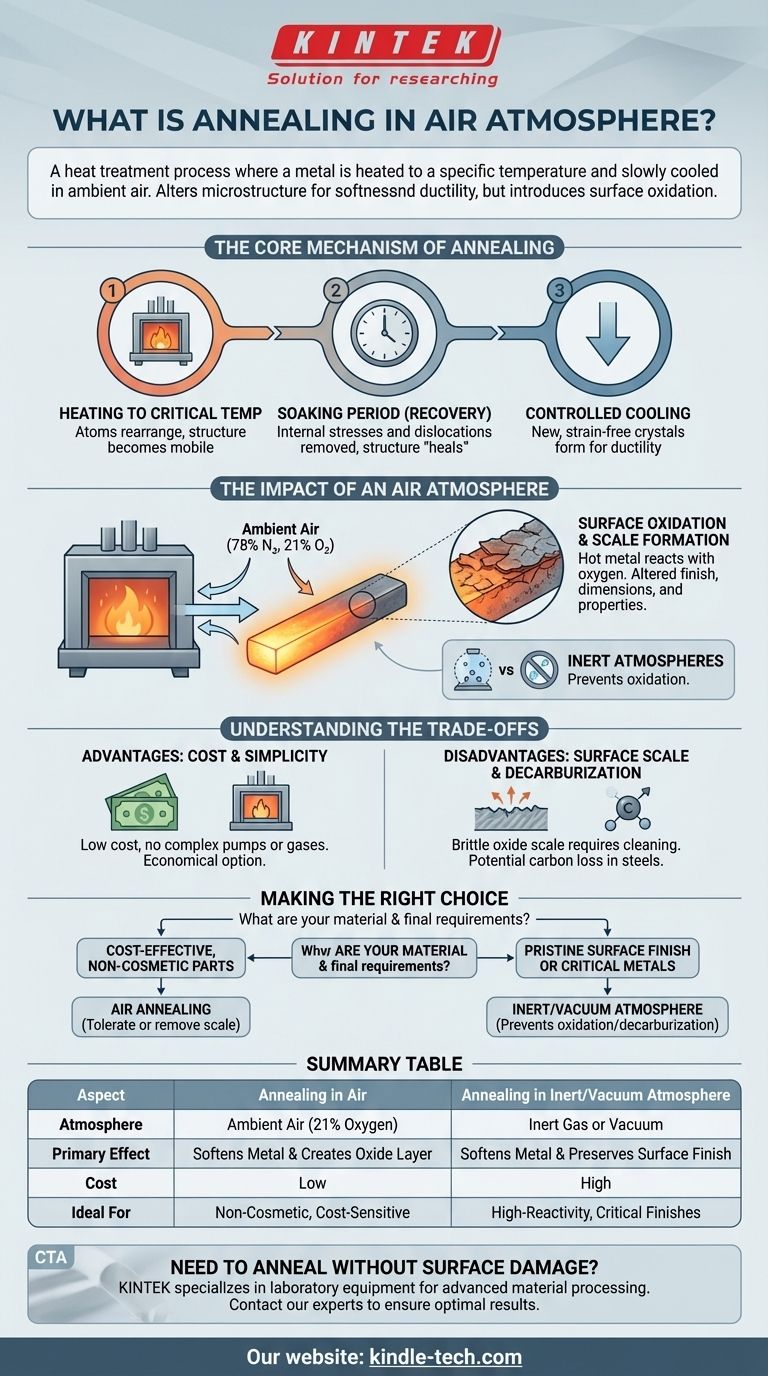
Annealing in an air atmosphere is a heat treatment process where a metal is heated to a specific temperature and slowly cooled in the presence of ambient air. This process alters the material's internal microstructure to make it softer, more ductile, and less brittle. The defining characteristic of this method is the interaction between the hot metal surface and the oxygen in the air, which leads to oxidation.

While annealing in air is the simplest and most cost-effective method to improve a metal's internal properties, it fundamentally introduces a trade-off: you gain the desired softness and ductility at the cost of creating an undesirable oxide layer on the material's surface.
What is annealing in air atmosphere? A Simple Guide to Cost-Effective Metal Softening

The Core Mechanism of Annealing

Before considering the atmosphere, it's crucial to understand the fundamental stages of any annealing process. The goal is to repair the internal crystalline structure, which becomes strained and distorted during manufacturing processes like bending, rolling, or stamping.

Heating to a Critical Temperature

The metal is heated to a temperature below its melting point but high enough to allow its atoms to rearrange. This allows the internal crystalline structure to become more mobile, preparing it for repair.

The Soaking Period (Recovery)

The material is held at this elevated temperature for a set period. During this stage, the metal softens by removing internal stresses and linear defects known as dislocations. The a tomic structure essentially "heals" itself, leading to a more uniform and less stressed state.

Controlled Cooling

Finally, the metal is cooled at a very slow, controlled rate. This slow cooling is critical for allowing new, strain-free crystals (or grains) to form. The result is a more ductile and less brittle final product.

The Impact of an Air Atmosphere

The "atmosphere" is the gaseous environment surrounding the metal inside the furnace. Choosing to use simple ambient air has significant and predictable consequences.

What "Air Atmosphere" Means

This refers to performing the annealing process in normal air, which is composed of approximately 78% nitrogen and 21% oxygen. At the high temperatures required for annealing, the oxygen is highly reactive.

The Inevitable Reaction: Oxidation

The primary effect of annealing in air is oxidation. The hot surface of the metal reacts with the oxygen, forming a layer of metallic oxide. This layer is commonly known as scale or tarnish. This scale alters the surface finish, dimensions, and properties of the part.

The Alternative: Inert Atmospheres

To avoid oxidation, annealing can be performed in a controlled environment. This involves using a vacuum furnace to remove the air or flooding the furnace with an inert gas (like argon or nitrogen) that will not react with the metal.

Understanding the Trade-offs

The choice to anneal in air is almost always a decision based on balancing cost against final material requirements.

Advantage: Cost and Simplicity

Air is free, and the equipment required is simpler. Furnaces that operate with ambient air do not need expensive vacuum pumps, complex sealing systems, or a continuous supply of costly inert gas. This makes it the most economical heat treatment option.

Disadvantage: Surface Scale Formation

The oxide scale is the single biggest drawback. This layer is often brittle, flaky, and aesthetically undesirable. It almost always must be removed in a secondary operation, such as sandblasting, grinding, or chemical cleaning (acid pickling), which adds time and cost to the overall process.

Disadvantage: Potential for Decarburization

For carbon steels, annealing in an oxygen-rich atmosphere can cause another problem: decarburization. Oxygen can react with and remove carbon from the surface of the steel, leaving a softer outer layer that may compromise the part's intended hardness and wear resistance.

Making the Right Choice for Your Application

Selecting the right annealing atmosphere depends entirely on the material and the final requirements of the component.

  • If your primary focus is cost-effectiveness for non-cosmetic parts: Air annealing is often the most practical choice, provided you can tolerate or later remove the resulting surface oxide layer.
  • If your primary focus is maintaining a pristine surface finish: You must use a controlled atmosphere, such as a vacuum or an inert gas like argon, to prevent any oxidation.
  • If you are working with high-carbon steels or highly reactive metals (like titanium): An inert or vacuum atmosphere is essential to prevent both oxidation and undesirable changes to the material's surface chemistry.

Ultimately, understanding the role of the atmosphere transforms annealing from a simple heating process into a precise engineering decision.

Summary Table:

Aspect Annealing in Air Annealing in Inert/Vacuum Atmosphere
Atmosphere Ambient Air (21% Oxygen) Inert Gas (Argon/Nitrogen) or Vacuum
Primary Effect Softens Metal & Creates Oxide Layer (Scale) Softens Metal & Preserves Surface Finish
Cost Low (Simple Equipment, No Gas) High (Specialized Equipment, Gas/Vacuum)
Ideal For Non-Cosmetic Parts, Cost-Sensitive Applications High-Reactivity Metals, Critical Surface Finishes

Need to Anneal a Critical Component Without Surface Damage?

Choosing the right heat treatment process is crucial for your material's performance. While air annealing is cost-effective, it may not be suitable for parts requiring pristine surfaces or precise material properties.

KINTEK specializes in laboratory equipment and consumables for advanced material processing. We can help you select the right furnace and atmosphere control system for your specific annealing needs, whether you're working with standard steels or highly reactive metals.

Contact our experts today to discuss your application and ensure optimal results for your laboratory work.

Visual Guide
What is annealing in air atmosphere? A Simple Guide to Cost-Effective Metal Softening Visual Guide

Related Products

People Also Ask

Related Products

Controlled Nitrogen Inert Hydrogen Atmosphere Furnace

Controlled Nitrogen Inert Hydrogen Atmosphere Furnace

KT-AH Hydrogen atmosphere furnace - induction gas furnace for sintering/annealing with built-in safety features, dual housing design, and energy-saving efficiency. Ideal for lab and industrial use.

Vacuum Heat Treat Furnace with Ceramic Fiber Liner

Vacuum Heat Treat Furnace with Ceramic Fiber Liner

Vacuum furnace with polycrystalline ceramic fiber insulation liner for excellent heat insulation and uniform temperature field. Choose from 1200℃ or 1700℃ max. working temperature with high vacuum performance and precise temperature control.

High Temperature Muffle Oven Furnace for Laboratory Debinding and Pre Sintering

High Temperature Muffle Oven Furnace for Laboratory Debinding and Pre Sintering

KT-MD High temperature debinding and pre-sintering furnace for ceramic materials with various molding processes. Ideal for electronic components such as MLCC and NFC.

1200℃ Controlled Atmosphere Furnace Nitrogen Inert Atmosphere Furnace

1200℃ Controlled Atmosphere Furnace Nitrogen Inert Atmosphere Furnace

Discover our KT-12A Pro Controlled atmosphere furnace - high precision, heavy duty vacuum chamber, versatile smart touch screen controller, and excellent temperature uniformity up to 1200C. Ideal for both laboratory and industrial application.

1700℃ Controlled Atmosphere Furnace Nitrogen Inert Atmosphere Furnace

1700℃ Controlled Atmosphere Furnace Nitrogen Inert Atmosphere Furnace

KT-17A Controlled atmosphere furnace: 1700℃ heating, vacuum sealing technology, PID temperature control, and versatile TFT smart touch screen controller for laboratory and industrial use.

Horizontal High Temperature Graphite Vacuum Graphitization Furnace

Horizontal High Temperature Graphite Vacuum Graphitization Furnace

Horizontal Graphitization Furnace: This type of furnace is designed with the heating elements placed horizontally, allowing for uniform heating of the sample. It's well-suited for graphitizing large or bulky samples that require precise temperature control and uniformity.

Mesh belt controlled atmosphere furnace

Mesh belt controlled atmosphere furnace

Discover our KT-MB mesh belt sintering furnace - perfect for high-temperature sintering of electronic components & glass insulators. Available for open air or controlled atmosphere environments.

Laboratory Muffle Oven Furnace Bottom Lifting Muffle Furnace

Laboratory Muffle Oven Furnace Bottom Lifting Muffle Furnace

Efficiently produce batches with excellent temperature uniformity using our Bottom Lifting Furnace. Features two electric lifting stages and advanced temperature control up to 1600℃.

1400℃ Controlled Atmosphere Furnace with Nitrogen and Inert Atmosphere

1400℃ Controlled Atmosphere Furnace with Nitrogen and Inert Atmosphere

Achieve precise heat treatment with KT-14A controlled atmosphere furnace. Vacuum sealed with a smart controller, it's ideal for lab and industrial use up to 1400℃.

Vacuum Heat Treat and Pressure Sintering Furnace for High Temperature Applications

Vacuum Heat Treat and Pressure Sintering Furnace for High Temperature Applications

Vacuum pressure sintering furnaces are designed for high temperature hot pressing applications in metal and ceramic sintering. Its advanced features ensure precise temperature control, reliable pressure maintenance, and a robust design for seamless operation.

Vertical High Temperature Graphite Vacuum Graphitization Furnace

Vertical High Temperature Graphite Vacuum Graphitization Furnace

Vertical high temperature graphitization furnace for carbonization and graphitization of carbon materials up to 3100℃.Suitable for shaped graphitization of carbon fiber filaments and other materials sintered in a carbon environment.Applications in metallurgy, electronics, and aerospace for producing high-quality graphite products like electrodes and crucibles.

Graphite Vacuum Furnace High Thermal Conductivity Film Graphitization Furnace

Graphite Vacuum Furnace High Thermal Conductivity Film Graphitization Furnace

The high thermal conductivity film graphitization furnace has uniform temperature, low energy consumption and can operate continuously.

Ultra-High Temperature Graphite Vacuum Graphitization Furnace

Ultra-High Temperature Graphite Vacuum Graphitization Furnace

The ultra-high temperature graphitization furnace utilizes medium frequency induction heating in a vacuum or inert gas environment. The induction coil generates an alternating magnetic field, inducing eddy currents in the graphite crucible, which heats up and radiates heat to the workpiece, bringing it to the desired temperature. This furnace is primarily used for graphitization and sintering of carbon materials, carbon fiber materials, and other composite materials.

Graphite Vacuum Furnace Bottom Discharge Graphitization Furnace for Carbon Materials

Graphite Vacuum Furnace Bottom Discharge Graphitization Furnace for Carbon Materials

Bottom-out graphitization furnace for carbon materials, ultra-high temperature furnace up to 3100°C, suitable for graphitization and sintering of carbon rods and carbon blocks. Vertical design, bottom discharging, convenient feeding and discharging, high temperature uniformity, low energy consumption, good stability, hydraulic lifting system, convenient loading and unloading.

Vacuum Sealed Continuous Working Rotary Tube Furnace Rotating Tube Furnace

Vacuum Sealed Continuous Working Rotary Tube Furnace Rotating Tube Furnace

Experience efficient material processing with our vacuum-sealed rotary tube furnace. Perfect for experiments or industrial production, equipped with optional features for controlled feeding and optimized results. Order now.

Vacuum Heat Treat and Molybdenum Wire Sintering Furnace for Vacuum Sintering

Vacuum Heat Treat and Molybdenum Wire Sintering Furnace for Vacuum Sintering

A vacuum molybdenum wire sintering furnace is a vertical or bedroom structure, which is suitable for withdrawal, brazing, sintering and degassing of metal materials under high vacuum and high temperature conditions. It is also suitable for dehydroxylation treatment of quartz materials.

Molybdenum Vacuum Heat Treat Furnace

Molybdenum Vacuum Heat Treat Furnace

Discover the benefits of a high-configuration molybdenum vacuum furnace with heat shield insulation. Ideal for high-purity, vacuum environments like sapphire crystal growth and heat treatment.

2200 ℃ Graphite Vacuum Heat Treat Furnace

2200 ℃ Graphite Vacuum Heat Treat Furnace

Discover the power of the KT-VG Graphite Vacuum Furnace - with a maximum working temperature of 2200℃, it's perfect for vacuum sintering of various materials. Learn more now.

Vertical Laboratory Tube Furnace

Vertical Laboratory Tube Furnace

Elevate your experiments with our Vertical Tube Furnace. Versatile design allows for operation under various environments and heat treatment applications. Order now for precise results!

Multi-zone Laboratory Tube Furnace

Multi-zone Laboratory Tube Furnace

Experience precise, efficient thermal testing with our Multi Zone Tube Furnace. Independent heating zones and temperature sensors allow for controlled high-temperature gradient heating fields. Order now for advanced thermal analysis!


Leave Your Message