Knowledge What is atomization in powder metallurgy? The Key to Creating High-Performance Metal Powders
Author avatar

Tech Team · Kintek Solution

Updated 1 week ago

What is atomization in powder metallurgy? The Key to Creating High-Performance Metal Powders


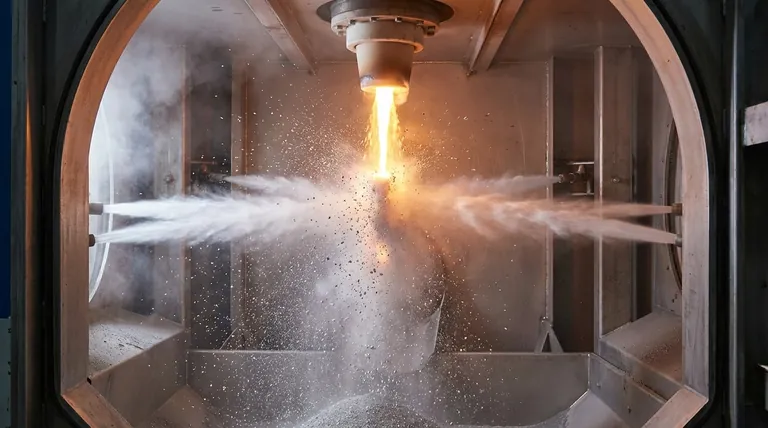
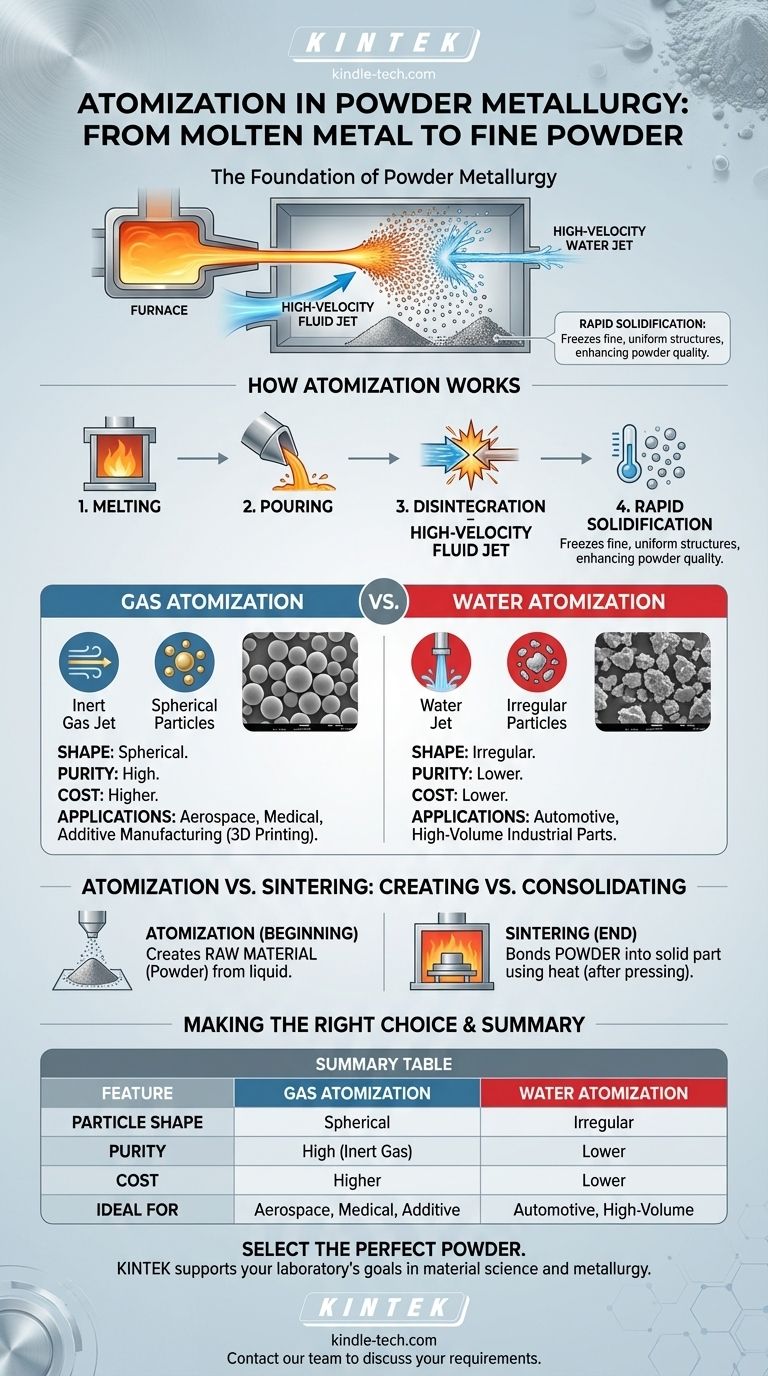
In powder metallurgy, atomization is the dominant process for converting molten metal into a fine powder. This is accomplished by striking a stream of liquid metal with a high-velocity jet of gas or liquid, which breaks the metal into millions of tiny droplets that cool and solidify into powder particles before they even hit the ground.

Atomization is the foundational step that dictates the final properties of a powder metallurgy part. The method used to create the powder—its shape, size, and purity—directly controls the strength, density, and performance of the finished component.
What is atomization in powder metallurgy? The Key to Creating High-Performance Metal Powders

How Atomization Works: From Liquid to Powder

Atomization is a physical process of disintegration. A carefully controlled stream of molten metal is engineered to collide with a high-energy fluid.

The Core Mechanism

The process begins by melting the desired metal or alloy in a furnace. This molten metal is then poured through a specialized nozzle, forming a predictable stream.

A high-pressure jet of gas or liquid is directed at this molten stream. The immense kinetic energy of the jet shatters the liquid metal into a spray of fine droplets.

The Role of Rapid Solidification

These droplets, now dispersed in the atomizing chamber, cool and solidify almost instantly. This rapid solidification is critical, as it freezes a very fine and uniform chemical structure into each powder particle, which is a key advantage of powder metallurgy.

Gas Atomization vs. Water Atomization

The fluid used has a profound impact on the final powder.

  • Gas Atomization: Uses a high-pressure jet of inert gas, such as argon or nitrogen. This produces highly spherical powder particles with excellent purity because the inert gas prevents oxidation during the process.
  • Water Atomization: Uses a high-pressure jet of water. This is a more aggressive quenching process, resulting in irregular, non-spherical powder particles. It is faster and more cost-effective than gas atomization.

Atomization vs. Sintering: Creating vs. Consolidating

It is crucial to distinguish between atomization and sintering, as they represent the beginning and end of the powder metallurgy workflow.

Atomization: The Beginning of the Process

Atomization is the manufacturing process for the raw material. Its sole purpose is to produce the metal powder from a bulk liquid state.

Sintering: Nearing the Finish Line

Sintering is a heat treatment that happens much later. After the powder is made, it is pressed into a desired shape (a "green compact").

This compact is then heated in a furnace to a temperature below the metal's melting point. During sintering, the powder particles bond and fuse together, creating a solid, dense part with mechanical strength.

Understanding the Trade-offs

The choice between atomization methods is not about which is "better," but which is right for the application. The decision creates a cascade of consequences for both cost and performance.

Gas Atomization: High Performance, High Cost

The spherical, pure powders created by gas atomization flow very well and pack predictably. This makes them essential for high-performance applications like aerospace components, medical implants, and advanced additive manufacturing where material integrity is paramount. This quality comes at a higher production cost.

Water Atomization: High Volume, Lower Cost

The irregular powders from water atomization are significantly cheaper to produce. While they don't flow as well as spherical powders, their jagged shape provides good "mechanical interlocking" when pressed, leading to strong green compacts. This makes them the workhorse of the automotive and industrial parts industries.

Control Dictates Quality

In any atomization method, process control is everything. Adjusting parameters like metal temperature, nozzle design, and fluid pressure allows manufacturers to precisely tailor the final particle size distribution to meet the requirements of the application.

Making the Right Choice for Your Goal

Selecting the correct powder type is the first and most important decision in designing a powder metallurgy component.

  • If your primary focus is maximum performance and material purity: Gas-atomized powders are the necessary choice for their sphericity and low oxygen content, despite the higher cost.
  • If your primary focus is cost-effective, high-volume production: Water-atomized powders offer an excellent and economical balance of properties for industrial and automotive parts.
  • If your primary focus is strength before sintering: The irregular shape of water-atomized powder can provide advantages in creating a robust component after pressing but before the final heating stage.

Ultimately, understanding the atomization process empowers you to select the right raw material, which is the most critical decision in powder metallurgy.

Summary Table:

Feature Gas Atomization Water Atomization
Particle Shape Spherical Irregular
Purity High (Inert Gas) Lower
Cost Higher Lower
Ideal For Aerospace, Medical, Additive Manufacturing Automotive, High-Volume Industrial Parts

Ready to select the perfect metal powder for your application?

At KINTEK, we specialize in providing high-quality lab equipment and consumables for material science and metallurgy. Whether you're developing components for aerospace, medical implants, or high-volume automotive parts, understanding your raw material is the first step to success.

Our experts can help you navigate the complexities of powder metallurgy to ensure you get the performance and cost-efficiency you need.

Contact our team today to discuss your specific requirements and discover how KINTEK can support your laboratory's goals.

Visual Guide
What is atomization in powder metallurgy? The Key to Creating High-Performance Metal Powders Visual Guide

Related Products

People Also Ask

Related Products

HFCVD Machine System Equipment for Drawing Die Nano-Diamond Coating

HFCVD Machine System Equipment for Drawing Die Nano-Diamond Coating

The nano-diamond composite coating drawing die uses cemented carbide (WC-Co) as the substrate, and uses the chemical vapor phase method ( CVD method for short ) to coat the conventional diamond and nano-diamond composite coating on the surface of the inner hole of the mold.

Laboratory Test Sieves and Sieving Machines

Laboratory Test Sieves and Sieving Machines

Precision lab test sieves & sieving machines for accurate particle analysis. Stainless steel, ISO-compliant, 20μm-125mm range. Request specs now!

915MHz MPCVD Diamond Machine Microwave Plasma Chemical Vapor Deposition System Reactor

915MHz MPCVD Diamond Machine Microwave Plasma Chemical Vapor Deposition System Reactor

915MHz MPCVD Diamond Machine and its multi-crystal effective growth, the maximum area can reach 8 inches, the maximum effective growth area of single crystal can reach 5 inches. This equipment is mainly used for the production of large-size polycrystalline diamond films, the growth of long single crystal diamonds, the low-temperature growth of high-quality graphene, and other materials that require energy provided by microwave plasma for growth.

Laboratory Sterilizer Lab Autoclave Pulse Vacuum Lifting Sterilizer

Laboratory Sterilizer Lab Autoclave Pulse Vacuum Lifting Sterilizer

The pulse vacuum lifting sterilizer is a state-of-the-art equipment for efficient and precise sterilization. It uses pulsating vacuum technology, customizable cycles, and a user-friendly design for easy operation and safety.

Laboratory Sterilizer Lab Autoclave Vertical Pressure Steam Sterilizer for Liquid Crystal Display Automatic Type

Laboratory Sterilizer Lab Autoclave Vertical Pressure Steam Sterilizer for Liquid Crystal Display Automatic Type

Liquid crystal display automatic vertical sterilizer is a safe, reliable and automatic control sterilization equipment, which is composed of heating system, microcomputer control system and overheating and overvoltage protection system.

Benchtop Laboratory Freeze Dryer for Lab Use

Benchtop Laboratory Freeze Dryer for Lab Use

Premium benchtop laboratory freeze dryer for lyophilization, preserving samples with ≤ -60°C cooling. Ideal for pharmaceuticals & research.

Benchtop Laboratory Vacuum Freeze Dryer

Benchtop Laboratory Vacuum Freeze Dryer

Benchtop laboratory freeze dryer for efficient lyophilization of biological, pharmaceutical, and food samples. Features intuitive touchscreen, high-performance refrigeration, and durable design. Preserve sample integrity—consult now!

High-Energy Omnidirectional Planetary Ball Mill Milling Machine for Laboratory

High-Energy Omnidirectional Planetary Ball Mill Milling Machine for Laboratory

The KT-P4000E is a new product derived from the vertical high-energy planetary ball mill with a 360° swivel function. Experience faster, uniform, and smaller sample output results with 4 ≤1000ml ball mill jars.

High-Energy Omnidirectional Planetary Ball Mill Machine for Laboratory

High-Energy Omnidirectional Planetary Ball Mill Machine for Laboratory

The KT-P2000E is a new product derived from the vertical high-energy planetary ball mill with a 360°rotation function. The product not only has the characteristics of the vertical high-energy ball mill, but also has a unique 360°rotation function for the planetary body.

High Energy Planetary Ball Mill Milling Machine for Laboratory

High Energy Planetary Ball Mill Milling Machine for Laboratory

Experience fast and effective sample processing with the F-P2000 high-energy planetary ball mill. This versatile equipment offers precise control and excellent grinding capabilities. Perfect for laboratories, it features multiple grinding bowls for simultaneous testing and high output. Achieve optimal results with its ergonomic design, compact structure, and advanced features. Ideal for a wide range of materials, it ensures consistent particle size reduction and low maintenance.

CVD Diamond Cutting Tool Blanks for Precision Machining

CVD Diamond Cutting Tool Blanks for Precision Machining

CVD Diamond Cutting Tools: Superior Wear Resistance, Low Friction, High Thermal Conductivity for Non-Ferrous Materials, Ceramics, Composites Machining

Variable Speed Peristaltic Pump

Variable Speed Peristaltic Pump

KT-VSP Series Smart Variable Speed Peristaltic Pumps offer precise flow control for labs, medical, and industrial applications. Reliable, contamination-free liquid transfer.

High Energy Vibratory Laboratory Ball Mill Grinding Mill Single Tank Type

High Energy Vibratory Laboratory Ball Mill Grinding Mill Single Tank Type

High-energy vibration ball mill is a small desktop laboratory grinding instrument.It can be ball-milled or mixed with different particle sizes and materials by dry and wet methods.

High Energy Vibratory Ball Mill for Lab Use

High Energy Vibratory Ball Mill for Lab Use

The high-energy vibrating ball mill is a high-energy oscillating and impacting multifunctional laboratory ball mill. The table-top type is easy to operate, small in size, comfortable and safe.

Anti-Cracking Press Mold for Lab Use

Anti-Cracking Press Mold for Lab Use

The anti-cracking press mold is a specialized equipment designed for molding various shapes and sizes of film using high pressure and electric heating.

Vacuum Heat Treat and Molybdenum Wire Sintering Furnace for Vacuum Sintering

Vacuum Heat Treat and Molybdenum Wire Sintering Furnace for Vacuum Sintering

A vacuum molybdenum wire sintering furnace is a vertical or bedroom structure, which is suitable for withdrawal, brazing, sintering and degassing of metal materials under high vacuum and high temperature conditions. It is also suitable for dehydroxylation treatment of quartz materials.

Small Vacuum Heat Treat and Tungsten Wire Sintering Furnace

Small Vacuum Heat Treat and Tungsten Wire Sintering Furnace

The small vacuum tungsten wire sintering furnace is a compact experimental vacuum furnace specially designed for universities and scientific research institutes. The furnace features a CNC welded shell and vacuum piping to ensure leak-free operation. Quick-connect electrical connections facilitate relocation and debugging, and the standard electrical control cabinet is safe and convenient to operate.

Graphite Vacuum Furnace IGBT Experimental Graphitization Furnace

Graphite Vacuum Furnace IGBT Experimental Graphitization Furnace

IGBT experimental graphitization furnace, a tailored solution for universities and research institutions, with high heating efficiency, user-friendliness, and precise temperature control.

RRDE rotating disk (ring disk) electrode / compatible with PINE, Japanese ALS, Swiss Metrohm glassy carbon platinum

RRDE rotating disk (ring disk) electrode / compatible with PINE, Japanese ALS, Swiss Metrohm glassy carbon platinum

Elevate your electrochemical research with our Rotating Disk and Ring Electrodes. Corrosion resistant and customizable to your specific needs, with complete specifications.

Vacuum Hot Press Furnace Machine for Lamination and Heating

Vacuum Hot Press Furnace Machine for Lamination and Heating

Experience clean and precise lamination with Vacuum Lamination Press. Perfect for wafer bonding, thin-film transformations, and LCP lamination. Order now!


Leave Your Message