Knowledge What is bio-oil production from biomass by using pyrolysis method? Turn Waste into Liquid Fuel
Author avatar

Tech Team · Kintek Solution

Updated 1 week ago

What is bio-oil production from biomass by using pyrolysis method? Turn Waste into Liquid Fuel


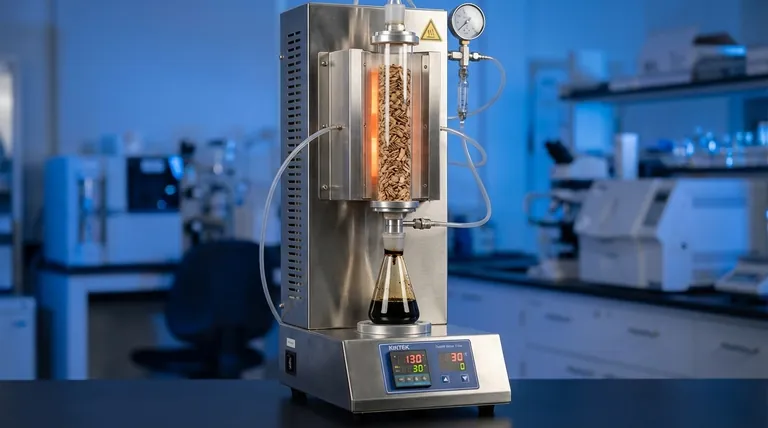
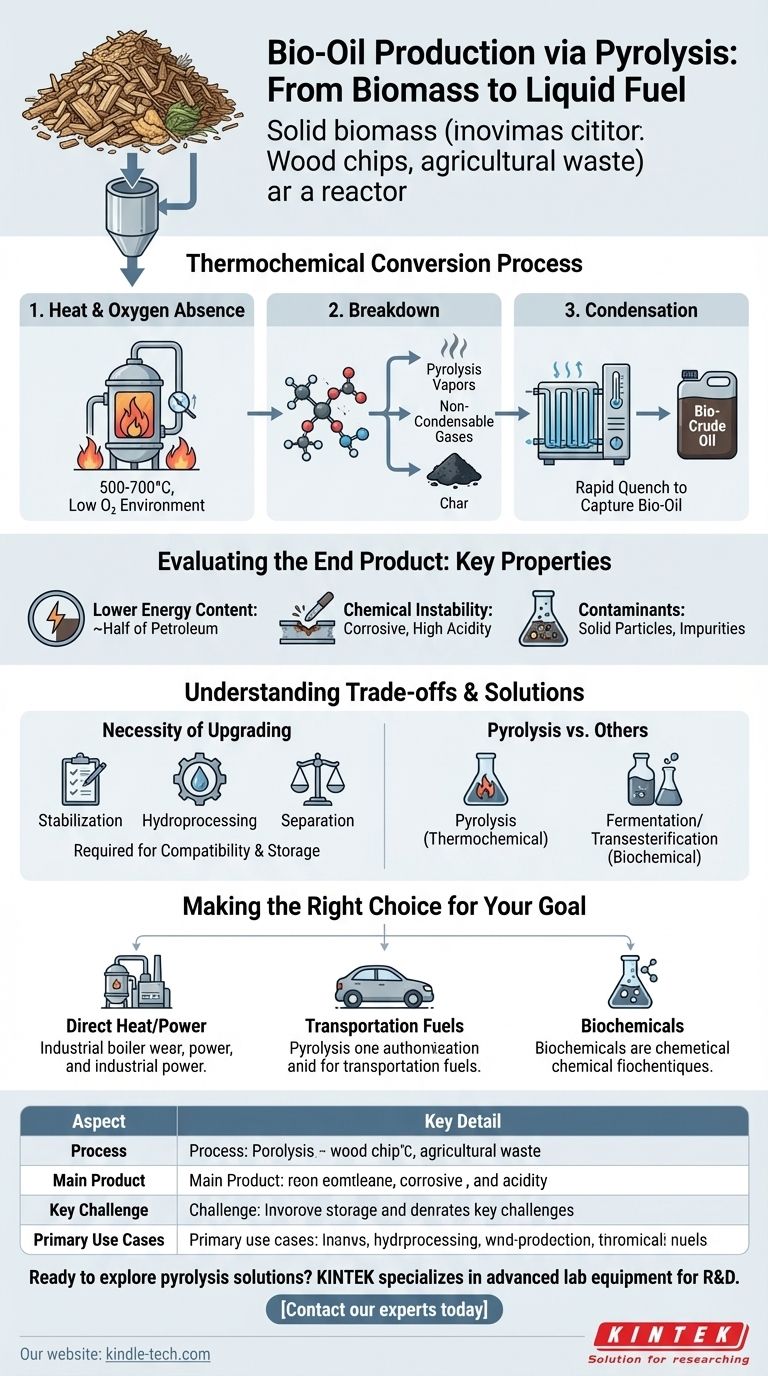
Bio-oil production via pyrolysis is a thermochemical conversion process that transforms solid biomass into a liquid fuel. It involves rapidly heating organic materials like wood or agricultural waste to high temperatures in an environment with little to no oxygen, breaking them down into vapors that are then cooled and condensed into a dark, viscous liquid known as bio-oil or pyrolysis oil.

Pyrolysis offers a direct path to liquefy solid biomass, making it easier to transport and store. However, the resulting raw bio-oil is chemically unstable and has a lower energy content than petroleum, requiring significant upgrading before it can be a widespread substitute for fossil fuels.
What is bio-oil production from biomass by using pyrolysis method? Turn Waste into Liquid Fuel

The Pyrolysis Process Deconstructed

Pyrolysis fundamentally "cooks" biomass to break its complex structure into simpler, valuable components. The process is carefully controlled to maximize the liquid yield.

The Role of Heat and Oxygen Absence

The core of the process is heating biomass to high temperatures, typically between 500°C and 700°C.

This is done in an oxygen-free or low-oxygen atmosphere. The absence of oxygen is critical because it prevents the biomass from combusting (burning) and instead forces it to thermally decompose into other substances.

From Solid to Vapor, Gas, and Char

This intense, oxygen-deprived heat breaks down the organic matter into three primary outputs:

  1. Pyrolysis Vapors: A hot mixture of aerosols and gaseous organic compounds. This is the primary precursor to bio-oil.
  2. Non-Condensable Gases: Light gases (like CO, CO2, H2, CH4) that do not turn into liquid upon cooling.
  3. Char: A solid, carbon-rich residue similar to charcoal.

Condensation: Capturing the Bio-Oil

After the solid char is separated, the hot pyrolysis vapors are rapidly cooled, or "quenched." This condensation process converts the vapors into a liquid, which is the final bio-crude oil.

Evaluating the End Product: The Properties of Bio-Oil

The raw bio-oil produced from pyrolysis is not a direct replacement for conventional crude oil. Its unique chemical properties present significant challenges.

Energy Content: A Key Limitation

The heating value of bio-oil is a primary concern. By weight, it contains only about half the energy of petroleum-based heating oil, meaning you need roughly twice as much to produce the same amount of heat.

Chemical Instability: Acidity and Corrosion

Bio-oil is highly acidic and contains a significant amount of water. This makes it extremely corrosive to common metals like steel and aluminum, complicating storage, transport, and use in standard engines or burners.

The Problem of Contaminants

The liquid can also contain small solid particles (char) and other impurities from the original biomass. These contaminants must be filtered out to prevent blockages and damage to equipment.

Understanding the Trade-offs and Solutions

While pyrolysis is an effective liquefaction technology, the resulting bio-oil must be improved to compete with fossil fuels. This introduces critical trade-offs between cost and usability.

The Necessity of Upgrading

To overcome its inherent flaws, raw bio-oil must undergo stabilization and upgrading.

Processes like hydroprocessing (treating with hydrogen at high pressure), separation, and derivatization can remove corrosive compounds, increase energy density, and improve chemical stability. This makes the oil more compatible with existing fuel infrastructure.

Pyrolysis vs. Other Biofuel Methods

It's important to distinguish pyrolysis from other biofuel production methods.

Pyrolysis is a thermochemical process that uses heat. In contrast, processes like fermentation (to produce ethanol) and transesterification (to produce biodiesel) are biochemical processes that use microorganisms or enzymes. Each pathway is suited for different types of biomass and produces a distinct type of fuel.

Making the Right Choice for Your Goal

The viability of bio-oil depends entirely on its intended application and your willingness to invest in post-processing.

  • If your primary focus is direct heat or power generation: Bio-oil can be burned in specialized industrial boilers or furnaces designed to handle its corrosive nature and lower energy content.
  • If your primary focus is producing transportation fuels: Upgrading is non-negotiable. The raw oil must be processed to create a stable, high-energy-density fuel compatible with conventional engines.
  • If your primary focus is creating biochemicals: Bio-oil can serve as a feedstock for refineries that extract valuable chemicals, but this requires advanced separation and purification technologies.

Ultimately, pyrolysis is a powerful tool for converting diverse, low-value biomass into a more valuable and versatile liquid energy carrier.

Summary Table:

Aspect Key Detail
Process Heating biomass (500-700°C) without oxygen to produce liquid bio-oil.
Main Product Bio-oil (pyrolysis oil), a dark, viscous liquid.
Key Challenge Raw bio-oil is unstable, corrosive, and has low energy content.
Primary Use Cases Heat/power generation (direct use) or upgraded for transport fuels/chemicals.

Ready to explore pyrolysis solutions for your biomass conversion needs?

KINTEK specializes in advanced laboratory equipment for bio-oil research and development. Whether you are developing new pyrolysis processes, analyzing bio-oil properties, or upgrading fuel quality, our reactors, analyzers, and consumables provide the precision and reliability you need.

Contact our experts today to discuss how our solutions can accelerate your biofuel projects and help you turn biomass into valuable energy.

Visual Guide
What is bio-oil production from biomass by using pyrolysis method? Turn Waste into Liquid Fuel Visual Guide

Related Products

People Also Ask

Related Products

Vertical Laboratory Quartz Tube Furnace Tubular Furnace

Vertical Laboratory Quartz Tube Furnace Tubular Furnace

Elevate your experiments with our Vertical Tube Furnace. Versatile design allows for operation under various environments and heat treatment applications. Order now for precise results!

1700℃ Laboratory Quartz Tube Furnace with Alumina Tube Tubular Furnace

1700℃ Laboratory Quartz Tube Furnace with Alumina Tube Tubular Furnace

Looking for a high-temperature tube furnace? Check out our 1700℃ Tube Furnace with Alumina Tube. Perfect for research and industrial applications up to 1700C.

1400℃ Laboratory Quartz Tube Furnace with Alumina Tube Tubular Furnace

1400℃ Laboratory Quartz Tube Furnace with Alumina Tube Tubular Furnace

Looking for a tube furnace for high-temperature applications? Our 1400℃ Tube Furnace with Alumina Tube is perfect for research and industrial use.

Laboratory Quartz Tube Furnace Tubular RTP Heating Furnace

Laboratory Quartz Tube Furnace Tubular RTP Heating Furnace

Get lightning-fast heating with our RTP Rapid Heating Tube Furnace. Designed for precise, high-speed heating and cooling with convenient sliding rail and TFT touch screen controller. Order now for ideal thermal processing!

1800℃ Muffle Oven Furnace for Laboratory

1800℃ Muffle Oven Furnace for Laboratory

KT-18 muffle furnace with Japan Al2O3 polycrystalline fibe and Silicon Molybdenum heating element, up to 1900℃, PID temperature control and 7" smart touch screen. Compact design, low heat loss, and high energy efficiency. Safety interlock system and versatile functions.

Laboratory Muffle Oven Furnace Bottom Lifting Muffle Furnace

Laboratory Muffle Oven Furnace Bottom Lifting Muffle Furnace

Efficiently produce batches with excellent temperature uniformity using our Bottom Lifting Furnace. Features two electric lifting stages and advanced temperature control up to 1600℃.

High Temperature Muffle Oven Furnace for Laboratory Debinding and Pre Sintering

High Temperature Muffle Oven Furnace for Laboratory Debinding and Pre Sintering

KT-MD High temperature debinding and pre-sintering furnace for ceramic materials with various molding processes. Ideal for electronic components such as MLCC and NFC.

1200℃ Split Tube Furnace with Quartz Tube Laboratory Tubular Furnace

1200℃ Split Tube Furnace with Quartz Tube Laboratory Tubular Furnace

KT-TF12 split tube furnace: high-purity insulation, embedded heating wire coils, and max. 1200C. Widely used for new materials and chemical vapour deposition.

1700℃ Muffle Oven Furnace for Laboratory

1700℃ Muffle Oven Furnace for Laboratory

Get superior heat control with our 1700℃ Muffle Furnace. Equipped with intelligent temperature microprocessor, TFT touch screen controller & advanced insulation materials for precise heating up to 1700C. Order now!

Graphite Vacuum Continuous Graphitization Furnace

Graphite Vacuum Continuous Graphitization Furnace

High-temperature graphitization furnace is a professional equipment for graphitization treatment of carbon materials. It is a key equipment for the production of high-quality graphite products. It has high temperature, high efficiency and uniform heating. It is suitable for various high-temperature treatments and graphitization treatments. It is widely used in metallurgy, electronics, aerospace, etc. industry.

Vacuum Sealed Continuous Working Rotary Tube Furnace Rotating Tube Furnace

Vacuum Sealed Continuous Working Rotary Tube Furnace Rotating Tube Furnace

Experience efficient material processing with our vacuum-sealed rotary tube furnace. Perfect for experiments or industrial production, equipped with optional features for controlled feeding and optimized results. Order now.

Laboratory Vacuum Tilt Rotary Tube Furnace Rotating Tube Furnace

Laboratory Vacuum Tilt Rotary Tube Furnace Rotating Tube Furnace

Discover the versatility of Laboratory Rotary Furnace: Ideal for calcination, drying, sintering, and high-temperature reactions. Adjustable rotating and tilting functions for optimal heating. Suitable for vacuum and controlled atmosphere environments. Learn more now!

Vertical High Temperature Graphite Vacuum Graphitization Furnace

Vertical High Temperature Graphite Vacuum Graphitization Furnace

Vertical high temperature graphitization furnace for carbonization and graphitization of carbon materials up to 3100℃.Suitable for shaped graphitization of carbon fiber filaments and other materials sintered in a carbon environment.Applications in metallurgy, electronics, and aerospace for producing high-quality graphite products like electrodes and crucibles.

1200℃ Controlled Atmosphere Furnace Nitrogen Inert Atmosphere Furnace

1200℃ Controlled Atmosphere Furnace Nitrogen Inert Atmosphere Furnace

Discover our KT-12A Pro Controlled atmosphere furnace - high precision, heavy duty vacuum chamber, versatile smart touch screen controller, and excellent temperature uniformity up to 1200C. Ideal for both laboratory and industrial application.

Vacuum Heat Treat Furnace and Levitation Induction Melting Furnace

Vacuum Heat Treat Furnace and Levitation Induction Melting Furnace

Experience precise melting with our Vacuum Levitation Melting Furnace. Ideal for high melting point metals or alloys, with advanced technology for effective smelting. Order now for high-quality results.

Vacuum Heat Treat Sintering Brazing Furnace

Vacuum Heat Treat Sintering Brazing Furnace

A vacuum brazing furnace is a type of industrial furnace used for brazing, a metalworking process that joins two pieces of metal using a filler metal that melts at a lower temperature than the base metals. Vacuum brazing furnaces are typically used for high-quality applications where a strong, clean joint is required.

1400℃ Controlled Atmosphere Furnace with Nitrogen and Inert Atmosphere

1400℃ Controlled Atmosphere Furnace with Nitrogen and Inert Atmosphere

Achieve precise heat treatment with KT-14A controlled atmosphere furnace. Vacuum sealed with a smart controller, it's ideal for lab and industrial use up to 1400℃.

Vacuum Heat Treat and Sintering Furnace with 9MPa Air Pressure

Vacuum Heat Treat and Sintering Furnace with 9MPa Air Pressure

The air pressure sintering furnace is a high-tech equipment commonly used for the sintering of advanced ceramic materials. It combines vacuum sintering and pressure sintering techniques to achieve high-density and high-strength ceramics.

1700℃ Controlled Atmosphere Furnace Nitrogen Inert Atmosphere Furnace

1700℃ Controlled Atmosphere Furnace Nitrogen Inert Atmosphere Furnace

KT-17A Controlled atmosphere furnace: 1700℃ heating, vacuum sealing technology, PID temperature control, and versatile TFT smart touch screen controller for laboratory and industrial use.

600T Vacuum Induction Hot Press Furnace for Heat Treat and Sintering

600T Vacuum Induction Hot Press Furnace for Heat Treat and Sintering

Discover the 600T Vacuum Induction Hot Press Furnace, designed for high-temperature sintering experiments in vacuum or protected atmospheres. Its precise temperature and pressure control, adjustable working pressure, and advanced safety features make it ideal for nonmetal materials, carbon composites, ceramics, and metal powders.


Leave Your Message