Knowledge What is high temperature method? A Guide to Controlled Thermal Transformation
Author avatar

Tech Team · Kintek Solution

Updated 6 days ago

What is high temperature method? A Guide to Controlled Thermal Transformation


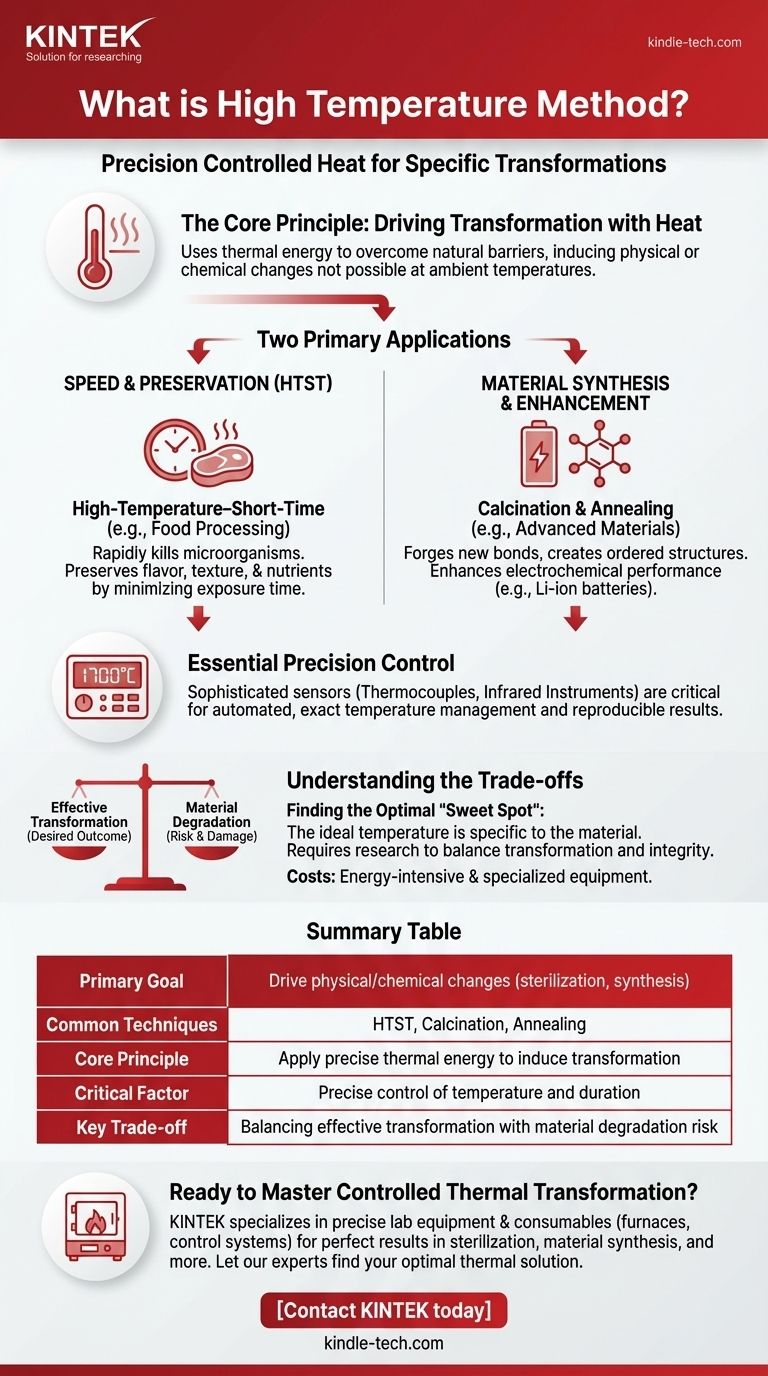
In essence, the "high temperature method" is not a single process but a broad category of techniques that use controlled, elevated heat to induce a specific physical or chemical change in a material. These methods are common across various fields, from food preservation, known as High-Temperature–Short-Time (HTST) processing, to advanced materials science for creating high-performance components like those in Li-ion batteries.

The core principle is using thermal energy as a tool to drive a desired transformation—such as sterilization or material synthesis—while carefully managing temperature and duration to avoid degrading the subject material's essential qualities.
What is high temperature method? A Guide to Controlled Thermal Transformation

The Core Principle: Driving Transformation with Heat

The fundamental goal of any high temperature method is to supply enough energy, in the form of heat, to overcome a natural barrier. This allows for changes that would not occur, or would occur too slowly, at ambient temperatures.

Speed and Efficiency

In many applications, the goal is to complete a process as quickly as possible. Applying a very high temperature for a very short time can achieve the desired outcome while minimizing unwanted side effects.

A classic example is the HTST method in food processing. It rapidly kills harmful microorganisms without significantly altering the food's flavor, texture, or nutritional value, which would happen with prolonged heating.

Material Synthesis and Enhancement

In materials science, high temperatures are used to create new structures or modify existing ones. This process, often called calcination or annealing, can forge new chemical bonds and create highly ordered materials.

For instance, a high-temperature solid-state method can produce a uniform carbon coating on battery components, which dramatically enhances their electrochemical performance and longevity.

Precision Control is Essential

Achieving the desired outcome is impossible without precise control over the thermal environment. The process is not simply about making something "hot."

Modern systems use sophisticated sensors, such as thermocouples for lower ranges and infrared instruments for temperatures above 1700°C. This allows for automated and exact temperature management, which is critical for reproducible results.

Understanding the Trade-offs

While powerful, high temperature methods are a balancing act. The same energy that drives a positive transformation can also cause damage if not applied correctly.

The Risk of Degradation

Every material has a temperature threshold beyond which it begins to break down. For food, this means a loss of quality. For an advanced chemical compound, it could mean complete structural failure.

The key is applying heat for the minimum duration required to achieve the goal, thereby preserving the material's integrity.

Finding the Optimal "Sweet Spot"

There is no universal "high temperature" that works for all applications. The optimal temperature is highly specific to the material being processed and the desired outcome.

Determining the ideal conditions for a new material often requires significant research and exploration to find the perfect balance between effective transformation and potential damage.

Energy and Equipment Costs

Maintaining very high temperatures is energy-intensive and requires specialized equipment built to withstand extreme thermal stress. These factors represent significant operational and capital costs that must be considered.

How to Apply This to Your Project

The right approach depends entirely on your end goal. The high temperature method is a means to an end, and your strategy should reflect the specific outcome you need to achieve.

  • If your primary focus is preservation or sterilization: Aim for a high-temperature, short-time (HTST) model to maximize the destructive effect on microbes while minimizing exposure time to preserve the core qualities of your product.
  • If your primary focus is material creation or modification: Concentrate on controlled calcination or annealing to create specific crystalline structures or surface properties, understanding that extensive testing is needed to find the optimal temperature for your specific material.

Ultimately, mastering a high temperature method is about understanding heat not as a brute force, but as a precise instrument for controlled change.

Summary Table:

Key Aspect Description
Primary Goal Use heat to drive physical/chemical changes (e.g., sterilization, synthesis).
Common Techniques High-Temperature-Short-Time (HTST), Calcination, Annealing.
Core Principle Apply precise thermal energy to overcome barriers and induce transformation.
Critical Factor Precise control of temperature and duration to avoid material degradation.
Key Trade-off Balancing effective transformation with the risk of damaging the material.

Ready to Master Controlled Thermal Transformation?

Choosing and implementing the right high temperature method is critical for your project's success. KINTEK specializes in providing the precise lab equipment and consumables—from high-temperature furnaces to exact temperature control systems—that your laboratory needs to achieve perfect results in sterilization, material synthesis, and beyond.

Let our experts help you find the optimal thermal solution. Contact KINTEK today to discuss your specific application!

Visual Guide
What is high temperature method? A Guide to Controlled Thermal Transformation Visual Guide

Related Products

People Also Ask

Related Products

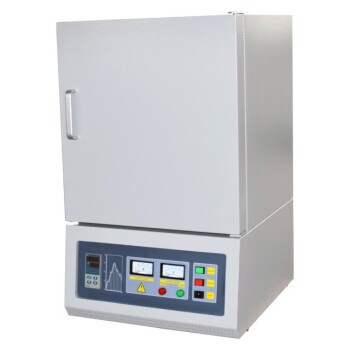
1700℃ Muffle Oven Furnace for Laboratory

1700℃ Muffle Oven Furnace for Laboratory

Get superior heat control with our 1700℃ Muffle Furnace. Equipped with intelligent temperature microprocessor, TFT touch screen controller & advanced insulation materials for precise heating up to 1700C. Order now!

Laboratory Muffle Oven Furnace Bottom Lifting Muffle Furnace

Laboratory Muffle Oven Furnace Bottom Lifting Muffle Furnace

Efficiently produce batches with excellent temperature uniformity using our Bottom Lifting Furnace. Features two electric lifting stages and advanced temperature control up to 1600℃.

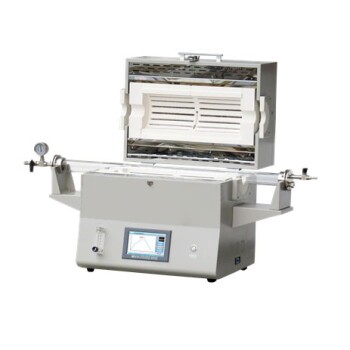
1400℃ Laboratory Quartz Tube Furnace with Alumina Tube Tubular Furnace

1400℃ Laboratory Quartz Tube Furnace with Alumina Tube Tubular Furnace

Looking for a tube furnace for high-temperature applications? Our 1400℃ Tube Furnace with Alumina Tube is perfect for research and industrial use.

High Temperature Muffle Oven Furnace for Laboratory Debinding and Pre Sintering

High Temperature Muffle Oven Furnace for Laboratory Debinding and Pre Sintering

KT-MD High temperature debinding and pre-sintering furnace for ceramic materials with various molding processes. Ideal for electronic components such as MLCC and NFC.

1700℃ Laboratory Quartz Tube Furnace with Alumina Tube Tubular Furnace

1700℃ Laboratory Quartz Tube Furnace with Alumina Tube Tubular Furnace

Looking for a high-temperature tube furnace? Check out our 1700℃ Tube Furnace with Alumina Tube. Perfect for research and industrial applications up to 1700C.

Laboratory Quartz Tube Furnace Tubular RTP Heating Furnace

Laboratory Quartz Tube Furnace Tubular RTP Heating Furnace

Get lightning-fast heating with our RTP Rapid Heating Tube Furnace. Designed for precise, high-speed heating and cooling with convenient sliding rail and TFT touch screen controller. Order now for ideal thermal processing!

1200℃ Split Tube Furnace with Quartz Tube Laboratory Tubular Furnace

1200℃ Split Tube Furnace with Quartz Tube Laboratory Tubular Furnace

KT-TF12 split tube furnace: high-purity insulation, embedded heating wire coils, and max. 1200C. Widely used for new materials and chemical vapour deposition.

Molybdenum Vacuum Heat Treat Furnace

Molybdenum Vacuum Heat Treat Furnace

Discover the benefits of a high-configuration molybdenum vacuum furnace with heat shield insulation. Ideal for high-purity, vacuum environments like sapphire crystal growth and heat treatment.

Graphite Vacuum Furnace High Thermal Conductivity Film Graphitization Furnace

Graphite Vacuum Furnace High Thermal Conductivity Film Graphitization Furnace

The high thermal conductivity film graphitization furnace has uniform temperature, low energy consumption and can operate continuously.

Ultra-High Temperature Graphite Vacuum Graphitization Furnace

Ultra-High Temperature Graphite Vacuum Graphitization Furnace

The ultra-high temperature graphitization furnace utilizes medium frequency induction heating in a vacuum or inert gas environment. The induction coil generates an alternating magnetic field, inducing eddy currents in the graphite crucible, which heats up and radiates heat to the workpiece, bringing it to the desired temperature. This furnace is primarily used for graphitization and sintering of carbon materials, carbon fiber materials, and other composite materials.

Graphite Vacuum Furnace IGBT Experimental Graphitization Furnace

Graphite Vacuum Furnace IGBT Experimental Graphitization Furnace

IGBT experimental graphitization furnace, a tailored solution for universities and research institutions, with high heating efficiency, user-friendliness, and precise temperature control.

Vacuum Dental Porcelain Sintering Furnace

Vacuum Dental Porcelain Sintering Furnace

Get precise and reliable results with KinTek's Vacuum Porcelain Furnace. Suitable for all porcelain powders, it features hyperbolic ceramic furnace function, voice prompt, and automatic temperature calibration.

Small Vacuum Heat Treat and Tungsten Wire Sintering Furnace

Small Vacuum Heat Treat and Tungsten Wire Sintering Furnace

The small vacuum tungsten wire sintering furnace is a compact experimental vacuum furnace specially designed for universities and scientific research institutes. The furnace features a CNC welded shell and vacuum piping to ensure leak-free operation. Quick-connect electrical connections facilitate relocation and debugging, and the standard electrical control cabinet is safe and convenient to operate.

Vacuum Heat Treat and Molybdenum Wire Sintering Furnace for Vacuum Sintering

Vacuum Heat Treat and Molybdenum Wire Sintering Furnace for Vacuum Sintering

A vacuum molybdenum wire sintering furnace is a vertical or bedroom structure, which is suitable for withdrawal, brazing, sintering and degassing of metal materials under high vacuum and high temperature conditions. It is also suitable for dehydroxylation treatment of quartz materials.

Vacuum Hot Press Furnace Machine for Lamination and Heating

Vacuum Hot Press Furnace Machine for Lamination and Heating

Experience clean and precise lamination with Vacuum Lamination Press. Perfect for wafer bonding, thin-film transformations, and LCP lamination. Order now!

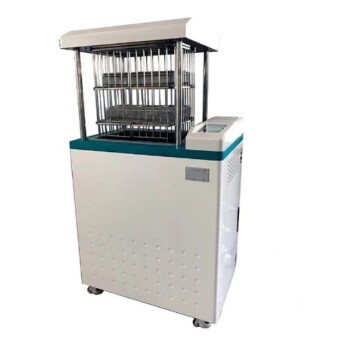
Laboratory Sterilizer Lab Autoclave Pulse Vacuum Lifting Sterilizer

Laboratory Sterilizer Lab Autoclave Pulse Vacuum Lifting Sterilizer

The pulse vacuum lifting sterilizer is a state-of-the-art equipment for efficient and precise sterilization. It uses pulsating vacuum technology, customizable cycles, and a user-friendly design for easy operation and safety.

Laboratory Sterilizer Lab Autoclave Vertical Pressure Steam Sterilizer for Liquid Crystal Display Automatic Type

Laboratory Sterilizer Lab Autoclave Vertical Pressure Steam Sterilizer for Liquid Crystal Display Automatic Type

Liquid crystal display automatic vertical sterilizer is a safe, reliable and automatic control sterilization equipment, which is composed of heating system, microcomputer control system and overheating and overvoltage protection system.

Laboratory Test Sieves and Sieving Machines

Laboratory Test Sieves and Sieving Machines

Precision lab test sieves & sieving machines for accurate particle analysis. Stainless steel, ISO-compliant, 20μm-125mm range. Request specs now!

High Energy Vibratory Laboratory Ball Mill Grinding Mill Single Tank Type

High Energy Vibratory Laboratory Ball Mill Grinding Mill Single Tank Type

High-energy vibration ball mill is a small desktop laboratory grinding instrument.It can be ball-milled or mixed with different particle sizes and materials by dry and wet methods.

HFCVD Machine System Equipment for Drawing Die Nano-Diamond Coating

HFCVD Machine System Equipment for Drawing Die Nano-Diamond Coating

The nano-diamond composite coating drawing die uses cemented carbide (WC-Co) as the substrate, and uses the chemical vapor phase method ( CVD method for short ) to coat the conventional diamond and nano-diamond composite coating on the surface of the inner hole of the mold.


Leave Your Message