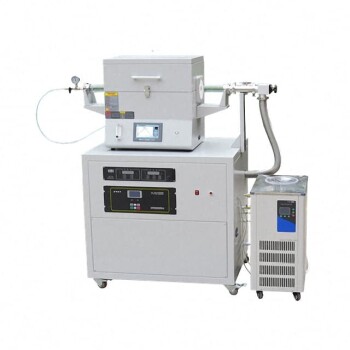
Laser Induced Chemical Vapour Deposition (LCVD) is a specialized technique for depositing thin films in which a laser beam provides the photon energy necessary to drive chemical reactions. Rather than relying on broad thermal heating, this method uses the laser to excite and decompose gas phase molecules, activating atoms that subsequently form a solid film on a target substrate.
LCVD elevates the standard Chemical Vapor Deposition (CVD) process by introducing a laser as the activation source. This allows for the direct manipulation of chemical reactions through photon energy, enabling precise control over where and how film formation occurs.
The Mechanics of Deposition
Photon-Driven Excitation
The fundamental principle of LCVD relies on the energy contained within photons. The laser beam interacts with the chemical vapor, providing the energy required to break chemical bonds.
Molecular Decomposition
Under the action of these photons, gas phase molecules are decomposed. This process activates the atoms within the gas, transitioning them from a stable vapor state into a reactive state capable of bonding.
Film Formation
Once activated, these atoms condense and react at the substrate level. This results in the growth of a thin, solid film with properties determined by the laser parameters and the precursor gases used.
Types of LCVD: Optical vs. Thermal
LCVD is not a monolithic process; it operates through two distinct mechanisms depending on how the laser energy is applied.
Optical LCVD (Photolytic)
In this method, the laser interacts directly with the gas. Resonant absorption occurs when the reacting gas molecules absorb laser light at specific wavelengths.
This direct absorption heats the molecules and induces dissociative chemical reactions before they even settle. Because the laser participates directly in the decomposition, it creates an extremely steep and controllable temperature gradient. This is ideal for preparing ultra-micro particles with strictly controlled components and sizes.
Thermal LCVD (Pyrolytic)
In this approach, the laser is used to heat the target, not the gas. The substrate absorbs the laser energy, creating a specific, localized temperature field on its surface.
When the reaction gas flows across this heated zone, the thermal energy drives the chemical reaction. This mirrors standard CVD but allows for localized deposition defined by the laser's focal point.
Understanding the Trade-offs
Wavelength Dependency
Optical LCVD relies on resonant absorption, meaning the laser wavelength must precisely match the absorption characteristics of the gas molecules. If the gas does not absorb the specific laser frequency being used, the direct decomposition required for this method will not occur.
Reaction Zone Control
While standard CVD coats large areas uniformly, LCVD creates steep temperature gradients. This offers high precision but requires sophisticated control systems to manage the reaction zone. The benefit is the ability to create ultra-micro particles, but the cost is increased process complexity compared to bulk heating methods.
Making the Right Choice for Your Goal
To determine if LCVD is the correct approach for your application, consider the specific requirements of your thin film project.
- If your primary focus is creating ultra-micro particles with controlled size: Utilize Optical LCVD, as the direct laser participation and steep temperature gradients allow for fine manipulation of particle growth.
- If your primary focus is localized film growth on a specific surface area: Utilize Thermal LCVD, which allows you to define exactly where the reaction occurs by heating only specific portions of the substrate.
LCVD offers a high-precision alternative to traditional deposition, granting you the ability to dictate exactly when and where chemical reactions take place.
Summary Table:
| Feature | Optical LCVD (Photolytic) | Thermal LCVD (Pyrolytic) |
|---|---|---|
| Energy Source | Direct photon absorption by gas | Laser-heated substrate surface |
| Primary Reaction | Molecular dissociation in gas phase | Thermal decomposition at surface |
| Best Used For | Ultra-micro particles & precise sizing | Localized deposition & micro-patterning |
| Key Advantage | Steep temperature gradients | Targeted heating of specific zones |
| Constraint | Wavelength must match gas absorption | Substrate must absorb laser energy |
Elevate Your Material Research with KINTEK’s Advanced Solutions
Are you looking to push the boundaries of thin film deposition and nanoparticle synthesis? KINTEK specializes in high-performance laboratory equipment designed for precision and reliability. Whether your research involves CVD, PECVD, or MPCVD processes, our range of high-temperature furnaces, vacuum systems, and crushing and milling equipment provides the control you need for superior results.
From high-pressure reactors for chemical synthesis to PTFE consumables and high-purity ceramics for contamination-free processing, KINTEK is your partner in advanced material science. Our expertise supports researchers in battery technology, dental ceramics, and industrial metallurgy with tailored solutions like isostatic presses and ULT freezers.
Ready to optimize your deposition process? Contact our technical experts today to discover how KINTEK can provide the specific tools and consumables required for your LCVD and CVD applications.
Related Products
- RF PECVD System Radio Frequency Plasma-Enhanced Chemical Vapor Deposition RF PECVD
- Chemical Vapor Deposition CVD Equipment System Chamber Slide PECVD Tube Furnace with Liquid Gasifier PECVD Machine
- Custom CVD Diamond Coating for Lab Applications
- Microwave Plasma Chemical Vapor Deposition MPCVD Machine System Reactor for Lab and Diamond Growth
- Customer Made Versatile CVD Tube Furnace Chemical Vapor Deposition Chamber System Equipment
People Also Ask
- What is plasma enhanced chemical vapour deposition PECVD used for? Enable Low-Temp Thin Films for Electronics & Solar
- What is an example of PECVD? RF-PECVD for High-Quality Thin Film Deposition
- What is the role of RF-PECVD in VFG preparation? Mastering Vertical Growth and Surface Functionality
- What is plasma enhanced chemical Vapour deposition process used for fabrication of? A Guide to Low-Temperature Thin Films
- What is plasma chemical vapor deposition? A Low-Temperature Thin Film Coating Solution