Knowledge vacuum induction melting furnace What is plasma arc melting? Achieve Unmatched Purity for High-Performance Metals
Author avatar

Tech Team · Kintek Solution

Updated 2 months ago

What is plasma arc melting? Achieve Unmatched Purity for High-Performance Metals


In essence, plasma arc melting (PAM) is a highly specialized process that uses a jet of ionized gas—a plasma—to melt and refine metals. Unlike conventional melting, which simply liquefies a material, PAM is an ultra-high-temperature furnace technology designed to produce exceptionally clean and high-quality ingots from reactive and high-performance metals like titanium and superalloys.

Plasma arc melting is not just a melting process; it is a purification process. Its primary value lies in its ability to remove contaminants and achieve precise metallurgical control, making it indispensable for critical applications in aerospace, medical, and defense industries.
What is plasma arc melting? Achieve Unmatched Purity for High-Performance Metals

How Plasma Arc Melting Works

Understanding the PAM process requires looking at how it generates and uses a controlled plasma arc within an inert environment to achieve results that other methods cannot.

The Core Components

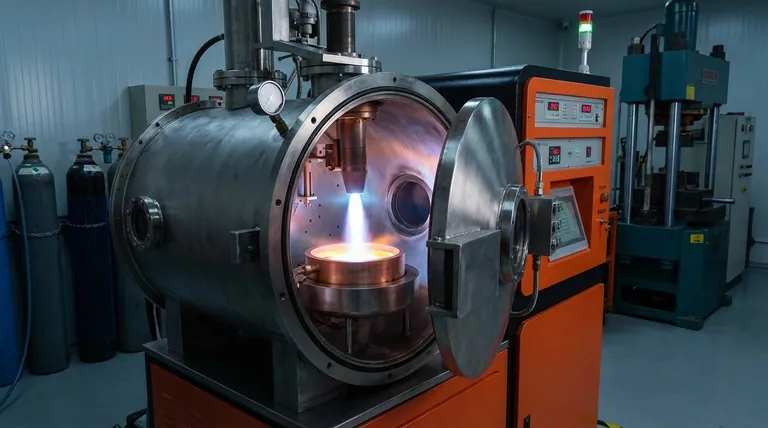
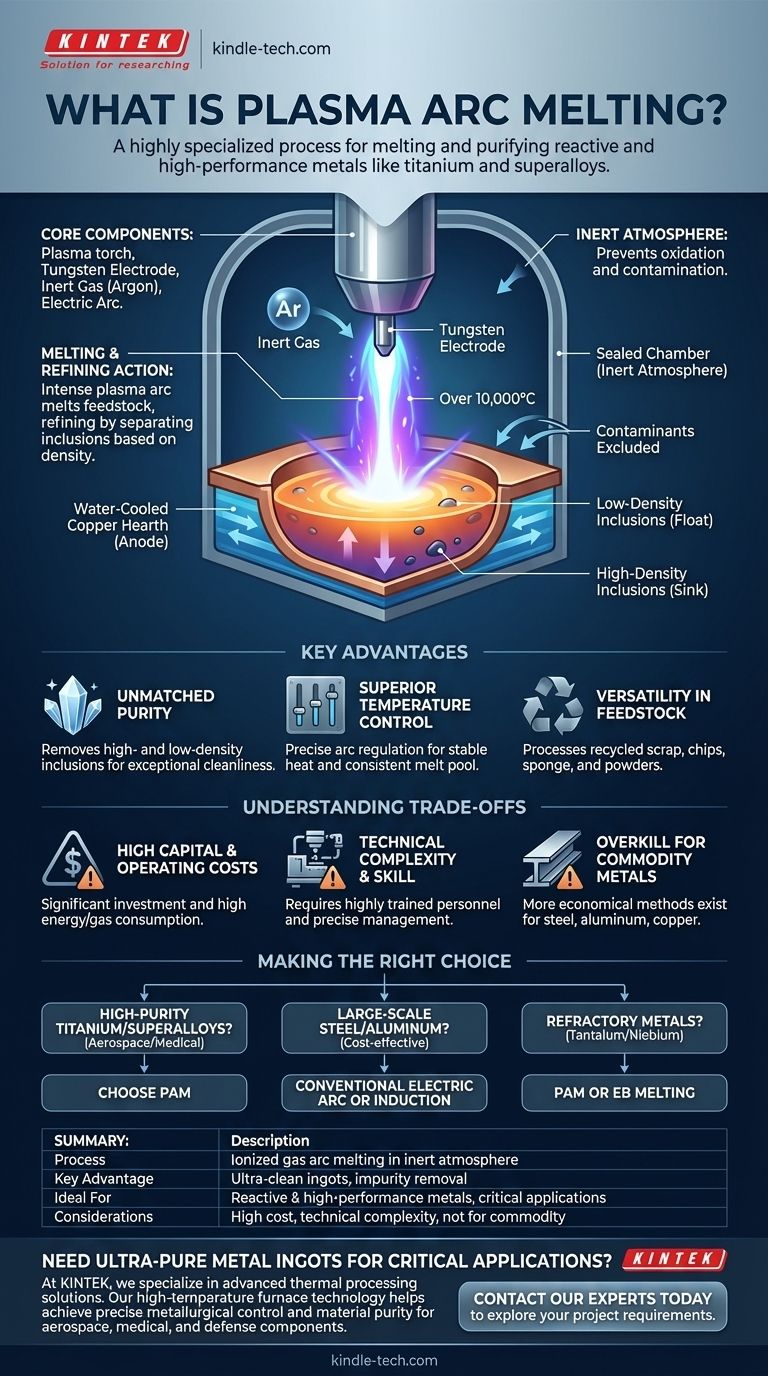
A plasma arc furnace consists of one or more plasma torches, which act as the heat source. A torch uses a tungsten electrode (cathode) through which an inert gas, typically argon, is passed. A powerful electric arc ionizes this gas, converting it into a superheated plasma jet.

The Melting and Refining Action

The material to be melted is placed in a water-cooled copper hearth or crucible, which acts as the anode. The plasma arc is directed at the material, with temperatures in the arc's core reaching over 10,000°C. This intense, focused energy rapidly melts the feedstock.

As the metal liquefies into a molten pool, the process begins its refining work. Lighter impurities, known as low-density inclusions, float to the surface and can be consolidated, while heavier high-density inclusions sink and become trapped at the bottom of the solidified ingot.

The Importance of the Inert Atmosphere

The entire process is conducted in a sealed chamber filled with an inert gas. This controlled atmosphere is critical because it prevents the highly reactive molten metal from being contaminated by oxygen and nitrogen from the air, which would degrade its properties.

Key Advantages of the PAM Process

Engineers and metallurgists choose PAM when the material's final quality is non-negotiable. Its advantages are centered on purity and control.

Unmatched Purity and Cleanliness

By effectively removing both high- and low-density inclusions, PAM produces a metal ingot with exceptional cleanliness. This is vital for materials like titanium alloys, where even microscopic impurities can lead to premature fatigue failure in a jet engine turbine blade or a medical implant.

Superior Temperature and Process Control

The energy output of the plasma torch can be precisely regulated, independent of the operating pressure inside the furnace. This provides a very stable and controllable heat source, allowing for a consistent melt pool and a predictable, uniform final product.

Versatility in Feedstock Material

PAM furnaces are flexible and can process a wide range of raw material forms. This includes everything from recycled scrap and machined chips to raw metal sponge and powders, allowing for efficient use of resources.

Understanding the Trade-offs and Limitations

While powerful, plasma arc melting is not a universal solution. Its specialized nature comes with significant considerations.

High Capital and Operating Costs

PAM furnaces are complex, precision-engineered systems that represent a significant capital investment. They also have high operating costs due to their consumption of electrical energy and large quantities of inert gas.

Technical Complexity and Skill Requirement

Operating a PAM furnace is not a simple task. It requires highly trained personnel who can manage the delicate balance between arc power, gas flow, cooling rates, and melting progression to ensure a successful outcome.

It's Overkill for Commodity Metals

For standard carbon steel, aluminum, or copper, much cheaper and higher-volume methods like induction furnaces or electric arc furnaces are far more economical. PAM is reserved for high-value materials where its refining benefits justify the cost.

Making the Right Choice for Your Goal

Selecting a melting technology depends entirely on your material and performance requirements. PAM is a tool for achieving the highest standards of metallurgical purity.

  • If your primary focus is producing high-purity titanium or superalloys for aerospace or medical use: PAM is the industry standard, offering unparalleled cleanliness and property control.
  • If your primary focus is large-scale, cost-effective production of steel or aluminum: Conventional electric arc or induction furnaces are the appropriate, economical choice.
  • If your primary focus is melting refractory metals like tantalum or niobium: PAM is a leading candidate, competing with Electron Beam (EB) melting, which operates in a high vacuum.

Ultimately, understanding the capabilities of plasma arc melting empowers you to create materials that meet the most demanding specifications with uncompromising quality.

Summary Table:

Feature Description
Process Uses an ionized gas (plasma) arc to melt and refine metals in an inert atmosphere.
Key Advantage Produces ultra-clean ingots by removing both high- and low-density impurities.
Ideal For Reactive & high-performance metals (titanium, superalloys), aerospace, medical implants.
Considerations High capital/operating costs, technical complexity, not for commodity metals.

Need to produce ultra-pure metal ingots for critical applications?

At KINTEK, we specialize in advanced thermal processing solutions for demanding laboratory and R&D environments. Our expertise in high-temperature furnace technology can help you achieve the precise metallurgical control and material purity required for aerospace, medical, and defense components.

Let's discuss how our specialized equipment can meet your specific material challenges. Contact our experts today to explore your project requirements.

Visual Guide
What is plasma arc melting? Achieve Unmatched Purity for High-Performance Metals Visual Guide

Related Products

People Also Ask

Related Products

Vacuum Arc Induction Melting Furnace

Vacuum Arc Induction Melting Furnace

Discover the power of Vacuum Arc Furnace for melting active & refractory metals. High-speed, remarkable degassing effect, and free of contamination. Learn more now!

Spark Plasma Sintering Furnace SPS Furnace

Spark Plasma Sintering Furnace SPS Furnace

Discover the benefits of Spark Plasma Sintering Furnaces for rapid, low-temperature material preparation. Uniform heating, low cost & eco-friendly.

Non Consumable Vacuum Arc Induction Melting Furnace

Non Consumable Vacuum Arc Induction Melting Furnace

Explore the benefits of Non-Consumable Vacuum Arc Furnace with high melting point electrodes. Small, easy to operate & eco-friendly. Ideal for laboratory research on refractory metals & carbides.

Vacuum Heat Treat Furnace and Levitation Induction Melting Furnace

Vacuum Heat Treat Furnace and Levitation Induction Melting Furnace

Experience precise melting with our Vacuum Levitation Melting Furnace. Ideal for high melting point metals or alloys, with advanced technology for effective smelting. Order now for high-quality results.

Lab-Scale Vacuum Induction Melting Furnace

Lab-Scale Vacuum Induction Melting Furnace

Get precise alloy composition with our Vacuum Induction Melting Furnace. Ideal for aerospace, nuclear energy, and electronic industries. Order now for effective smelting and casting of metals and alloys.

High Temperature Muffle Oven Furnace for Laboratory Debinding and Pre Sintering

High Temperature Muffle Oven Furnace for Laboratory Debinding and Pre Sintering

KT-MD High temperature debinding and pre-sintering furnace for ceramic materials with various molding processes. Ideal for electronic components such as MLCC and NFC.

Vacuum Heat Treat and Molybdenum Wire Sintering Furnace for Vacuum Sintering

Vacuum Heat Treat and Molybdenum Wire Sintering Furnace for Vacuum Sintering

A vacuum molybdenum wire sintering furnace is a vertical or bedroom structure, which is suitable for withdrawal, brazing, sintering and degassing of metal materials under high vacuum and high temperature conditions. It is also suitable for dehydroxylation treatment of quartz materials.

Vacuum Heat Treat Sintering Brazing Furnace

Vacuum Heat Treat Sintering Brazing Furnace

A vacuum brazing furnace is a type of industrial furnace used for brazing, a metalworking process that joins two pieces of metal using a filler metal that melts at a lower temperature than the base metals. Vacuum brazing furnaces are typically used for high-quality applications where a strong, clean joint is required.

Mesh belt controlled atmosphere furnace

Mesh belt controlled atmosphere furnace

Discover our KT-MB mesh belt sintering furnace - perfect for high-temperature sintering of electronic components & glass insulators. Available for open air or controlled atmosphere environments.

Vertical High Temperature Graphite Vacuum Graphitization Furnace

Vertical High Temperature Graphite Vacuum Graphitization Furnace

Vertical high temperature graphitization furnace for carbonization and graphitization of carbon materials up to 3100℃.Suitable for shaped graphitization of carbon fiber filaments and other materials sintered in a carbon environment.Applications in metallurgy, electronics, and aerospace for producing high-quality graphite products like electrodes and crucibles.

Ultra-High Temperature Graphite Vacuum Graphitization Furnace

Ultra-High Temperature Graphite Vacuum Graphitization Furnace

The ultra-high temperature graphitization furnace utilizes medium frequency induction heating in a vacuum or inert gas environment. The induction coil generates an alternating magnetic field, inducing eddy currents in the graphite crucible, which heats up and radiates heat to the workpiece, bringing it to the desired temperature. This furnace is primarily used for graphitization and sintering of carbon materials, carbon fiber materials, and other composite materials.

Horizontal High Temperature Graphite Vacuum Graphitization Furnace

Horizontal High Temperature Graphite Vacuum Graphitization Furnace

Horizontal Graphitization Furnace: This type of furnace is designed with the heating elements placed horizontally, allowing for uniform heating of the sample. It's well-suited for graphitizing large or bulky samples that require precise temperature control and uniformity.

Laboratory Muffle Oven Furnace Bottom Lifting Muffle Furnace

Laboratory Muffle Oven Furnace Bottom Lifting Muffle Furnace

Efficiently produce batches with excellent temperature uniformity using our Bottom Lifting Furnace. Features two electric lifting stages and advanced temperature control up to 1600℃.

600T Vacuum Induction Hot Press Furnace for Heat Treat and Sintering

600T Vacuum Induction Hot Press Furnace for Heat Treat and Sintering

Discover the 600T Vacuum Induction Hot Press Furnace, designed for high-temperature sintering experiments in vacuum or protected atmospheres. Its precise temperature and pressure control, adjustable working pressure, and advanced safety features make it ideal for nonmetal materials, carbon composites, ceramics, and metal powders.

2200 ℃ Tungsten Vacuum Heat Treat and Sintering Furnace

2200 ℃ Tungsten Vacuum Heat Treat and Sintering Furnace

Experience the ultimate refractory metal furnace with our Tungsten vacuum furnace. Capable of reaching 2200℃, perfect for sintering advanced ceramics and refractory metals. Order now for high-quality results.

Vacuum Heat Treat and Pressure Sintering Furnace for High Temperature Applications

Vacuum Heat Treat and Pressure Sintering Furnace for High Temperature Applications

Vacuum pressure sintering furnaces are designed for high temperature hot pressing applications in metal and ceramic sintering. Its advanced features ensure precise temperature control, reliable pressure maintenance, and a robust design for seamless operation.

1700℃ Controlled Atmosphere Furnace Nitrogen Inert Atmosphere Furnace

1700℃ Controlled Atmosphere Furnace Nitrogen Inert Atmosphere Furnace

KT-17A Controlled atmosphere furnace: 1700℃ heating, vacuum sealing technology, PID temperature control, and versatile TFT smart touch screen controller for laboratory and industrial use.

Graphite Vacuum Furnace High Thermal Conductivity Film Graphitization Furnace

Graphite Vacuum Furnace High Thermal Conductivity Film Graphitization Furnace

The high thermal conductivity film graphitization furnace has uniform temperature, low energy consumption and can operate continuously.

1400℃ Controlled Atmosphere Furnace with Nitrogen and Inert Atmosphere

1400℃ Controlled Atmosphere Furnace with Nitrogen and Inert Atmosphere

Achieve precise heat treatment with KT-14A controlled atmosphere furnace. Vacuum sealed with a smart controller, it's ideal for lab and industrial use up to 1400℃.

Vacuum Heat Treat Furnace with Ceramic Fiber Liner

Vacuum Heat Treat Furnace with Ceramic Fiber Liner

Vacuum furnace with polycrystalline ceramic fiber insulation liner for excellent heat insulation and uniform temperature field. Choose from 1200℃ or 1700℃ max. working temperature with high vacuum performance and precise temperature control.


Leave Your Message