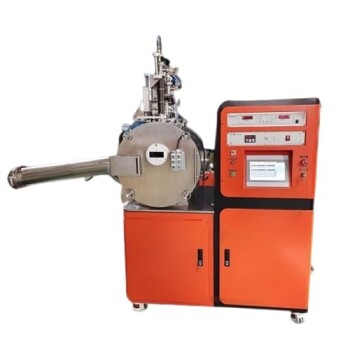
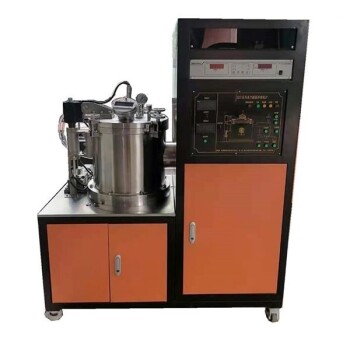
The primary function of a vacuum arc melting furnace in this context is to create a chemically homogeneous, high-purity master alloy ingot by melting raw metal materials under extreme heat. Utilizing high-energy electric arcs within a controlled argon atmosphere, the furnace facilitates the thorough mixing of iron (Fe), cobalt (Co), and other elements to ensure uniformity at the atomic scale, which is a prerequisite for producing high-quality metallic glass ribbons.
The Critical Foundation Producing metallic glass requires precise chemistry and zero impurities. The vacuum arc melting furnace serves as the "gatekeeper" of quality, using repeated melting cycles in an inert environment to eliminate oxidation and guarantee that every part of the alloy has the exact same chemical composition.
Achieving Atomic-Scale Homogeneity
The Necessity of Uniformity
For Fe-Co based metallic glasses, the initial master alloy must be perfectly mixed. If the elements are not distributed uniformly at the atomic level, the material may fail to form a glass structure during subsequent processing.
The Role of Repeated Melting
A single melt is rarely sufficient to mix multi-component elements. The furnace allows for repeated melting cycles, where the ingot is melted, solidified, flipped, and melted again. This process mechanically and thermally forces the constituent elements to mix thoroughly.
Overcoming Melting Point Differences
Iron and Cobalt have high melting points. The high-energy electric arc generates localized temperatures extreme enough to fully melt these refractory components, ensuring no un-melted particles remain to act as defect sites.
Preserving Material Purity
The Argon Shield
Fe and Co are chemically active and prone to oxidation at high temperatures. The furnace operates under a controlled high-purity argon atmosphere (often after pulling a vacuum) to shield the melt. This prevents oxygen from reacting with the metal, which would otherwise degrade the magnetic properties of the final product.
Preventing Electrode Contamination
Modern arc furnaces typically utilize a non-consumable electrode (often tungsten). This design ensures that the electrode itself does not degrade and introduce foreign impurities into the melt, maintaining the strict purity levels required for metallic glass.
Understanding the Trade-offs
The "Flip-Melt" Requirement
Because the electric arc provides localized heating, the bottom of the ingot is in contact with a water-cooled copper hearth and stays cooler. To achieve true homogeneity, the operator must manually or mechanically flip the ingot multiple times. Skipping this step is a common cause of compositional segregation.
Batch Size vs. Quality
This process is inherently a batch operation, ideal for high-precision, smaller-scale master alloys. It is not a continuous flow process, meaning throughput is sacrificed in exchange for the exceptional control over composition and purity required for high-performance materials.
Making the Right Choice for Your Goal
To ensure your Fe-Co master alloy meets the requirements for metallic glass production, prioritize the following parameters:
- If your primary focus is Compositional Uniformity: Ensure your process protocol mandates multiple flip-melting cycles (typically 4 or more) to guarantee atomic-level mixing.
- If your primary focus is Magnetic Performance: Verify the integrity of the vacuum and argon backfill systems to minimize oxygen content, as inclusions will act as pinning sites that degrade magnetic softness.
The quality of your final metallic glass ribbon is determined the moment the master alloy solidifies; the vacuum arc furnace is the tool that ensures this foundation is flawless.
Summary Table:
| Feature | Function in Fe-Co Alloy Preparation | Benefit for Metallic Glass |
|---|---|---|
| High-Energy Electric Arc | Rapidly melts high-melting-point elements (Fe, Co) | Ensures no un-melted defect sites remain |
| Inert Argon Atmosphere | Prevents oxidation during high-temperature melting | Protects magnetic properties and purity |
| Water-Cooled Copper Hearth | Facilitates rapid solidification after melting | Prevents contamination from the crucible |
| Repeated Flip-Melting | Mechanically forces thorough element mixing | Guarantees atomic-scale chemical uniformity |
Elevate Your Material Research with KINTEK Precision
Achieving the perfect atomic mix for Fe-Co metallic glasses requires more than just heat; it requires absolute control. KINTEK specializes in advanced laboratory equipment, providing high-performance vacuum arc melting furnaces and induction melting systems designed for the rigors of material science.
Whether you are developing magnetic alloys, exploring battery research, or require specialized crushing and milling systems, our comprehensive portfolio—from high-temperature furnaces to PTFE consumables—ensures your lab has the foundation for breakthrough results.
Ready to achieve flawless alloy homogeneity? Contact KINTEK today to discuss your project requirements!
References
- Jiali Jiang, Jian Lü. Synergistic function of iron and cobalt in metallic glasses for highly improving persulfate activation in water treatment. DOI: 10.1016/j.jallcom.2019.153574
This article is also based on technical information from Kintek Solution Knowledge Base .
Related Products
- Vacuum Arc Induction Melting Furnace
- Vacuum Induction Melting Spinning System Arc Melting Furnace
- Non Consumable Vacuum Arc Induction Melting Furnace
- Vacuum Heat Treat Furnace and Levitation Induction Melting Furnace
- Lab-Scale Vacuum Induction Melting Furnace
People Also Ask
- How do vacuum induction or arc melting furnaces facilitate the synthesis of U-Al-C MAX phases? Precision Heat & Purity
- What core role does a Vacuum Induction Melting furnace play in nickel-free steel production? Achieve High-Purity Alloys
- What is the function of vacuum arc melting equipment? Creating High-Purity Ferrochrome (CrFe) Alloys
- What is the function of a vacuum arc melting furnace? Prepare High-Purity Alx(CrFeNi)1-x High-Entropy Alloys
- What is the function of a vacuum arc melting furnace? Master Homogeneity for Amorphous Alloy Ribbons