Knowledge What is PVD coating on inserts? Boost Tool Life & Performance with Thin-Film Technology
Author avatar

Tech Team · Kintek Solution

Updated 1 week ago

What is PVD coating on inserts? Boost Tool Life & Performance with Thin-Film Technology


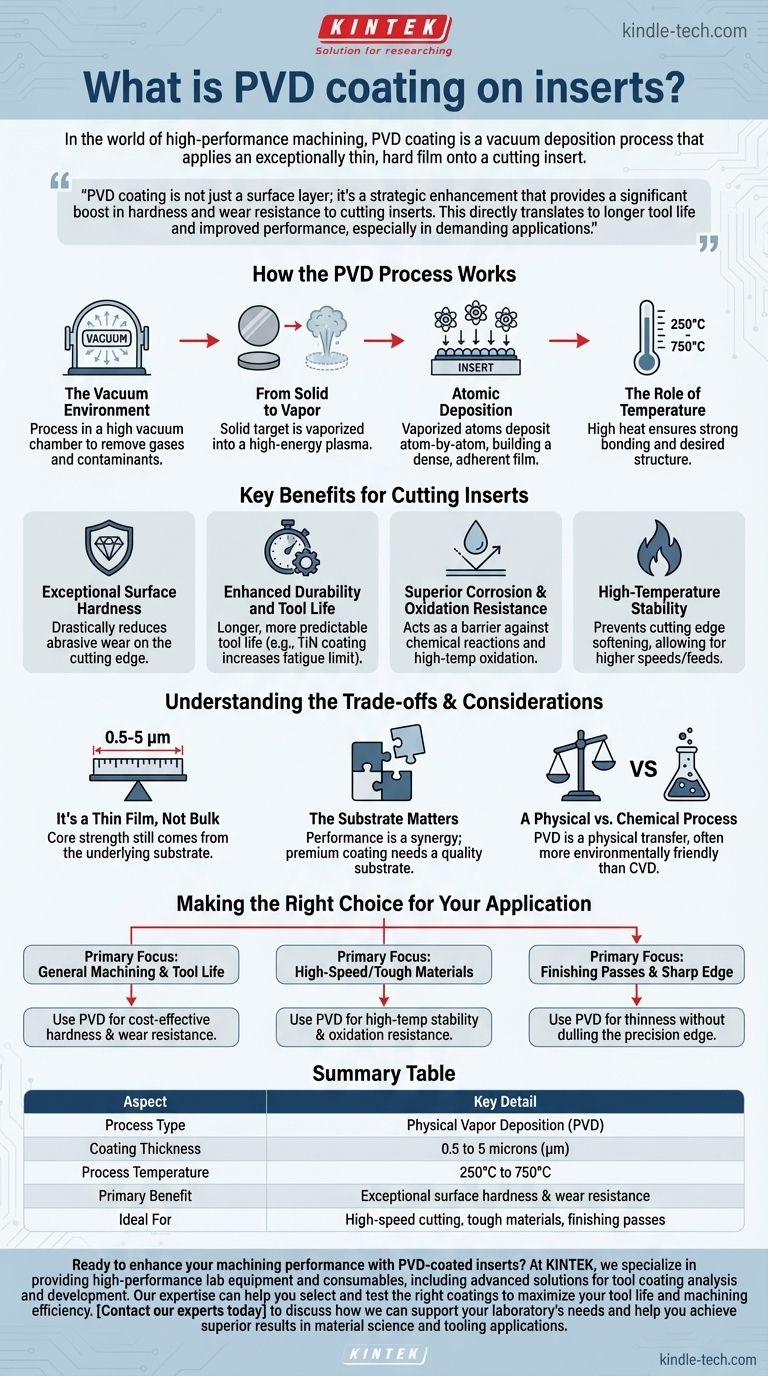
In the world of high-performance machining, PVD coating is a vacuum deposition process that applies an exceptionally thin, hard film onto a cutting insert. This technique works by vaporizing a solid material, which then condenses atom by atom onto the tool's surface. The result is a molecular-level enhancement of the insert's physical properties without altering its core geometry.

PVD coating is not just a surface layer; it's a strategic enhancement that provides a significant boost in hardness and wear resistance to cutting inserts. This directly translates to longer tool life and improved performance, especially in demanding applications.
What is PVD coating on inserts? Boost Tool Life & Performance with Thin-Film Technology

How the PVD Process Works

Physical Vapor Deposition (PVD) is a sophisticated process that transforms a solid material into a durable, high-performance coating. The entire operation takes place within a specialized, controlled environment.

The Vacuum Environment

The process must be carried out in a high vacuum chamber. This removes any atmospheric gases or contaminants that could interfere with the coating's purity and adhesion.

From Solid to Vapor

The coating material, known as the "target," begins as a solid wafer. Inside the vacuum chamber, this target is vaporized into a plasma, which is a high-energy state of matter.

Atomic Deposition

The vaporized atoms or molecules travel through the vacuum and are deposited onto the cutting inserts, which are called the "substrate." This builds the coating one atom at a time, creating an extremely dense and well-adhered thin film.

The Role of Temperature

This physical process is performed at high temperatures, typically ranging from 250°C to 750°C. This heat is critical for ensuring the coating bonds strongly to the insert's surface and forms the desired structure.

Key Benefits for Cutting Inserts

Applying a PVD coating fundamentally changes the performance characteristics of an insert. The benefits are directly tied to overcoming the common challenges faced in machining.

Exceptional Surface Hardness

PVD coatings are extremely hard, which is the primary reason for their use. This added hardness drastically reduces abrasive wear on the cutting edge as it engages with the workpiece.

Enhanced Durability and Tool Life

The increased hardness and wear resistance lead directly to a longer and more predictable tool life. For example, a Titanium Nitride (TiN) PVD coating can increase the fatigue limit and endurance of the underlying material.

Superior Corrosion and Oxidation Resistance

The dense, non-porous nature of the PVD film acts as a barrier, protecting the insert from chemical reactions. This makes it highly resistant to corrosion from coolants and oxidation at high cutting temperatures.

High-Temperature Stability

The resulting coated layer is very stable at the high temperatures generated during aggressive cutting operations. This prevents the cutting edge from softening, allowing for higher speeds and feeds.

Understanding the Trade-offs and Considerations

While powerful, PVD coatings are not a universal solution. Their effectiveness is dependent on understanding their nature and how they interact with the tool itself.

It's a Thin Film, Not a Bulk Material

PVD coatings are incredibly thin, typically ranging from 0.5 to 5 microns (μm). This means they provide surface properties, but the insert's core strength and toughness still come from the underlying substrate material.

The Substrate Matters

The final performance is a synergy between the coating and the insert. The benefits of a coating are directly influenced by the material it is applied to. A premium coating cannot compensate for a low-quality substrate.

A Physical vs. Chemical Process

PVD is a physical process, where the source material is physically transferred to the part. This contrasts with Chemical Vapor Deposition (CVD), which uses chemical reactions to form the film. PVD is often considered more environmentally friendly than traditional plating or CVD processes.

Making the Right Choice for Your Application

Knowing when to specify a PVD-coated insert over an uncoated or alternatively coated one is key to optimizing your machining strategy.

  • If your primary focus is extending tool life in general machining: PVD coatings provide a cost-effective and significant increase in hardness and wear resistance.
  • If your primary focus is high-speed cutting or working with tough materials: The high-temperature stability and oxidation resistance of PVD are critical advantages that protect the cutting edge.
  • If your primary focus is maintaining a sharp cutting edge for finishing passes: The thin, smooth nature of PVD coatings is ideal, as it adds durability without significantly dulling the precision edge required for fine surface finishes.

Ultimately, understanding PVD coating allows you to select a cutting insert based on a precise enhancement of its core properties, leading to more predictable and efficient machining.

Summary Table:

Aspect Key Detail
Process Type Physical Vapor Deposition (PVD)
Coating Thickness 0.5 to 5 microns (µm)
Process Temperature 250°C to 750°C
Primary Benefit Exceptional surface hardness & wear resistance
Ideal For High-speed cutting, tough materials, finishing passes

Ready to enhance your machining performance with PVD-coated inserts?

At KINTEK, we specialize in providing high-performance lab equipment and consumables, including advanced solutions for tool coating analysis and development. Our expertise can help you select and test the right coatings to maximize your tool life and machining efficiency.

Contact our experts today to discuss how we can support your laboratory's needs and help you achieve superior results in material science and tooling applications.

Visual Guide
What is PVD coating on inserts? Boost Tool Life & Performance with Thin-Film Technology Visual Guide

Related Products

People Also Ask

Related Products

RF PECVD System Radio Frequency Plasma-Enhanced Chemical Vapor Deposition RF PECVD

RF PECVD System Radio Frequency Plasma-Enhanced Chemical Vapor Deposition RF PECVD

RF-PECVD is an acronym for "Radio Frequency Plasma-Enhanced Chemical Vapor Deposition." It deposits DLC (Diamond-like carbon film) on germanium and silicon substrates. It is utilized in the 3-12um infrared wavelength range.

Custom PTFE Teflon Parts Manufacturer for Magnetic Stirring Bar

Custom PTFE Teflon Parts Manufacturer for Magnetic Stirring Bar

The PTFE magnetic stirring bar, made from high-quality PTFE, offers exceptional resistance to acids, alkalis, and organic solvents, coupled with high-temperature stability and low friction. Ideal for laboratory use, these stirring bars are compatible with standard flask ports, ensuring stability and safety during operations.

Stainless Steel Quick Release Vacuum Chain Three-Section Clamp

Stainless Steel Quick Release Vacuum Chain Three-Section Clamp

Discover our stainless steel quick release clamp vacuum clamp, Ideal for high vacuum applications, Strong connections, reliable sealing, Easy installation, and durable design.

Ultra-High Vacuum Flange Aviation Plug Glass Sintered Airtight Circular Connector for KF ISO CF

Ultra-High Vacuum Flange Aviation Plug Glass Sintered Airtight Circular Connector for KF ISO CF

Discover the Ultra-High Vacuum CF Knife-Edge Flange Aviation Plug, engineered for superior airtightness and durability in aerospace and semiconductor applications.

Custom PTFE Teflon Parts Manufacturer for PTFE Buchner Funnel and Triangular Funnel

Custom PTFE Teflon Parts Manufacturer for PTFE Buchner Funnel and Triangular Funnel

The PTFE funnel is a piece of laboratory equipment used primarily for filtration processes, particularly in the separation of solid and liquid phases in a mixture. This setup allows for efficient and rapid filtration, making it indispensable in various chemical and biological applications.

Custom PTFE Teflon Parts Manufacturer Corrosion Resistant Cleaning Rack Flower Basket

Custom PTFE Teflon Parts Manufacturer Corrosion Resistant Cleaning Rack Flower Basket

The PTFE cleaning rack, also known as the PTFE flower basket cleaning flower basket, is a specialized laboratory tool designed for the efficient cleaning of PTFE materials. This cleaning rack ensures thorough and safe cleaning of PTFE items, maintaining their integrity and performance in laboratory settings.

RRDE rotating disk (ring disk) electrode / compatible with PINE, Japanese ALS, Swiss Metrohm glassy carbon platinum

RRDE rotating disk (ring disk) electrode / compatible with PINE, Japanese ALS, Swiss Metrohm glassy carbon platinum

Elevate your electrochemical research with our Rotating Disk and Ring Electrodes. Corrosion resistant and customizable to your specific needs, with complete specifications.

Manual Lab Heat Press

Manual Lab Heat Press

Manual hydraulic presses are mainly used in laboratories for various applications such as forging, molding, stamping, riveting and other operations. It allows the creation of complex shapes while saving material.

Small Jaw Crusher for Laboratory and Small Mines Efficient Flexible Affordable Laboratory Ore Crusher Coal Crusher

Small Jaw Crusher for Laboratory and Small Mines Efficient Flexible Affordable Laboratory Ore Crusher Coal Crusher

Discover the small jaw crusher for efficient, flexible, and affordable crushing in labs and small mines. Ideal for coal, ores, and rocks. Learn more now!

Heated Hydraulic Press Machine with Heated Plates Split Manual Laboratory Hot Press

Heated Hydraulic Press Machine with Heated Plates Split Manual Laboratory Hot Press

Efficiently prepare your samples with our Split Manual Heated Lab Press. With a pressure range up to 40T and heating plates up to 300°C, it's perfect for various industries.

Single Punch Electric Tablet Press Machine Laboratory Powder Tablet Punching TDP Tablet Press

Single Punch Electric Tablet Press Machine Laboratory Powder Tablet Punching TDP Tablet Press

The single-punch electric tablet press is a laboratory-scale tablet press suitable for corporate laboratories in pharmaceutical, chemical, food, metallurgical and other industries.

24T 30T 60T Heated Hydraulic Press Machine with Heated Plates for Laboratory Hot Press

24T 30T 60T Heated Hydraulic Press Machine with Heated Plates for Laboratory Hot Press

Looking for a reliable Hydraulic Heated Lab Press? Our 24T / 40T model is perfect for material research labs, pharmacy, ceramics, and more. With a small footprint and the ability to work inside a vacuum glove box, it's the efficient and versatile solution for your sample preparation needs.

Lab Scale Rotary Single Punch Tablet Press Machine TDP Tablet Punching Machine

Lab Scale Rotary Single Punch Tablet Press Machine TDP Tablet Punching Machine

This machine is a single-pressure automatic rotating, continuous tableting machine that compresses granular raw materials into various tablets. It is mainly used for tablet production in the pharmaceutical industry, and is also suitable for chemical, food, electronics and other industrial sectors.

Lab-Scale Vacuum Induction Melting Furnace

Lab-Scale Vacuum Induction Melting Furnace

Get precise alloy composition with our Vacuum Induction Melting Furnace. Ideal for aerospace, nuclear energy, and electronic industries. Order now for effective smelting and casting of metals and alloys.

Laboratory Vacuum Tilt Rotary Tube Furnace Rotating Tube Furnace

Laboratory Vacuum Tilt Rotary Tube Furnace Rotating Tube Furnace

Discover the versatility of Laboratory Rotary Furnace: Ideal for calcination, drying, sintering, and high-temperature reactions. Adjustable rotating and tilting functions for optimal heating. Suitable for vacuum and controlled atmosphere environments. Learn more now!

High Pressure Laboratory Vacuum Tube Furnace Quartz Tubular Furnace

High Pressure Laboratory Vacuum Tube Furnace Quartz Tubular Furnace

KT-PTF High Pressure Tube Furnace: Compact split tube furnace with strong positive pressure resistance. Working temp up to 1100°C and pressure up to 15Mpa. Also works under controller atmosphere or high vacuum.

Vacuum Dental Porcelain Sintering Furnace

Vacuum Dental Porcelain Sintering Furnace

Get precise and reliable results with KinTek's Vacuum Porcelain Furnace. Suitable for all porcelain powders, it features hyperbolic ceramic furnace function, voice prompt, and automatic temperature calibration.

Lab Sterile Slapping Type Homogenizer for Tissue Mashing and Dispersing

Lab Sterile Slapping Type Homogenizer for Tissue Mashing and Dispersing

The slapping sterile homogenizer can effectively separate the particles contained in and on the surface of solid samples, ensuring that the mixed samples in the sterile bag are fully representative.

Small Vacuum Heat Treat and Tungsten Wire Sintering Furnace

Small Vacuum Heat Treat and Tungsten Wire Sintering Furnace

The small vacuum tungsten wire sintering furnace is a compact experimental vacuum furnace specially designed for universities and scientific research institutes. The furnace features a CNC welded shell and vacuum piping to ensure leak-free operation. Quick-connect electrical connections facilitate relocation and debugging, and the standard electrical control cabinet is safe and convenient to operate.

Molybdenum Disilicide (MoSi2) Thermal Elements Electric Furnace Heating Element

Molybdenum Disilicide (MoSi2) Thermal Elements Electric Furnace Heating Element

Discover the power of Molybdenum Disilicide (MoSi2) Heating Element for high-temperature resistance. Unique oxidation resistance with stable resistance value. Learn more about its benefits now!


Leave Your Message