Knowledge What is sintering in powder metallurgy? The Key to Strong, Dense Metal Parts
Author avatar

Tech Team · Kintek Solution

Updated 5 days ago

What is sintering in powder metallurgy? The Key to Strong, Dense Metal Parts


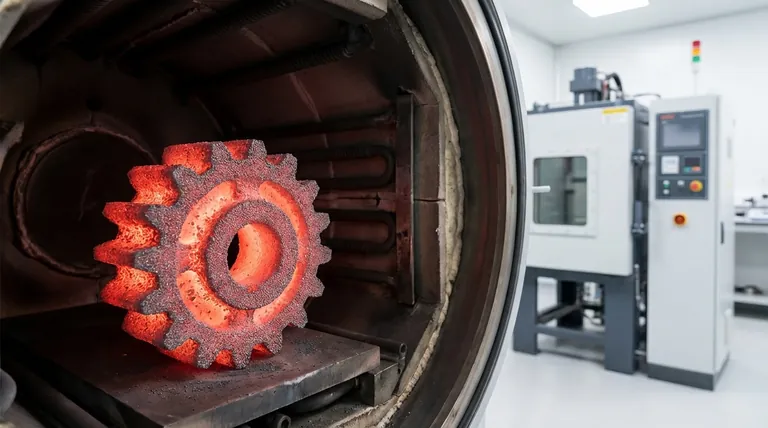
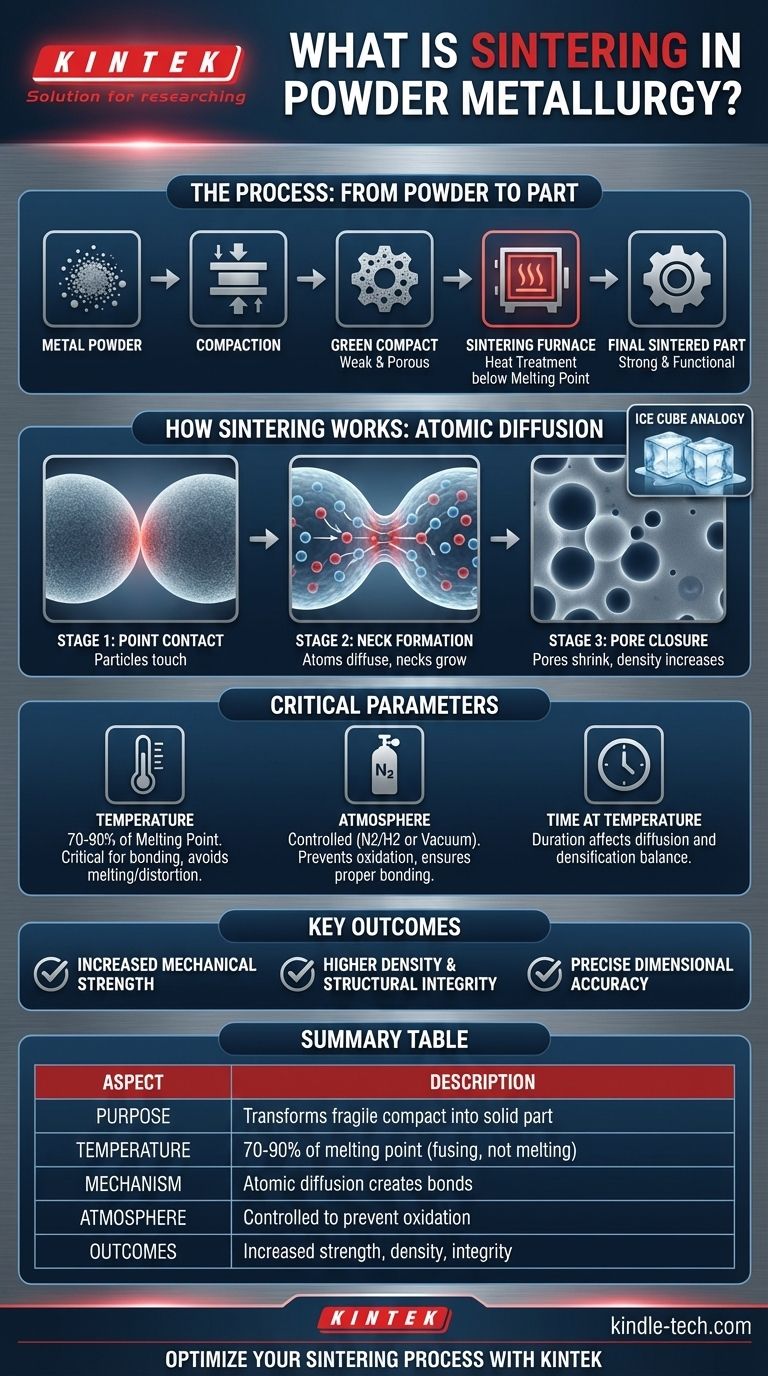
In powder metallurgy, sintering is a critical heat treatment process. It involves heating a compacted metal powder part, known as a "green compact," to a high temperature just below its melting point. This thermal energy causes the individual metal particles to fuse, creating strong bonds that give the component its final strength, density, and structural integrity.

The core purpose of sintering is to transform a fragile, pressed powder shape into a solid, functional metal part. It achieves this by bonding the metal particles together through atomic diffusion, fundamentally converting a collection of grains into a unified engineering material without ever melting it.
What is sintering in powder metallurgy? The Key to Strong, Dense Metal Parts

The Role of Sintering in the Powder Metallurgy Process

Powder metallurgy is a multi-step manufacturing method. Sintering is the crucial step that provides the final properties to the component after it has been initially shaped.

From Initial Shape to "Green Compact"

The process begins by pressing metal powders into a desired shape using a die. The resulting part is called a "green compact."

This green compact holds its shape but possesses very low mechanical strength. It is often brittle and porous, making it unsuitable for any functional application in this state.

The Sintering Transformation

The green compact is then placed into a controlled-atmosphere furnace for sintering. The high temperature, typically 70-90% of the metal's melting point, energizes the atoms.

This energy drives a process called atomic diffusion, where atoms migrate across the boundaries of adjacent particles. This migration creates metallurgical bonds, or "necks," at the points where the particles touch.

The Goal: Fusing, Not Melting

It is critical that the temperature remains below the material's melting point. Melting would cause the part to lose its precise shape and dimensional accuracy.

Sintering achieves the strength of a solid part while preserving the net-shape or near-net-shape geometry created during the compaction phase.

How Sintering Fundamentally Works

At a microscopic level, sintering is a process of reducing surface energy by bonding particles and minimizing empty space, or porosity.

The Ice Cube Analogy

An excellent way to visualize sintering is to think of ice cubes in a glass. Even at a temperature below melting (0°C or 32°F), ice cubes left in contact with each other will slowly fuse together at their contact points.

Sintering functions on a similar principle, but the process is accelerated dramatically by the high temperatures used for metal powders.

Reducing Porosity and Increasing Density

As the particles bond and the "necks" between them grow, the empty spaces (pores) within the compact begin to shrink and become more rounded.

This reduction in porosity leads to an increase in the part's overall density and strength. A properly sintered part is a solid, coherent mass with significantly improved mechanical properties compared to its green state.

Understanding the Critical Parameters

The success of the sintering process depends on precise control over several key variables. Failure to manage these can lead to defective parts.

The Importance of Temperature Control

The sintering temperature is the most critical parameter. Too low a temperature will result in incomplete bonding and poor strength. Too high a temperature risks melting, distortion, and loss of dimensional tolerance.

The Need for a Controlled Atmosphere

Sintering is almost always performed in a controlled atmosphere, such as a nitrogen/hydrogen mix or a vacuum. This is essential to prevent oxidation of the metal powders at high temperatures, which would inhibit proper bonding and degrade the material's properties.

Time at Temperature

The duration the part is held at the peak sintering temperature also influences the final outcome. A longer time allows for more complete diffusion and densification, but it must be balanced against production efficiency and the risk of undesirable grain growth.

The Key Outcomes of Successful Sintering

Applying this knowledge helps in understanding why sintering is essential for achieving specific manufacturing goals.

  • If your primary focus is mechanical strength: Sintering is the non-negotiable step that creates the strong, inter-particle atomic bonds necessary for load-bearing applications.
  • If your primary focus is dimensional accuracy: The sintering cycle must be precisely controlled to manage part shrinkage and achieve the final, desired density without distortion.
  • If your primary focus is material properties: Sintering is what transforms a simple powder compact into a finished component with the required hardness, durability, and structural integrity.

Ultimately, sintering is the fundamental process that gives powder metallurgy components their final form and function.

Summary Table:

Key Aspect Description
Purpose Transforms fragile "green compact" into solid, functional metal part
Temperature 70-90% of metal's melting point (fusing without melting)
Mechanism Atomic diffusion creates bonds between particles
Atmosphere Controlled (nitrogen/hydrogen or vacuum) to prevent oxidation
Key Outcomes Increased strength, density, and structural integrity

Ready to optimize your powder metallurgy process with precision sintering equipment? KINTEK specializes in laboratory furnaces and consumables that deliver the exact temperature control and atmosphere management required for successful sintering. Whether you're developing new metal components or improving existing manufacturing processes, our solutions ensure consistent, high-quality results. Contact our experts today to discuss how we can support your laboratory's specific sintering requirements!

Visual Guide
What is sintering in powder metallurgy? The Key to Strong, Dense Metal Parts Visual Guide

Related Products

People Also Ask

Related Products

Vacuum Heat Treat and Pressure Sintering Furnace for High Temperature Applications

Vacuum Heat Treat and Pressure Sintering Furnace for High Temperature Applications

Vacuum pressure sintering furnaces are designed for high temperature hot pressing applications in metal and ceramic sintering. Its advanced features ensure precise temperature control, reliable pressure maintenance, and a robust design for seamless operation.

Graphite Vacuum Furnace Negative Material Graphitization Furnace

Graphite Vacuum Furnace Negative Material Graphitization Furnace

Graphitization furnace for battery production has uniform temperature and low energy consumption. Graphitization furnace for negative electrode materials: an efficient graphitization solution for battery production and advanced functions to enhance battery performance.

Horizontal High Temperature Graphite Vacuum Graphitization Furnace

Horizontal High Temperature Graphite Vacuum Graphitization Furnace

Horizontal Graphitization Furnace: This type of furnace is designed with the heating elements placed horizontally, allowing for uniform heating of the sample. It's well-suited for graphitizing large or bulky samples that require precise temperature control and uniformity.

Small Vacuum Heat Treat and Tungsten Wire Sintering Furnace

Small Vacuum Heat Treat and Tungsten Wire Sintering Furnace

The small vacuum tungsten wire sintering furnace is a compact experimental vacuum furnace specially designed for universities and scientific research institutes. The furnace features a CNC welded shell and vacuum piping to ensure leak-free operation. Quick-connect electrical connections facilitate relocation and debugging, and the standard electrical control cabinet is safe and convenient to operate.

1200℃ Muffle Furnace Oven for Laboratory

1200℃ Muffle Furnace Oven for Laboratory

Upgrade your lab with our 1200℃ Muffle Furnace. Achieve fast, precise heating with Japan alumina fibers and Molybdenum coils. Features TFT touch screen controller for easy programming and data analysis. Order now!

Large Vertical Graphite Vacuum Graphitization Furnace

Large Vertical Graphite Vacuum Graphitization Furnace

A large vertical high-temperature graphitization furnace is a type of industrial furnace used for the graphitization of carbon materials, such as carbon fiber and carbon black. It is a high-temperature furnace that can reach temperatures of up to 3100°C.

Graphite Vacuum Furnace Bottom Discharge Graphitization Furnace for Carbon Materials

Graphite Vacuum Furnace Bottom Discharge Graphitization Furnace for Carbon Materials

Bottom-out graphitization furnace for carbon materials, ultra-high temperature furnace up to 3100°C, suitable for graphitization and sintering of carbon rods and carbon blocks. Vertical design, bottom discharging, convenient feeding and discharging, high temperature uniformity, low energy consumption, good stability, hydraulic lifting system, convenient loading and unloading.

Laboratory Sterilizer Lab Autoclave Vertical Pressure Steam Sterilizer for Liquid Crystal Display Automatic Type

Laboratory Sterilizer Lab Autoclave Vertical Pressure Steam Sterilizer for Liquid Crystal Display Automatic Type

Liquid crystal display automatic vertical sterilizer is a safe, reliable and automatic control sterilization equipment, which is composed of heating system, microcomputer control system and overheating and overvoltage protection system.

Vacuum Hot Press Furnace Machine for Lamination and Heating

Vacuum Hot Press Furnace Machine for Lamination and Heating

Experience clean and precise lamination with Vacuum Lamination Press. Perfect for wafer bonding, thin-film transformations, and LCP lamination. Order now!

Multi Heating Zones CVD Tube Furnace Machine Chemical Vapor Deposition Chamber System Equipment

Multi Heating Zones CVD Tube Furnace Machine Chemical Vapor Deposition Chamber System Equipment

KT-CTF14 Multi Heating Zones CVD Furnace - Precise Temperature Control and Gas Flow for Advanced Applications. Max temp up to 1200℃, 4 channels MFC mass flow meter, and 7" TFT touch screen controller.

Laboratory Scientific Electric Heating Blast Drying Oven

Laboratory Scientific Electric Heating Blast Drying Oven

The desktop fast autoclave sterilizer is a compact and reliable device used for rapid sterilization of medical, pharmaceutical, and research items.

Electric Rotary Kiln Small Rotary Furnace Biomass Pyrolysis Plant

Electric Rotary Kiln Small Rotary Furnace Biomass Pyrolysis Plant

Learn about Rotary Biomass Pyrolysis Furnaces & how they decompose organic material at high temps without oxygen. Use for biofuels, waste processing, chemicals & more.

Laboratory Sterilizer Lab Autoclave Pulse Vacuum Lifting Sterilizer

Laboratory Sterilizer Lab Autoclave Pulse Vacuum Lifting Sterilizer

The pulse vacuum lifting sterilizer is a state-of-the-art equipment for efficient and precise sterilization. It uses pulsating vacuum technology, customizable cycles, and a user-friendly design for easy operation and safety.

Laboratory Test Sieves and Sieving Machines

Laboratory Test Sieves and Sieving Machines

Precision lab test sieves & sieving machines for accurate particle analysis. Stainless steel, ISO-compliant, 20μm-125mm range. Request specs now!

HFCVD Machine System Equipment for Drawing Die Nano-Diamond Coating

HFCVD Machine System Equipment for Drawing Die Nano-Diamond Coating

The nano-diamond composite coating drawing die uses cemented carbide (WC-Co) as the substrate, and uses the chemical vapor phase method ( CVD method for short ) to coat the conventional diamond and nano-diamond composite coating on the surface of the inner hole of the mold.

Laboratory Hybrid Tissue Grinding Mill

Laboratory Hybrid Tissue Grinding Mill

KT-MT20 is a versatile laboratory device used for rapid grinding or mixing of small samples, whether dry, wet, or frozen. It comes with two 50ml ball mill jars and various cell wall breaking adapters for biological applications such as DNA/RNA and protein extraction.

Anti-Cracking Press Mold for Lab Use

Anti-Cracking Press Mold for Lab Use

The anti-cracking press mold is a specialized equipment designed for molding various shapes and sizes of film using high pressure and electric heating.

915MHz MPCVD Diamond Machine Microwave Plasma Chemical Vapor Deposition System Reactor

915MHz MPCVD Diamond Machine Microwave Plasma Chemical Vapor Deposition System Reactor

915MHz MPCVD Diamond Machine and its multi-crystal effective growth, the maximum area can reach 8 inches, the maximum effective growth area of single crystal can reach 5 inches. This equipment is mainly used for the production of large-size polycrystalline diamond films, the growth of long single crystal diamonds, the low-temperature growth of high-quality graphene, and other materials that require energy provided by microwave plasma for growth.

Inclined Rotary Plasma Enhanced Chemical Vapor Deposition PECVD Equipment Tube Furnace Machine

Inclined Rotary Plasma Enhanced Chemical Vapor Deposition PECVD Equipment Tube Furnace Machine

Upgrade your coating process with PECVD coating equipment. Ideal for LED, power semiconductors, MEMS and more. Deposits high-quality solid films at low temps.

High-Purity Titanium Foil and Sheet for Industrial Applications

High-Purity Titanium Foil and Sheet for Industrial Applications

Titanium is chemically stable, with a density of 4.51g/cm3, which is higher than aluminum and lower than steel, copper, and nickel, but its specific strength ranks first among metals.


Leave Your Message