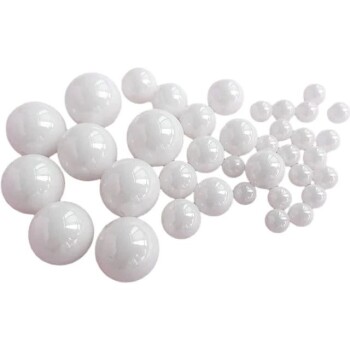
The primary advantage of using high-hardness Zirconia grinding balls is the critical preservation of material purity. Specifically, Zirconia media prevents the introduction of wear-induced contaminants during the aggressive, long-duration (13.5 hours) and high-speed (500 rpm) milling processes required to synthesize Na3SbS4-xSex electrolytes.
Core Insight: The synthesis of sulfide solid electrolytes is a high-energy process that destroys softer grinding media. The resulting debris creates impurity phases that block ion transport channels; Zirconia is uniquely capable of withstanding this environment to ensure high ionic conductivity.
The Critical Role of Purity in Electrolyte Synthesis
Withstanding High-Energy Processing
The synthesis of Na3SbS4-xSex requires a mechanochemical reaction driven by intense kinetic energy. The process involves high-speed milling at 500 rpm for extended periods, typically exceeding 13 hours.
Preventing Wear Debris
Under these aggressive conditions, standard grinding media would degrade rapidly. Zirconia’s extreme hardness allows it to withstand these impacts without shedding material. This prevents the electrolyte powder from being contaminated by the grinding media itself.
Preserving Ion Transport Channels
Purity is not merely a cosmetic requirement; it is functional. Foreign impurities introduced during milling can form secondary phases within the electrolyte. These impurity phases interfere with ion transport channels, directly degrading the material's ionic conductivity.
Mechanism of Action
Chemical Inertness
Beyond physical hardness, Zirconia provides chemical stability. Unlike metallic grinding balls, Zirconia is chemically inert and does not react with sensitive sulfide electrolytes.
Elimination of Metallic Contaminants
Using Zirconia prevents the introduction of iron or other metal fragments. Metallic impurities are particularly dangerous as they can trigger side reactions or cause internal short circuits during battery cycling.
Efficient Energy Transfer
The high density and hardness of Zirconia media allow for the efficient transfer of mechanical energy. This ensures the effective pulverization of hard particles and facilitates the necessary mechanochemical reactions without compromising the chemical makeup of the electrolyte.
The Risks of Inadequate Media
The Consequence of Soft Media
If grinding media with insufficient hardness is used, the wear rate increases dramatically. This results in a composite material that is a mixture of the desired electrolyte and media dust.
Electrochemical Instability
Contamination from improper media leads to a narrowing of the electrochemical window. This reduces the voltage range in which the electrolyte remains stable, limiting the overall performance and energy density of the final battery cell.
Making the Right Choice for Your Goal
To maximize the performance of Na3SbS4-xSex electrolytes, materials selection for the milling process is just as critical as the precursor materials themselves.
- If your primary focus is Ionic Conductivity: Prioritize Zirconia media to prevent impurity phases that block the internal pathways required for ion movement.
- If your primary focus is Electrochemical Stability: Use Zirconia to eliminate metallic contaminants that cause side reactions and reduce the electrochemical window.
By utilizing high-hardness Zirconia, you ensure the structural and chemical integrity required for high-performance solid-state batteries.
Summary Table:
| Feature | Advantage of Zirconia Media | Impact on Na3SbS4-xSex Electrolyte |
|---|---|---|
| Hardness | Resists wear during 500 rpm milling | Prevents debris from blocking ion transport channels |
| Chemical Inertness | Non-reactive with sulfides | Maintains chemical integrity and electrochemical window |
| Energy Transfer | High density for efficient pulverization | Facilitates complete mechanochemical reaction |
| Purity Control | No metallic contamination | Eliminates risks of internal short circuits |
Elevate Your Electrolyte Synthesis with KINTEK Precision
Don't let grinding media impurities compromise your battery research. KINTEK specializes in premium laboratory equipment and consumables designed for high-energy processing. From high-hardness Zirconia grinding balls and advanced crushing and milling systems to precision hydraulic presses and high-temperature furnaces, we provide the tools necessary to ensure maximum ionic conductivity and material purity.
Whether you are developing solid-state electrolytes or advanced battery components, our experts are ready to match you with the right solutions. Contact KINTEK today to optimize your lab's performance!
Related Products
- Laboratory Jar Ball Mill with Alumina Zirconia Grinding Jar and Balls
- Precision Machined Zirconia Ceramic Ball for Engineering Advanced Fine Ceramics
- Laboratory Jar Mill with Agate Grinding Jar and Balls
- Laboratory Ball Mill Jar Mill with Metal Alloy Grinding Jar and Balls
- High Energy Planetary Ball Mill Milling Machine for Laboratory
People Also Ask
- What are the primary functions of using a ball mill for BZCY72 powder? Achieve High Purity and Enhanced Sintering
- In what way does a laboratory ball mill affect material properties when modifying PHBV/pulp fiber composites?
- Why is a laboratory ball mill required for ultra-fine fly ash? Unlock Nano-Scale Adsorption Power
- What is the function of a laboratory ball mill in the preparation of AMMCs? Optimize Dispersion & Grain Refinement
- What is the function of a laboratory ball mill in the pretreatment of waste tire char (WTC)? Optimize Material Reactivity