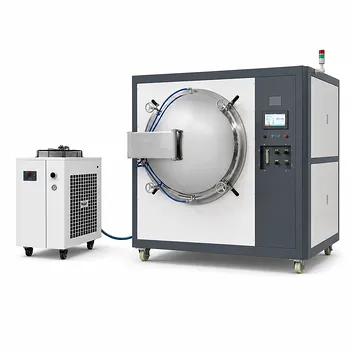
The definitive advantage of Very High Frequency Plasma Chemical Vapour Deposition (VHF-PECVD) is its ability to substantially increase the thin film precipitation rate. By operating at frequencies significantly higher than standard Radio Frequency (RF) systems, VHF-PECVD generates a plasma environment that allows for rapid film growth, effectively removing the speed bottlenecks associated with conventional methods.
Core Takeaway: VHF-PECVD overcomes the inherent deposition rate limitations of standard RF-PECVD. It achieves this by generating a higher density of plasma electrons at a lower plasma temperature, enabling faster processing without relying on the dilute silane mixtures often required by RF systems.
The Physics of Higher Throughput
To understand why VHF-PECVD outperforms RF-PECVD in terms of speed, one must look at the differences in plasma characteristics described in the primary technical literature.
Higher Plasma Electron Density
The shift to Very High Frequency excitation fundamentally changes the density of the plasma. VHF creates a significantly higher density of plasma electrons compared to conventional RF generation.
This increased density means there are more energetic electrons available to collide with and dissociate the precursor gases. This accelerates the chemical reactions required to deposit the film on the substrate.
Lower Plasma Temperature
Contrary to what one might expect, the primary reference notes that VHF-excited plasma maintains a much lower temperature than its RF counterpart.
It is important to distinguish this from the substrate temperature. Here, "plasma temperature" refers to the energy distribution of the electrons. A lower electron temperature combined with high density creates a "softer" but more active plasma, conducive to high-quality deposition at high speeds.
Overcoming RF-PECVD Limitations
Conventional RF-PECVD is a robust technology, but it faces specific constraints that VHF addresses directly.
Removing the Dilution Constraint
In standard RF-PECVD processes, engineers often have to use dilute silane gas mixtures to achieve high-quality precipitation at low temperatures.
While this technique works, it artificially limits the deposition rate. VHF-PECVD removes this requirement. Because the plasma density is naturally higher, the process can sustain high precipitation rates without needing to heavily dilute the precursor gas, unlocking higher production efficiency.
Understanding the Trade-offs
While VHF-PECVD offers superior speed, it is part of the broader PECVD family, and the complexity of the technology introduces specific challenges that must be managed.
Equipment Complexity and Maintenance
Transitioning to higher frequencies often increases equipment complexity. As noted in general PECVD operational data, complex systems require rigorous maintenance and debugging to ensure consistent performance.
Film Formation Stability
High-speed deposition brings the risk of film formation stability issues. If the plasma becomes unstable, it can lead to defects such as film bursting or quality fluctuations. Precisely controlling the process parameters (power, flow, pressure) is critical to preventing these instabilities.
Making the Right Choice for Your Goal
The decision to utilize VHF-PECVD over RF-PECVD should be driven by your specific manufacturing priorities.
- If your primary focus is Production Throughput: VHF-PECVD is the superior choice because its high electron density enables substantially faster deposition rates.
- If your primary focus is Process Efficiency: VHF-PECVD allows you to avoid the use of dilute silane, streamlining the gas composition requirements while maintaining speed.
- If your primary focus is Substrate Safety: Both methods offer low-temperature deposition (room temperature to 350°C), but VHF's lower plasma temperature may offer additional protection against ion bombardment damage.
Summary: VHF-PECVD is the high-performance evolution of the standard RF process, trading a degree of system simplicity for a massive gain in deposition speed and process efficiency.
Summary Table:
| Feature | RF-PECVD (13.56 MHz) | VHF-PECVD (30-300 MHz) |
|---|---|---|
| Deposition Rate | Standard / Limited | Significantly Higher |
| Plasma Electron Density | Lower | Higher |
| Plasma Temperature | Higher | Much Lower (Softer Plasma) |
| Precursor Requirement | Often requires dilute silane | High rates without dilution |
| Process Efficiency | Moderate | High (High Throughput) |
Elevate Your Thin Film Research with KINTEK
Transitioning to VHF-PECVD is a game-changer for labs demanding high throughput without compromising material integrity. At KINTEK, we specialize in high-performance laboratory equipment, providing advanced CVD and PECVD systems tailored to your precise research needs.
Whether you are scaling up semiconductor production or exploring novel battery research tools, our comprehensive portfolio—including high-temperature furnaces, vacuum systems, and crushing equipment—is designed for precision and durability.
Ready to accelerate your deposition processes? Contact our experts today to find the perfect technical solution for your laboratory.
Related Products
- RF PECVD System Radio Frequency Plasma-Enhanced Chemical Vapor Deposition RF PECVD
- Inclined Rotary Plasma Enhanced Chemical Vapor Deposition PECVD Equipment Tube Furnace Machine
- Chemical Vapor Deposition CVD Equipment System Chamber Slide PECVD Tube Furnace with Liquid Gasifier PECVD Machine
- Inclined Rotary Plasma Enhanced Chemical Vapor Deposition PECVD Equipment Tube Furnace Machine
- Electric Heated Hydraulic Vacuum Heat Press for Lab
People Also Ask
- What is plasma enhanced chemical vapour deposition PECVD used for? Enable Low-Temp Thin Films for Electronics & Solar
- What is an example of PECVD? RF-PECVD for High-Quality Thin Film Deposition
- What is the role of RF-PECVD in VFG preparation? Mastering Vertical Growth and Surface Functionality
- What is plasma enhanced chemical Vapour deposition process used for fabrication of? A Guide to Low-Temperature Thin Films
- What is plasma CVD? Unlock Low-Temperature Thin Film Deposition for Sensitive Materials