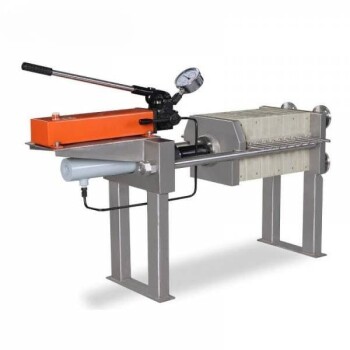
In the fabrication of layered copper-based electrical contact materials, the laboratory hydraulic press acts as the critical stabilization tool during the powder stacking phase. Its primary function is to apply a specific pre-pressure—approximately 60MPa—to individual powder layers, such as Cu-Y composites and pure copper, to generate initial plastic deformation.
The hydraulic press serves a function far more sophisticated than simple compaction; it is the gatekeeper of layer integrity. By fixing loose powder into a solid state before the next layer is added, it prevents inter-layer mixing and ensures the precise compositional gradients required for high-performance electrical contacts.
The Mechanics of Layered Pre-Pressing
Establishing Initial Plastic Deformation
The primary technical objective of the hydraulic press in this context is to transform loose powder into a semi-solid state. By applying 60MPa of pressure, the press forces the powder particles to undergo initial plastic deformation.
This deformation creates a "pre-pressed block" with sufficient mechanical strength to be handled. This structural integrity is a prerequisite for the material to withstand the subsequent stages of manufacturing without collapsing or shifting.
Facilitating the Stacking Process
Fabricating layered materials involves a delicate "powder stacking" process, typically performed within a graphite mold. The hydraulic press is utilized sequentially after each specific layer of powder is deposited.
Rather than pressing the entire stack at once, the machine applies low-pressure pre-pressing to each layer individually. This step compacts the current layer, creating a stable foundation for the next deposition.
Critical Impacts on Material Quality
Preventing Inter-Layer Mixing
The most significant contribution of the hydraulic press is the preservation of the compositional gradient. If loose powder were simply piled on top of loose powder, the interface would become undefined and muddy.
By fixing the powder through pre-pressing, the machine ensures that the addition of a subsequent layer does not disrupt the existing one. This results in a clear, distinct distribution of materials between the composite layers.
Enhancing Interface Bonding
The pre-pressing stage is not the final densification, but it prepares the material for hot pressing sintering. The initial compaction ensures that the layers are in intimate contact before high heat is applied.
This preparation facilitates layered filling and promotes high-quality bonding at the interlayer interface. Without this pre-densification, the final sintered product would likely suffer from delamination or weak structural continuity.
Process Considerations and Risks
The Necessity of Sequential Pressure
A common pitfall in layered fabrication is attempting to compress multiple powder variations simultaneously without intermediate steps. This often leads to uncontrolled mixing and structural inconsistencies.
The hydraulic press must be used to fix the "loose" state of the powder immediately upon deposition. Skipping this step risks the disruption of the interface, effectively destroying the intended layered architecture of the electrical contact.
Making the Right Choice for Your Goal
## Optimizing Fabrication for Performance
- If your primary focus is Structural Integrity: Ensure your press is set to approximately 60MPa to achieve the necessary plastic deformation for handling strength.
- If your primary focus is Compositional Accuracy: Prioritize sequential pre-pressing within the graphite mold to lock in the gradient and prevent inter-layer mixing.
The laboratory hydraulic press transforms undefined powder into a precision-engineered structure, acting as the essential bridge between raw material and the final sintered product.
Summary Table:
| Process Phase | Function of Hydraulic Press | Technical Impact |
|---|---|---|
| Powder Stacking | Sequential Pre-pressing (60MPa) | Converts loose powder to a stable semi-solid state |
| Layer Management | Fixing Individual Layers | Prevents inter-layer mixing and preserves compositional gradients |
| Interface Prep | Initial Plastic Deformation | Promotes superior bonding during final hot pressing sintering |
| Structural Control | Mold Stabilization | Prevents delamination and ensures structural continuity |
Elevate Your Material Research with KINTEK Precision
Precision in layered material fabrication starts with the right equipment. KINTEK specializes in high-performance laboratory hydraulic presses (pellet, hot, and isostatic) designed to provide the exact pressure control—such as the critical 60MPa required for copper-based composites—to ensure your research integrity.
Beyond pressing solutions, our comprehensive portfolio supports your entire workflow with:
- High-temperature furnaces (muffle, vacuum, and CVD) for advanced sintering.
- Crushing and milling systems for precise powder preparation.
- High-pressure reactors and autoclaves for specialized material synthesis.
- Essential consumables including ceramics, crucibles, and PTFE products.
Don't let inter-layer mixing compromise your electrical contact performance. Partner with KINTEK for reliable, high-precision laboratory equipment. Contact our technical experts today to find the perfect solution for your lab!
Related Products
- Laboratory Hydraulic Press Lab Pellet Press Machine for Glove Box
- Laboratory Hydraulic Press Split Electric Lab Pellet Press
- Laboratory Hydraulic Press Lab Pellet Press for Button Battery
- Automatic Laboratory Hydraulic Press for XRF & KBR Pellet Press
- Automatic Laboratory Hydraulic Pellet Press Machine for Lab Use
People Also Ask
- What is the function of a laboratory hydraulic press in W-Cu composites? Control Porosity and Material Ratio
- What is the role of a laboratory hydraulic press in the initial stages of Li6PS5Cl preparation? Key to Green Pellets
- What role does a laboratory hydraulic press play in triboelectric testing? Achieve Precision Alloy Sample Prep
- How can a laboratory hydraulic press be applied to chitosan for wastewater treatment? Optimize Pores & Strength
- How do a precision laboratory hydraulic press and specialized molds contribute to the fabrication of spherical ceramic samples? Achieving High-Density Material Precision