Knowledge atmosphere furnace What is the atmosphere of the annealing furnace? A Guide to Protective Gas Selection
Author avatar

Tech Team · Kintek Solution

Updated 2 months ago

What is the atmosphere of the annealing furnace? A Guide to Protective Gas Selection


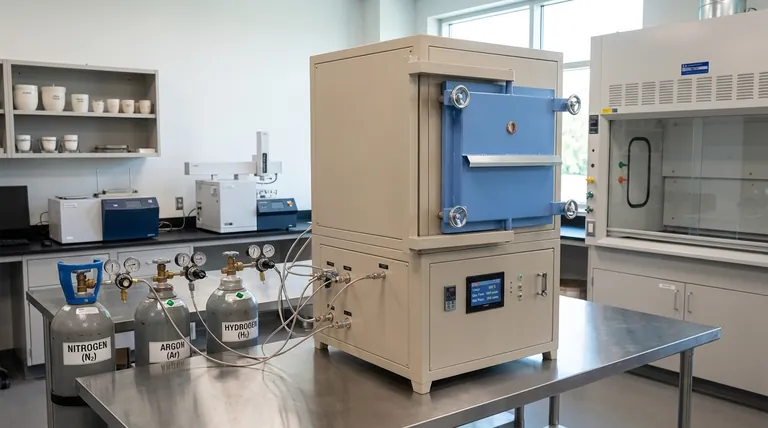
The atmosphere in an annealing furnace is a carefully controlled gas or mixture of gases intentionally introduced into the heating chamber. This atmosphere displaces ambient air to protect the material from oxidation and other unwanted surface reactions during the high-temperature process. The specific gas used—such as nitrogen, hydrogen, or argon—is selected based on the material being treated and the desired final properties.

The primary purpose of an annealing furnace atmosphere isn't just to fill a space; it's an active, engineered component of the process designed to control the surface chemistry of the material, preventing defects and ensuring the final product meets its metallurgical specifications.
What is the atmosphere of the annealing furnace? A Guide to Protective Gas Selection

The Core Function of a Furnace Atmosphere

A controlled atmosphere is fundamental to the success of the annealing process. It serves several critical purposes that directly impact the quality of the finished product.

Preventing Oxidation and Scaling

At the high temperatures required for annealing, most metals will readily react with oxygen in the air. This reaction, known as oxidation, creates a layer of scale on the material's surface, which is often undesirable and must be removed. A protective atmosphere displaces the oxygen, preventing this from happening.

Ensuring Surface Purity

Beyond just preventing oxidation, the furnace atmosphere ensures the surface of the material remains clean and free from contamination. It provides a specific, controlled environment that stops other unwanted chemical reactions from occurring at high temperatures.

Aiding in Uniform Heating

The atmosphere itself acts as a medium for heat transfer. In many furnace designs, powerful convection fans stir the heated protective atmosphere, as noted with aluminum products. This strong circulation ensures that all parts of the workpiece reach the target temperature evenly and consistently.

Common Types of Annealing Atmospheres

The choice of atmosphere depends entirely on the material being processed and the specific goals of the annealing cycle. Different gases provide different levels of protection and reactivity.

Inert Atmospheres (Nitrogen, Argon)

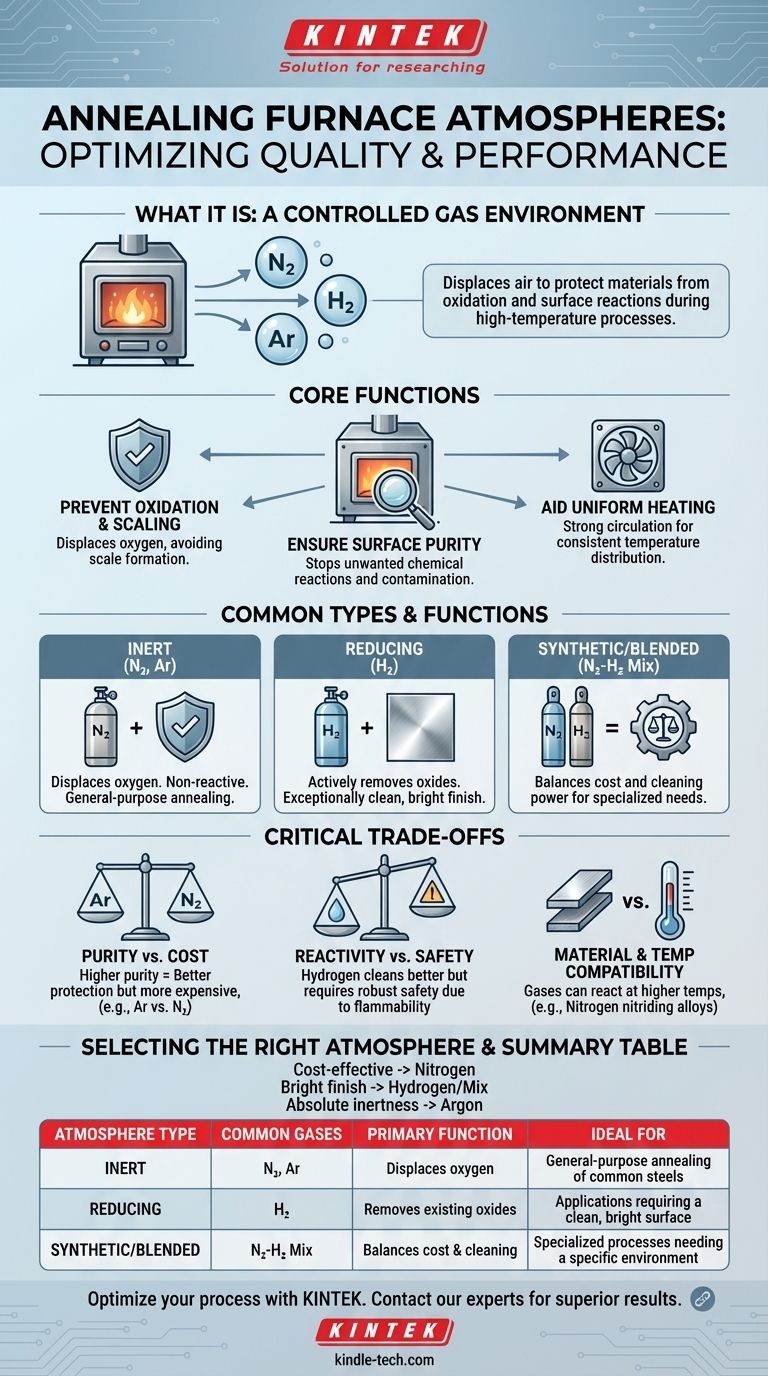
Inert atmospheres are the most common choice for general-purpose annealing. Gases like nitrogen (N₂) and argon (Ar) are used because they are non-reactive with most metals under annealing conditions. They work by simply displacing the oxygen.

Reducing Atmospheres (Hydrogen)

A reducing atmosphere, typically containing hydrogen (H₂), goes a step further. Instead of just preventing oxidation, hydrogen actively reacts with and removes any existing oxides on the material's surface. This results in an exceptionally clean and bright surface finish.

Synthetic & Blended Atmospheres

For highly specialized processes, gases are often mixed to create a synthetic atmosphere with specific properties. For example, a blend of nitrogen and hydrogen can balance the cost-effectiveness of nitrogen with the cleaning power of hydrogen.

Understanding the Critical Trade-offs

Selecting an atmosphere is an engineering decision that involves balancing performance, cost, and safety. There is no single "best" option for all applications.

Gas Purity vs. Cost

Higher purity gases provide better protection. Argon, for instance, is more inert than nitrogen at very high temperatures but is also significantly more expensive. The required purity level is dictated by the sensitivity of the material being processed.

Reactivity vs. Safety

While hydrogen provides superior surface cleaning, it is also highly flammable. Furnaces designed for hydrogen atmospheres require robust safety features, including specialized pressure and flow control systems, which adds to their complexity and cost.

Material and Temperature Compatibility

The inertness of a gas can change with temperature. While nitrogen is non-reactive with most steels, it can form nitrides on the surface of certain alloys at higher temperatures. Understanding the specific interaction between the gas, the material, and the temperature is critical to avoid unintended surface modification.

Selecting the Right Atmosphere for Your Process

Your choice of atmosphere should be directly aligned with the technical requirements of your material and the desired outcome of the annealing cycle.

  • If your primary focus is cost-effective oxidation prevention for common steels: A nitrogen-based atmosphere is often the most balanced and widely used choice.
  • If your primary focus is achieving the brightest, cleanest possible surface finish: A hydrogen or a nitrogen-hydrogen blend is superior due to its active reducing properties.
  • If your primary focus is treating highly reactive metals or applications demanding absolute inertness: A pure argon atmosphere is necessary, despite the higher operational cost.

Choosing the correct furnace atmosphere is a critical engineering decision that directly impacts the quality, performance, and cost of the final product.

Summary Table:

Atmosphere Type Common Gases Primary Function Ideal For
Inert Nitrogen (N₂), Argon (Ar) Displaces oxygen to prevent oxidation General-purpose annealing of common steels
Reducing Hydrogen (H₂) Actively removes existing oxides for a bright finish Applications requiring a clean, bright surface
Synthetic/Blended Nitrogen-Hydrogen Mix Balances cost and cleaning power Specialized processes needing a specific environment

Optimize your annealing process with the right atmosphere. The choice of furnace gas is critical to achieving your desired material properties, from preventing oxidation to ensuring a bright surface finish. KINTEK specializes in lab equipment and consumables, providing expert solutions for your laboratory's thermal processing needs. Contact our experts today to discuss the ideal annealing furnace atmosphere for your specific application and ensure superior results.

Visual Guide
What is the atmosphere of the annealing furnace? A Guide to Protective Gas Selection Visual Guide

Related Products

People Also Ask

Related Products

Controlled Nitrogen Inert Hydrogen Atmosphere Furnace

Controlled Nitrogen Inert Hydrogen Atmosphere Furnace

KT-AH Hydrogen atmosphere furnace - induction gas furnace for sintering/annealing with built-in safety features, dual housing design, and energy-saving efficiency. Ideal for lab and industrial use.

Vacuum Heat Treat Furnace with Ceramic Fiber Liner

Vacuum Heat Treat Furnace with Ceramic Fiber Liner

Vacuum furnace with polycrystalline ceramic fiber insulation liner for excellent heat insulation and uniform temperature field. Choose from 1200℃ or 1700℃ max. working temperature with high vacuum performance and precise temperature control.

High Temperature Muffle Oven Furnace for Laboratory Debinding and Pre Sintering

High Temperature Muffle Oven Furnace for Laboratory Debinding and Pre Sintering

KT-MD High temperature debinding and pre-sintering furnace for ceramic materials with various molding processes. Ideal for electronic components such as MLCC and NFC.

Laboratory Muffle Oven Furnace Bottom Lifting Muffle Furnace

Laboratory Muffle Oven Furnace Bottom Lifting Muffle Furnace

Efficiently produce batches with excellent temperature uniformity using our Bottom Lifting Furnace. Features two electric lifting stages and advanced temperature control up to 1600℃.

Graphite Vacuum Furnace High Thermal Conductivity Film Graphitization Furnace

Graphite Vacuum Furnace High Thermal Conductivity Film Graphitization Furnace

The high thermal conductivity film graphitization furnace has uniform temperature, low energy consumption and can operate continuously.

Non Consumable Vacuum Arc Induction Melting Furnace

Non Consumable Vacuum Arc Induction Melting Furnace

Explore the benefits of Non-Consumable Vacuum Arc Furnace with high melting point electrodes. Small, easy to operate & eco-friendly. Ideal for laboratory research on refractory metals & carbides.

Vertical High Temperature Graphite Vacuum Graphitization Furnace

Vertical High Temperature Graphite Vacuum Graphitization Furnace

Vertical high temperature graphitization furnace for carbonization and graphitization of carbon materials up to 3100℃.Suitable for shaped graphitization of carbon fiber filaments and other materials sintered in a carbon environment.Applications in metallurgy, electronics, and aerospace for producing high-quality graphite products like electrodes and crucibles.

1200℃ Controlled Atmosphere Furnace Nitrogen Inert Atmosphere Furnace

1200℃ Controlled Atmosphere Furnace Nitrogen Inert Atmosphere Furnace

Discover our KT-12A Pro Controlled atmosphere furnace - high precision, heavy duty vacuum chamber, versatile smart touch screen controller, and excellent temperature uniformity up to 1200C. Ideal for both laboratory and industrial application.

Horizontal High Temperature Graphite Vacuum Graphitization Furnace

Horizontal High Temperature Graphite Vacuum Graphitization Furnace

Horizontal Graphitization Furnace: This type of furnace is designed with the heating elements placed horizontally, allowing for uniform heating of the sample. It's well-suited for graphitizing large or bulky samples that require precise temperature control and uniformity.

1700℃ Controlled Atmosphere Furnace Nitrogen Inert Atmosphere Furnace

1700℃ Controlled Atmosphere Furnace Nitrogen Inert Atmosphere Furnace

KT-17A Controlled atmosphere furnace: 1700℃ heating, vacuum sealing technology, PID temperature control, and versatile TFT smart touch screen controller for laboratory and industrial use.

Dental Porcelain Zirconia Sintering Ceramic Furnace Chairside with Transformer

Dental Porcelain Zirconia Sintering Ceramic Furnace Chairside with Transformer

Experience top-notch sintering with Chairside Sintering Furnace with Transformer. Easy to operate, noise-free pallet, and automatic temperature calibration. Order now!

Ultra-High Temperature Graphite Vacuum Graphitization Furnace

Ultra-High Temperature Graphite Vacuum Graphitization Furnace

The ultra-high temperature graphitization furnace utilizes medium frequency induction heating in a vacuum or inert gas environment. The induction coil generates an alternating magnetic field, inducing eddy currents in the graphite crucible, which heats up and radiates heat to the workpiece, bringing it to the desired temperature. This furnace is primarily used for graphitization and sintering of carbon materials, carbon fiber materials, and other composite materials.

Mesh belt controlled atmosphere furnace

Mesh belt controlled atmosphere furnace

Discover our KT-MB mesh belt sintering furnace - perfect for high-temperature sintering of electronic components & glass insulators. Available for open air or controlled atmosphere environments.

1400℃ Controlled Atmosphere Furnace with Nitrogen and Inert Atmosphere

1400℃ Controlled Atmosphere Furnace with Nitrogen and Inert Atmosphere

Achieve precise heat treatment with KT-14A controlled atmosphere furnace. Vacuum sealed with a smart controller, it's ideal for lab and industrial use up to 1400℃.

Vacuum Heat Treat and Pressure Sintering Furnace for High Temperature Applications

Vacuum Heat Treat and Pressure Sintering Furnace for High Temperature Applications

Vacuum pressure sintering furnaces are designed for high temperature hot pressing applications in metal and ceramic sintering. Its advanced features ensure precise temperature control, reliable pressure maintenance, and a robust design for seamless operation.

Graphite Vacuum Furnace Bottom Discharge Graphitization Furnace for Carbon Materials

Graphite Vacuum Furnace Bottom Discharge Graphitization Furnace for Carbon Materials

Bottom-out graphitization furnace for carbon materials, ultra-high temperature furnace up to 3100°C, suitable for graphitization and sintering of carbon rods and carbon blocks. Vertical design, bottom discharging, convenient feeding and discharging, high temperature uniformity, low energy consumption, good stability, hydraulic lifting system, convenient loading and unloading.

Large Vertical Graphite Vacuum Graphitization Furnace

Large Vertical Graphite Vacuum Graphitization Furnace

A large vertical high-temperature graphitization furnace is a type of industrial furnace used for the graphitization of carbon materials, such as carbon fiber and carbon black. It is a high-temperature furnace that can reach temperatures of up to 3100°C.

Graphite Vacuum Continuous Graphitization Furnace

Graphite Vacuum Continuous Graphitization Furnace

High-temperature graphitization furnace is a professional equipment for graphitization treatment of carbon materials. It is a key equipment for the production of high-quality graphite products. It has high temperature, high efficiency and uniform heating. It is suitable for various high-temperature treatments and graphitization treatments. It is widely used in metallurgy, electronics, aerospace, etc. industry.

Vacuum Arc Induction Melting Furnace

Vacuum Arc Induction Melting Furnace

Discover the power of Vacuum Arc Furnace for melting active & refractory metals. High-speed, remarkable degassing effect, and free of contamination. Learn more now!

Vertical Laboratory Tube Furnace

Vertical Laboratory Tube Furnace

Elevate your experiments with our Vertical Tube Furnace. Versatile design allows for operation under various environments and heat treatment applications. Order now for precise results!


Leave Your Message