Knowledge What is the conversion of plastic to fuel by pyrolysis? A Complete Guide to Waste-to-Energy Technology
Author avatar

Tech Team · Kintek Solution

Updated 6 days ago

What is the conversion of plastic to fuel by pyrolysis? A Complete Guide to Waste-to-Energy Technology


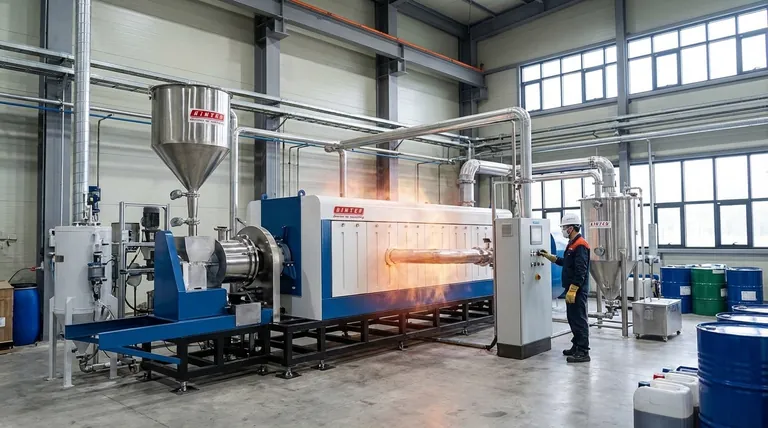
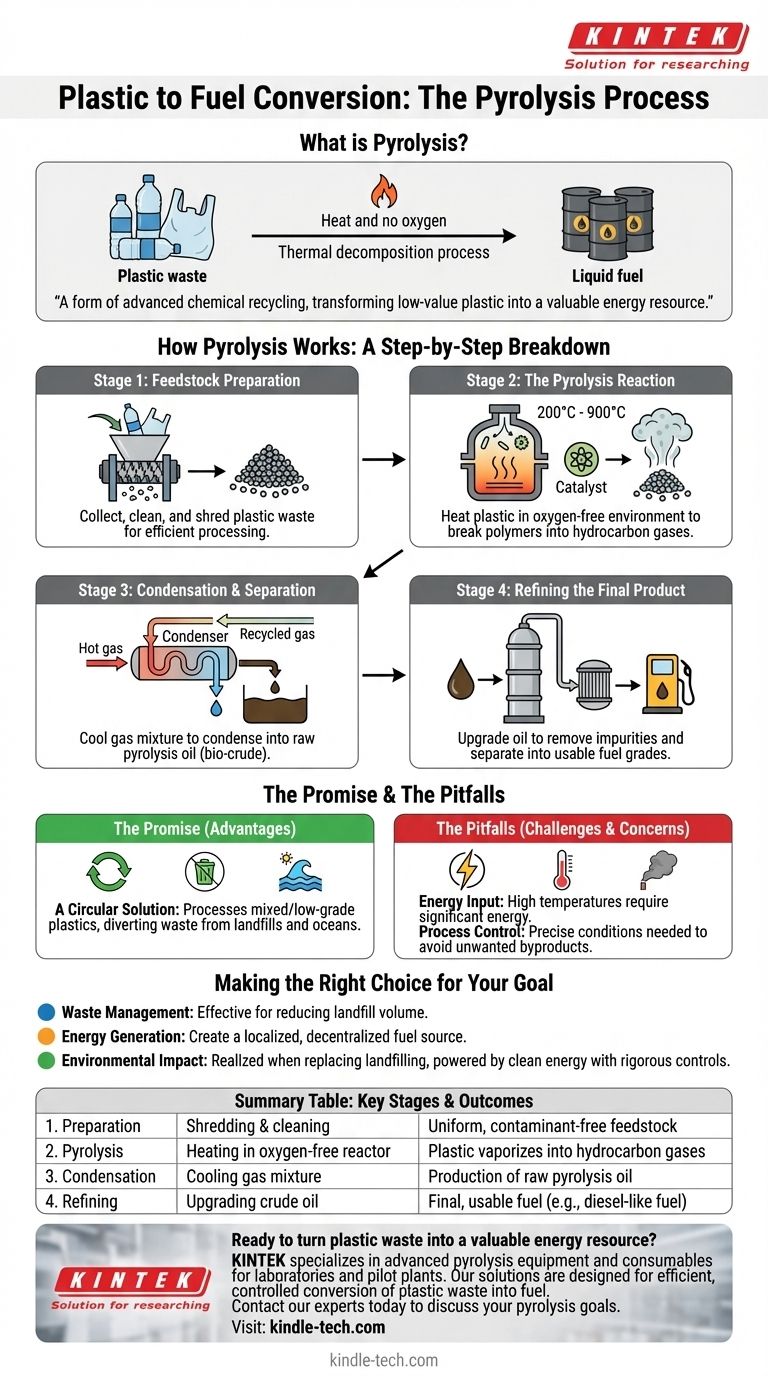
In essence, the conversion of plastic to fuel by pyrolysis is a thermochemical decomposition process. It uses intense heat in an oxygen-free environment to break down long-chain plastic polymers into smaller, simpler hydrocarbon molecules, which can then be refined into a liquid fuel similar to diesel or gasoline.

At its core, pyrolysis is a form of advanced chemical recycling. It reverts plastic waste back to its fundamental components, transforming a low-value, environmentally persistent pollutant into a valuable energy resource.
What is the conversion of plastic to fuel by pyrolysis? A Complete Guide to Waste-to-Energy Technology

How Pyrolysis Works: A Step-by-Step Breakdown

To understand the potential of pyrolysis, it's essential to grasp the distinct stages of the process, from waste collection to final fuel product.

Stage 1: Feedstock Preparation

Before any thermal process begins, the raw plastic waste must be prepared. This involves collecting the waste, cleaning it to remove non-plastic contaminants like dirt or metal, and then shredding or grinding it into a uniform, smaller size.

This pre-treatment is critical for ensuring an efficient and consistent reaction inside the pyrolysis chamber.

Stage 2: The Pyrolysis Reaction

The prepared plastic is loaded into a sealed reactor. The chamber is purged of oxygen and heated to extremely high temperatures, typically between 200°C and 900°C.

This intense heat, often aided by a catalyst, provides the energy to break the strong chemical bonds holding the long plastic polymer chains together. Because there is no oxygen, the plastic doesn't burn; it vaporizes into a mixture of hydrocarbon gases.

Stage 3: Condensation and Separation

The hot gas mixture is directed out of the reactor and into a condensation system. As the gas cools, it condenses back into a liquid.

This raw liquid product is often called pyrolysis oil or "bio-crude." Any non-condensable gases are typically recycled to help fuel the reactor, improving the system's overall energy efficiency.

Stage 4: Refining the Final Product

The raw pyrolysis oil is then collected. It often requires further refining or upgrading to remove remaining impurities and to separate it into different fuel grades, such as a diesel-like fuel, which can then be used in engines or generators.

The Promise and The Pitfalls

While pyrolysis presents a compelling solution to plastic waste, a balanced perspective requires understanding its advantages and inherent challenges.

The Advantage: A Circular Solution

Pyrolysis is a powerful tool for chemical recycling. It can process mixed, contaminated, and lower-grade plastics that are unsuitable for traditional mechanical recycling, diverting massive amounts of waste from landfills and oceans.

The Challenge: Energy Input

The process is energy-intensive. Reaching and maintaining the high temperatures required for pyrolysis consumes a significant amount of energy, which can impact the net energy gain and overall environmental footprint of a facility.

The Concern: Process Control

If the process is not managed perfectly, it has the potential to create unwanted byproducts or emissions. The quality of the final fuel and the safety of the operation depend heavily on precise control over temperature, pressure, and feedstock purity.

Making the Right Choice for Your Goal

Understanding pyrolysis allows you to evaluate its role based on specific objectives.

  • If your primary focus is waste management: Pyrolysis is a highly effective method for reducing the volume of non-recyclable plastic waste destined for landfills.
  • If your primary focus is energy generation: It offers a pathway to create a localized, decentralized fuel source from a readily available waste stream.
  • If your primary focus is environmental impact: The technology's true benefit is realized when it replaces landfilling and is powered by clean energy, with rigorous controls on all outputs.

Ultimately, viewing pyrolysis as a sophisticated waste-valorization technology is the most accurate way to assess its place in a circular economy.

Summary Table:

Stage Process Key Outcome
1. Preparation Shredding & cleaning plastic waste Uniform, contaminant-free feedstock
2. Pyrolysis Heating in an oxygen-free reactor (200-900°C) Plastic vaporizes into hydrocarbon gases
3. Condensation Cooling the gas mixture Production of raw pyrolysis oil
4. Refining Upgrading the crude oil Final, usable fuel (e.g., diesel-like fuel)

Ready to turn plastic waste into a valuable energy resource?

KINTEK specializes in advanced pyrolysis equipment and consumables for laboratories and pilot plants. Our solutions are designed for efficient, controlled conversion of plastic waste into fuel, helping you advance your waste management and energy recovery projects.

Contact our experts today to discuss how our reliable lab equipment can support your pyrolysis research and development goals.

Visual Guide
What is the conversion of plastic to fuel by pyrolysis? A Complete Guide to Waste-to-Energy Technology Visual Guide

Related Products

People Also Ask

Related Products

Electric Rotary Kiln Small Rotary Furnace Biomass Pyrolysis Plant

Electric Rotary Kiln Small Rotary Furnace Biomass Pyrolysis Plant

Learn about Rotary Biomass Pyrolysis Furnaces & how they decompose organic material at high temps without oxygen. Use for biofuels, waste processing, chemicals & more.

High Pressure Laboratory Autoclave Reactor for Hydrothermal Synthesis

High Pressure Laboratory Autoclave Reactor for Hydrothermal Synthesis

Discover the applications of Hydrothermal Synthesis Reactor - a small, corrosion-resistant reactor for chemical labs. Achieve rapid digestion of insoluble substances in a safe and reliable way. Learn more now.

Customizable High Pressure Reactors for Advanced Scientific and Industrial Applications

Customizable High Pressure Reactors for Advanced Scientific and Industrial Applications

This laboratory-scale high-pressure reactor is a high-performance autoclave engineered for precision and safety in demanding research and development environments.

Stainless High Pressure Autoclave Reactor Laboratory Pressure Reactor

Stainless High Pressure Autoclave Reactor Laboratory Pressure Reactor

Discover the versatility of Stainless High Pressure Reactor - a safe and reliable solution for direct and indirect heating. Built with stainless steel, it can withstand high temperatures and pressures. Learn more now.

Mini SS High Pressure Autoclave Reactor for Laboratory Use

Mini SS High Pressure Autoclave Reactor for Laboratory Use

Mini SS High Pressure Reactor - Ideal for medicine, chemical, and scientific research industries. Programmed heating temp and stirring speed, up to 22Mpa pressure.

Quartz Electrolytic Electrochemical Cell for Electrochemical Experiments

Quartz Electrolytic Electrochemical Cell for Electrochemical Experiments

Looking for a reliable quartz electrochemical cell? Our product boasts excellent corrosion resistance and complete specifications. With high-quality materials and good sealing, it's both safe and durable. Customize to meet your needs.

Cylindrical Resonator MPCVD Machine System Reactor for Microwave Plasma Chemical Vapor Deposition and Lab Diamond Growth

Cylindrical Resonator MPCVD Machine System Reactor for Microwave Plasma Chemical Vapor Deposition and Lab Diamond Growth

Learn about Cylindrical Resonator MPCVD Machine, the microwave plasma chemical vapor deposition method used for growing diamond gemstones and films in the jewelry and semi-conductor industries. Discover its cost-effective advantages over traditional HPHT methods.

24T 30T 60T Heated Hydraulic Press Machine with Heated Plates for Laboratory Hot Press

24T 30T 60T Heated Hydraulic Press Machine with Heated Plates for Laboratory Hot Press

Looking for a reliable Hydraulic Heated Lab Press? Our 24T / 40T model is perfect for material research labs, pharmacy, ceramics, and more. With a small footprint and the ability to work inside a vacuum glove box, it's the efficient and versatile solution for your sample preparation needs.

Microwave Plasma Chemical Vapor Deposition MPCVD Machine System Reactor for Lab and Diamond Growth

Microwave Plasma Chemical Vapor Deposition MPCVD Machine System Reactor for Lab and Diamond Growth

Get high-quality diamond films with our Bell-jar Resonator MPCVD machine designed for lab and diamond growth. Discover how Microwave Plasma Chemical Vapor Deposition works for growing diamonds using carbon gas and plasma.

Inclined Rotary Plasma Enhanced Chemical Vapor Deposition PECVD Equipment Tube Furnace Machine

Inclined Rotary Plasma Enhanced Chemical Vapor Deposition PECVD Equipment Tube Furnace Machine

Upgrade your coating process with PECVD coating equipment. Ideal for LED, power semiconductors, MEMS and more. Deposits high-quality solid films at low temps.

Customizable PEM Electrolysis Cells for Diverse Research Applications

Customizable PEM Electrolysis Cells for Diverse Research Applications

Custom PEM test cell for electrochemical research. Durable, versatile, for fuel cells & CO2 reduction. Fully customizable. Get a quote!

Laboratory High Pressure Horizontal Autoclave Steam Sterilizer for Lab Use

Laboratory High Pressure Horizontal Autoclave Steam Sterilizer for Lab Use

The horizontal autoclave steam sterilizer adopts the gravity displacement method to remove the cold air in the inner chamber, so that the inner steam and cold air content is less, and the sterilization is more reliable.

Molybdenum Disilicide (MoSi2) Thermal Elements Electric Furnace Heating Element

Molybdenum Disilicide (MoSi2) Thermal Elements Electric Furnace Heating Element

Discover the power of Molybdenum Disilicide (MoSi2) Heating Element for high-temperature resistance. Unique oxidation resistance with stable resistance value. Learn more about its benefits now!

Optical Water Bath Electrolytic Electrochemical Cell

Optical Water Bath Electrolytic Electrochemical Cell

Upgrade your electrolytic experiments with our Optical Water Bath. With controllable temperature and excellent corrosion resistance, it's customizable for your specific needs. Discover our complete specifications today.

Double-Layer Water Bath Electrolytic Electrochemical Cell

Double-Layer Water Bath Electrolytic Electrochemical Cell

Discover the temperature-controllable electrolytic cell with a double-layer water bath, corrosion resistance, and customization options. Complete specifications included.

RRDE rotating disk (ring disk) electrode / compatible with PINE, Japanese ALS, Swiss Metrohm glassy carbon platinum

RRDE rotating disk (ring disk) electrode / compatible with PINE, Japanese ALS, Swiss Metrohm glassy carbon platinum

Elevate your electrochemical research with our Rotating Disk and Ring Electrodes. Corrosion resistant and customizable to your specific needs, with complete specifications.

Glassy Carbon Electrochemical Electrode

Glassy Carbon Electrochemical Electrode

Upgrade your experiments with our Glassy Carbon Electrode. Safe, durable, and customizable to fit your specific needs. Discover our complete models today.

Customizable CO2 Reduction Flow Cell for NRR ORR and CO2RR Research

Customizable CO2 Reduction Flow Cell for NRR ORR and CO2RR Research

The cell is meticulously crafted from high-quality materials to ensure chemical stability and experimental accuracy.

Automatic Heated Hydraulic Press Machine with Heated Plates for Laboratory Hot Press

Automatic Heated Hydraulic Press Machine with Heated Plates for Laboratory Hot Press

The Automatic High Temperature Heat Press is a sophisticated hydraulic hot press designed for efficient temperature control and product quality processing.

Silicon Carbide SiC Thermal Heating Elements for Electric Furnace

Silicon Carbide SiC Thermal Heating Elements for Electric Furnace

Experience the advantages of Silicon Carbide (SiC) Heating Element: Long service life, high corrosion and oxidation resistance, fast heating speed, and easy maintenance. Learn more now!


Leave Your Message