Knowledge What is the electron beam method? A Guide to Precision Coating, Cutting & Sterilization
Author avatar

Tech Team · Kintek Solution

Updated 5 days ago

What is the electron beam method? A Guide to Precision Coating, Cutting & Sterilization


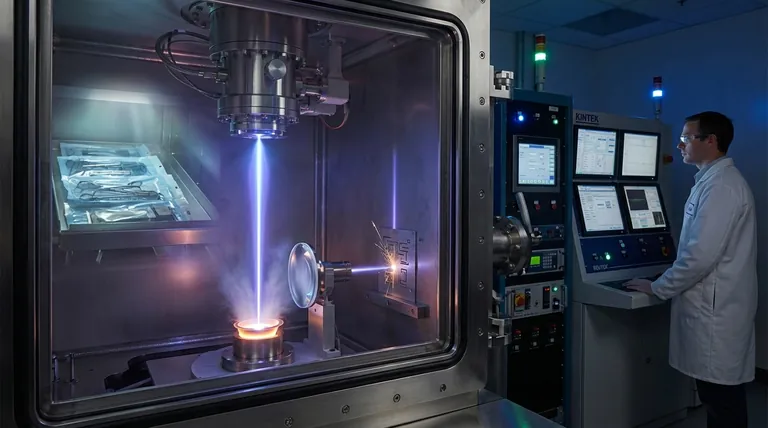
At its core, the electron beam method is a highly versatile process that uses a focused stream of high-energy electrons within a vacuum to precisely alter materials. This controlled energy transfer is adapted for vastly different outcomes, from vaporizing materials for advanced coatings and cutting through metals with surgical precision to sterilizing medical equipment.

The defining characteristic of any electron beam method is its ability to deliver a highly concentrated and controllable dose of energy to a specific point on a target. The specific application—whether it's coating, cutting, or sterilizing—is determined entirely by how that energy is manipulated and the effect it has on the material.
What is the electron beam method? A Guide to Precision Coating, Cutting & Sterilization

The Fundamental Principle: How an Electron Beam Works

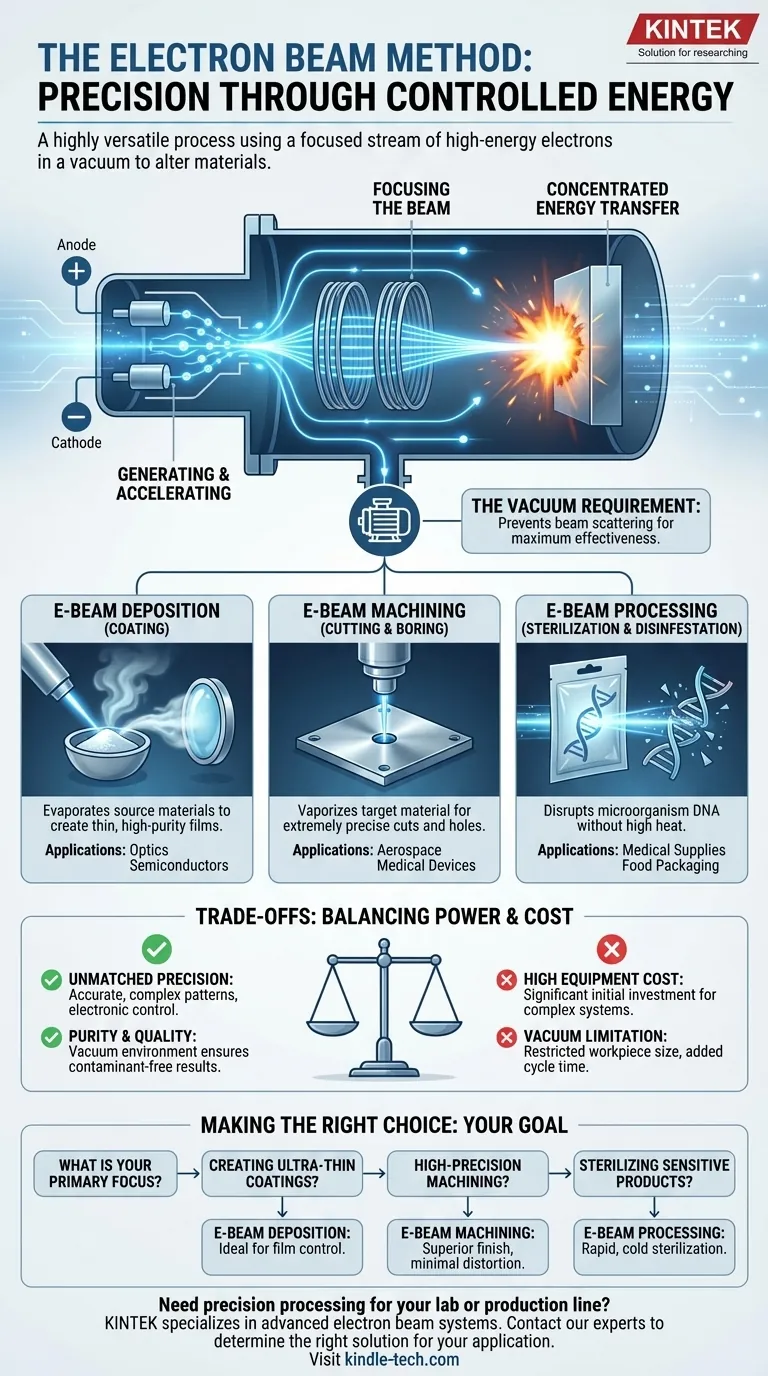
An electron beam (E-beam) system operates on a simple but powerful principle of controlled energy transfer. The process can be broken down into a few key stages.

Generating and Focusing the Beam

Inside a vacuum chamber, free electrons are generated and then accelerated to high velocities using powerful electric fields. Magnetic fields act as lenses, focusing these fast-moving electrons into a narrow, concentrated beam.

Concentrated Energy Transfer

When this high-velocity beam collides with a solid material, the kinetic energy of the electrons is instantly converted into other forms, primarily intense, localized heat. The power and focus of this energy delivery can be adjusted with extreme precision.

The Importance of a Vacuum

The entire process must occur in a vacuum. This is critical because it prevents the electrons from colliding with and scattering off air molecules, which would diffuse the beam and drastically reduce its effectiveness.

Key Applications of Electron Beam Technology

The ability to precisely control this energy transfer allows E-beam technology to be adapted for a wide range of industrial applications.

E-Beam Deposition (Coating)

In this application, the electron beam is aimed at a source material, such as ceramic or metal powders, held in a crucible. The intense heat from the beam causes the material to evaporate. This vapor then travels through the vacuum chamber and condenses as a very thin, uniform film on a target surface, such as an optical lens.

E-Beam Machining (Cutting & Boring)

For machining, a much higher power density beam is used. The energy is so concentrated that it instantly vaporizes the target material, allowing for extremely precise cuts, holes, or complex shapes to be created. This method is valued for producing a superior surface finish and a very narrow cut (kerf width).

E-Beam Processing (Sterilization & Disinfestation)

Here, the goal is not to heat or vaporize the material but to use the beam's energy to break down biological matter. The electrons disrupt the DNA of microorganisms, sterilizing medical products or aseptic food packaging. The same principle is used for disinfestation, eliminating insects from bulk crops without damaging the product.

Understanding the Trade-offs

While powerful, E-beam technology is not a universal solution. Its advantages are balanced by specific operational requirements and costs.

The Advantage: Unmatched Precision

Because the beam is controlled by electric and magnetic fields, its position, size, and power can be manipulated electronically with incredible speed and accuracy. This allows for complex patterns and extremely fine detail.

The Advantage: Purity and Quality

In deposition and machining, the vacuum environment ensures a high-purity process, free from atmospheric contaminants. This results in higher-quality coatings and cleaner cuts compared to many alternative methods.

The Limitation: High Equipment Cost

The complexity of the electron gun, high-voltage power supplies, and vacuum systems makes the initial capital investment for E-beam equipment significant. This often restricts its use to high-value applications where precision is paramount.

The Limitation: Vacuum Requirement

The need for a vacuum chamber limits the size of the workpiece that can be processed. It also adds time and complexity to the overall manufacturing cycle due to the need to pump down the chamber for each batch.

Making the Right Choice for Your Goal

Evaluating whether an E-beam method is appropriate depends entirely on your specific technical and commercial requirements.

  • If your primary focus is creating ultra-thin, high-purity coatings: E-beam deposition offers exceptional control over film thickness and composition, making it ideal for advanced optics and semiconductors.
  • If your primary focus is high-precision machining of difficult materials: E-beam machining provides a superior surface finish and minimal thermal distortion, perfect for aerospace and medical device components.
  • If your primary focus is sterilizing sensitive products without high heat: E-beam processing is a powerful and rapid method for treating medical supplies, pharmaceuticals, and food packaging.

Ultimately, the electron beam method is a premier tool for applications that demand the highest degree of precision energy delivery in a highly controlled environment.

Summary Table:

Application Primary Use Key Characteristic
E-Beam Deposition Creating thin films & coatings High-purity, uniform layers
E-Beam Machining Precision cutting & boring Superior surface finish, minimal distortion
E-Beam Processing Sterilization & disinfestation Cold process, no chemical residues

Need precision processing for your lab or production line? KINTEK specializes in advanced lab equipment, including electron beam systems for high-purity coating, precise machining, and effective sterilization. Our experts can help you determine if this high-precision technology is the right solution for your application. Contact our team today to discuss your specific requirements!

Visual Guide
What is the electron beam method? A Guide to Precision Coating, Cutting & Sterilization Visual Guide

Related Products

People Also Ask

Related Products

Laboratory Sterilizer Lab Autoclave Pulse Vacuum Lifting Sterilizer

Laboratory Sterilizer Lab Autoclave Pulse Vacuum Lifting Sterilizer

The pulse vacuum lifting sterilizer is a state-of-the-art equipment for efficient and precise sterilization. It uses pulsating vacuum technology, customizable cycles, and a user-friendly design for easy operation and safety.

Laboratory Sterilizer Lab Autoclave Vertical Pressure Steam Sterilizer for Liquid Crystal Display Automatic Type

Laboratory Sterilizer Lab Autoclave Vertical Pressure Steam Sterilizer for Liquid Crystal Display Automatic Type

Liquid crystal display automatic vertical sterilizer is a safe, reliable and automatic control sterilization equipment, which is composed of heating system, microcomputer control system and overheating and overvoltage protection system.

Laboratory Test Sieves and Sieving Machines

Laboratory Test Sieves and Sieving Machines

Precision lab test sieves & sieving machines for accurate particle analysis. Stainless steel, ISO-compliant, 20μm-125mm range. Request specs now!

HFCVD Machine System Equipment for Drawing Die Nano-Diamond Coating

HFCVD Machine System Equipment for Drawing Die Nano-Diamond Coating

The nano-diamond composite coating drawing die uses cemented carbide (WC-Co) as the substrate, and uses the chemical vapor phase method ( CVD method for short ) to coat the conventional diamond and nano-diamond composite coating on the surface of the inner hole of the mold.

Benchtop Laboratory Vacuum Freeze Dryer

Benchtop Laboratory Vacuum Freeze Dryer

Benchtop laboratory freeze dryer for efficient lyophilization of biological, pharmaceutical, and food samples. Features intuitive touchscreen, high-performance refrigeration, and durable design. Preserve sample integrity—consult now!

Three-dimensional electromagnetic sieving instrument

Three-dimensional electromagnetic sieving instrument

KT-VT150 is a desktop sample processing instrument for both sieving and grinding. Grinding and sieving can be used both dry and wet. The vibration amplitude is 5mm and the vibration frequency is 3000-3600 times/min.

915MHz MPCVD Diamond Machine Microwave Plasma Chemical Vapor Deposition System Reactor

915MHz MPCVD Diamond Machine Microwave Plasma Chemical Vapor Deposition System Reactor

915MHz MPCVD Diamond Machine and its multi-crystal effective growth, the maximum area can reach 8 inches, the maximum effective growth area of single crystal can reach 5 inches. This equipment is mainly used for the production of large-size polycrystalline diamond films, the growth of long single crystal diamonds, the low-temperature growth of high-quality graphene, and other materials that require energy provided by microwave plasma for growth.

Benchtop Laboratory Freeze Dryer for Lab Use

Benchtop Laboratory Freeze Dryer for Lab Use

Premium benchtop laboratory freeze dryer for lyophilization, preserving samples with ≤ -60°C cooling. Ideal for pharmaceuticals & research.

Anti-Cracking Press Mold for Lab Use

Anti-Cracking Press Mold for Lab Use

The anti-cracking press mold is a specialized equipment designed for molding various shapes and sizes of film using high pressure and electric heating.

Custom PTFE Wafer Holders for Lab and Semiconductor Processing

Custom PTFE Wafer Holders for Lab and Semiconductor Processing

This is a high-purity, custom-machined PTFE (Teflon) holder, expertly designed for the secure handling and processing of delicate substrates like conductive glass, wafers, and optical components.

Laboratory Vibratory Sieve Shaker Machine Slap Vibrating Sieve

Laboratory Vibratory Sieve Shaker Machine Slap Vibrating Sieve

KT-T200TAP is a slapping and oscillating sieving instrument for laboratory desktop use, with 300 rpm horizontal circular motion and 300 vertical slapping motions to simulate manual sieving to help sample particles pass through better.

Vacuum Heat Treat and Molybdenum Wire Sintering Furnace for Vacuum Sintering

Vacuum Heat Treat and Molybdenum Wire Sintering Furnace for Vacuum Sintering

A vacuum molybdenum wire sintering furnace is a vertical or bedroom structure, which is suitable for withdrawal, brazing, sintering and degassing of metal materials under high vacuum and high temperature conditions. It is also suitable for dehydroxylation treatment of quartz materials.

Small Vacuum Heat Treat and Tungsten Wire Sintering Furnace

Small Vacuum Heat Treat and Tungsten Wire Sintering Furnace

The small vacuum tungsten wire sintering furnace is a compact experimental vacuum furnace specially designed for universities and scientific research institutes. The furnace features a CNC welded shell and vacuum piping to ensure leak-free operation. Quick-connect electrical connections facilitate relocation and debugging, and the standard electrical control cabinet is safe and convenient to operate.

Electric Rotary Kiln Continuous Working Small Rotary Furnace Heating Pyrolysis Plant

Electric Rotary Kiln Continuous Working Small Rotary Furnace Heating Pyrolysis Plant

Efficiently calcine and dry bulk powder and lump fluid materials with an electric heating rotary furnace. Ideal for processing lithium ion battery materials and more.

Variable Speed Peristaltic Pump

Variable Speed Peristaltic Pump

KT-VSP Series Smart Variable Speed Peristaltic Pumps offer precise flow control for labs, medical, and industrial applications. Reliable, contamination-free liquid transfer.

Vacuum Dental Porcelain Sintering Furnace

Vacuum Dental Porcelain Sintering Furnace

Get precise and reliable results with KinTek's Vacuum Porcelain Furnace. Suitable for all porcelain powders, it features hyperbolic ceramic furnace function, voice prompt, and automatic temperature calibration.

Vertical High Temperature Graphite Vacuum Graphitization Furnace

Vertical High Temperature Graphite Vacuum Graphitization Furnace

Vertical high temperature graphitization furnace for carbonization and graphitization of carbon materials up to 3100℃.Suitable for shaped graphitization of carbon fiber filaments and other materials sintered in a carbon environment.Applications in metallurgy, electronics, and aerospace for producing high-quality graphite products like electrodes and crucibles.

Laboratory Vacuum Tilt Rotary Tube Furnace Rotating Tube Furnace

Laboratory Vacuum Tilt Rotary Tube Furnace Rotating Tube Furnace

Discover the versatility of Laboratory Rotary Furnace: Ideal for calcination, drying, sintering, and high-temperature reactions. Adjustable rotating and tilting functions for optimal heating. Suitable for vacuum and controlled atmosphere environments. Learn more now!

Graphite Vacuum Continuous Graphitization Furnace

Graphite Vacuum Continuous Graphitization Furnace

High-temperature graphitization furnace is a professional equipment for graphitization treatment of carbon materials. It is a key equipment for the production of high-quality graphite products. It has high temperature, high efficiency and uniform heating. It is suitable for various high-temperature treatments and graphitization treatments. It is widely used in metallurgy, electronics, aerospace, etc. industry.

Ultra-High Temperature Graphite Vacuum Graphitization Furnace

Ultra-High Temperature Graphite Vacuum Graphitization Furnace

The ultra-high temperature graphitization furnace utilizes medium frequency induction heating in a vacuum or inert gas environment. The induction coil generates an alternating magnetic field, inducing eddy currents in the graphite crucible, which heats up and radiates heat to the workpiece, bringing it to the desired temperature. This furnace is primarily used for graphitization and sintering of carbon materials, carbon fiber materials, and other composite materials.


Leave Your Message