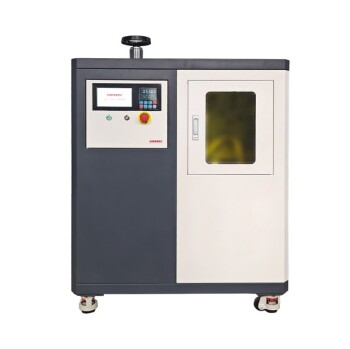
A hot press functions as the critical densification driver for Ultra-High Temperature Ceramic Matrix Composites (UHTCMC) following Slurry Impregnation (SIP). By simultaneously applying extreme temperatures ($1600-2100^\circ\text{C}$) and uniaxial mechanical pressure ($20-100\text{ MPa}$), it forces the rearrangement and diffusion of ceramic particles to create a solid, structural material.
The hot press solves the challenge of "difficult-to-sinter" ceramics by using external force to close the residual pores left by slurry impregnation, directly translating to higher final density and mechanical strength.
The Mechanics of Densification
Overcoming Sintering Resistance
Ultra-High Temperature Ceramics (UHTC) are notoriously difficult to sinter using heat alone due to their covalent bonding and low self-diffusion rates.
A hot press overcomes this resistance by introducing mechanical force. This external pressure physically moves particles into better packing positions, initiating densification where thermal energy alone would fail.
Eliminating Residual Voids
The Slurry Impregnation (SIP) process is effective at introducing ceramic powders into the fiber preform, but it inherently leaves gaps.
The hot press targets these residual pores between fiber bundles. The combination of heat and pressure collapses these voids, significantly reducing the porosity that would otherwise compromise the material's structural integrity.
The Role of Temperature and Pressure
Thermal Activation
The process requires an environment typically between $1600^\circ\text{C}$ and $2100^\circ\text{C}$.
At these extreme temperatures, the ceramic particles gain the kinetic energy required for atomic diffusion. This thermal activation is the prerequisite for bonding the green body into a cohesive unit.
Uniaxial Mechanical Pressure
While heat prepares the particles, pressure drives the consolidation. The hot press applies uniaxial pressure ranging from 20 to 100 MPa.
This directional force accelerates the densification process. It forces the plastic flow of the material, ensuring that the ceramic matrix tightly fills the spaces around the reinforcement fibers.
Understanding the Trade-offs
Uniaxial Limitations
The pressure applied in this process is uniaxial (applied in a single direction).
While this is highly effective for densifying plates or simple geometries, it can create challenges for complex 3D shapes. The densification is most uniform in the direction of the applied force, requiring careful process control to ensure homogeneity throughout the composite.
Optimizing the Densification Process
To achieve the best results with UHTCMC green bodies, align your process parameters with your specific material goals:
- If your primary focus is Maximum Density: Utilize pressures closer to the upper limit (100 MPa) to forcefully eliminate the smallest residual pores between fiber bundles.
- If your primary focus is Material Diffusion: Ensure temperatures reach the $2000-2100^\circ\text{C}$ range to fully activate the sintering mechanism of difficult-to-sinter UHTC particles.
By balancing extreme thermal energy with massive mechanical pressure, the hot press transforms a porous green body into a high-performance, high-strength composite.
Summary Table:
| Parameter | Typical Range | Primary Function |
|---|---|---|
| Temperature | $1600 - 2100^\circ\text{C}$ | Thermal activation and atomic diffusion |
| Pressure | $20 - 100\text{ MPa}$ | Mechanical consolidation and void elimination |
| Force Type | Uniaxial | Directional densification of ceramic matrix |
| Goal | High Density | Transform porous green bodies into structural composites |
Elevate Your Materials Research with KINTEK
Achieving the perfect density in Ultra-High Temperature Ceramic Matrix Composites requires precision and power. KINTEK specializes in advanced laboratory equipment designed for the most demanding sintering environments.
Our industry-leading hot presses, vacuum furnaces, and hydraulic systems provide the exact thermal and mechanical control needed to eliminate porosity and maximize mechanical strength in your UHTCMC projects. Beyond sintering, we offer a comprehensive range of high-temperature reactors, crushing systems, and specialized ceramics to support every stage of your material development.
Ready to optimize your densification process? Contact our technical experts today to find the ideal solution for your laboratory’s unique requirements.
Related Products
- Automatic Heated Hydraulic Press Machine with Heated Plates for Laboratory Hot Press 25T 30T 50T
- Manual High Temperature Heated Hydraulic Press Machine with Heated Plates for Lab
- Touchscreen Automatic Vacuum Heat Press
- 30T 40T Split Automatic Heated Hydraulic Press Machine with Heated Plates for Laboratory Hot Press
- Vacuum Hot Press Furnace Machine Heated Vacuum Press
People Also Ask
- Why is the heating function of a laboratory hydraulic press essential for MEA assembly in DEFC? Optimize Cell Bonding
- What technical conditions does a heated hydraulic press provide for PEO batteries? Optimize Solid-State Interfaces
- How is a heated hydraulic press used for Li-LLZO batteries? Optimize Interfacial Bonding with Thermal-Pressure
- What role does a heated hydraulic press play in Cold Sintering (CSP)? Enhancing LATP-Halide Densification
- What are heated hydraulic presses used for? Molding Composites, Vulcanizing Rubber, and More