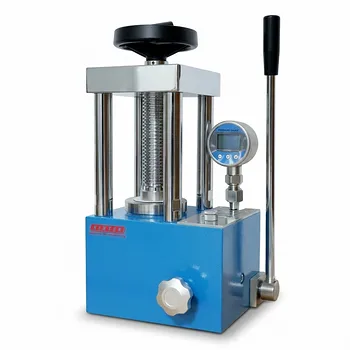
The primary function of a laboratory hydraulic press in the preparation of bulk tungsten reference samples is to consolidate loose, high-purity powder into a solid, cohesive form known as a "green body." This mechanical compression is the essential first step in the powder metallurgy process, applying uniform pressure to tightly rearrange particles and establish the high density required for successful high-temperature sintering.
The press acts as the bridge between raw material and finished product; it eliminates voids and forces particle interlocking to create a structural foundation. Without this densification, the tungsten cannot be sintered into the stable polycrystalline plates used as performance benchmarks in coating research.
The Physics of Powder Consolidation
Particle Rearrangement and Packing
The immediate goal of the hydraulic press is to alter the geometry of the raw material. Loose tungsten powder consists of particles with significant air gaps between them.
When the hydraulic ram applies force, these particles are physically shoved into a tighter configuration. This rearrangement minimizes void space and maximizes points of contact between individual tungsten grains.
Forming the "Green Body"
In powder metallurgy, the compressed object is referred to as a green body. At this stage, the material is solid enough to handle but has not yet been fused by heat.
The hydraulic press ensures that this green body has sufficient mechanical strength to maintain its shape during transfer to a sintering furnace. It provides the initial structural integrity necessary for the material to survive subsequent processing steps.
Preparing for Sintering
Sintering—the process of fusing particles using heat—relies heavily on the work done by the press.
By achieving a high initial density through compression, the press reduces the amount of shrinkage and deformation that occurs when the tungsten is heated. A well-pressed sample ensures a more predictable and uniform transformation into the final metallic plate.
Creating a Valid Reference Standard
Uniformity is Critical
For a tungsten sample to serve as a valid reference benchmark, it must be consistent throughout its volume.
The laboratory hydraulic press applies controlled, uniform pressure across the mold. This ensures that the density of the tungsten is consistent from the center to the edges, preventing density gradients that could skew research data later.
Benchmarking for Coating Research
The ultimate output of this process is a stable polycrystalline tungsten plate.
These plates are used to test and evaluate various coatings. Because the hydraulic press ensures the substrate (the tungsten) is dense and stable, researchers can be confident that any variations in their data are due to the coating being tested, not flaws in the underlying tungsten sample.
Understanding the Trade-offs
The Risk of Density Gradients
While hydraulic presses are versatile, improper operation can lead to density gradients. If the pressure is not applied uniformly or if the mold geometry is complex, the powder may pack tighter in some areas than others. This leads to warping or cracking during the sintering phase.
Green Strength vs. Sintering Requirements
There is a balance to be struck regarding pressure levels.
Applying too little pressure results in a green body that is too fragile to handle (low green strength). However, excessive pressure can sometimes cause lamination defects where the powder layers separate. The pressure must be optimized to maximize density without introducing structural flaws.
Making the Right Choice for Your Goal
To ensure your tungsten reference samples are effective benchmarks, you must tailor your pressing parameters to your specific research outcomes.
- If your primary focus is structural stability: Prioritize maximizing the initial density of the green body to minimize shrinkage and warping during the high-temperature sintering phase.
- If your primary focus is research reproducibility: Ensure the pressure application is strictly controlled and identical across all samples to create a consistent baseline for coating comparisons.
The laboratory hydraulic press is not just a compaction tool; it is the instrument that defines the quality and reliability of your final experimental baseline.
Summary Table:
| Stage of Preparation | Role of Hydraulic Press | Impact on Quality |
|---|---|---|
| Powder Consolidation | Particle rearrangement and void elimination | Increases density and reduces air gaps |
| Green Body Formation | Establishes mechanical strength | Allows for safe handling and transfer to furnaces |
| Sintering Prep | Minimizes shrinkage and deformation | Ensures predictable final geometry and stability |
| Benchmarking | Uniform pressure application | Prevents density gradients for consistent research data |
Elevate your material science research with KINTEK’s precision laboratory equipment. From high-performance hydraulic presses (pellet, hot, isostatic) for creating uniform green bodies to advanced high-temperature furnaces (muffle, vacuum, sintering) for final densification, we provide the tools necessary for reliable benchmarking. Whether you are conducting coating research or exploring powder metallurgy, KINTEK specializes in laboratory equipment and consumables tailored to your needs. Contact us today to optimize your sample preparation workflow!
References
- N. A. Azarenkov, L. A. Gamayunova. Investigation of the Processes of Retention and Release of Implanted Deuterium and Helium Ions for Tungsten and Tantalum Coatings. DOI: 10.26565/2312-4334-2024-1-01
This article is also based on technical information from Kintek Solution Knowledge Base .
Related Products
- Laboratory Hydraulic Press Lab Pellet Press Machine for Glove Box
- Laboratory Hydraulic Press Split Electric Lab Pellet Press
- Laboratory Hydraulic Press Lab Pellet Press for Button Battery
- Automatic Laboratory Hydraulic Press for XRF & KBR Pellet Press
- Automatic Laboratory Hydraulic Pellet Press Machine for Lab Use
People Also Ask
- What is the function of a laboratory hydraulic press in W-Cu composites? Control Porosity and Material Ratio
- What is the role of a laboratory hydraulic press in the initial stages of Li6PS5Cl preparation? Key to Green Pellets
- What role does a laboratory hydraulic press play in triboelectric testing? Achieve Precision Alloy Sample Prep
- How can a laboratory hydraulic press be applied to chitosan for wastewater treatment? Optimize Pores & Strength
- How do a precision laboratory hydraulic press and specialized molds contribute to the fabrication of spherical ceramic samples? Achieving High-Density Material Precision